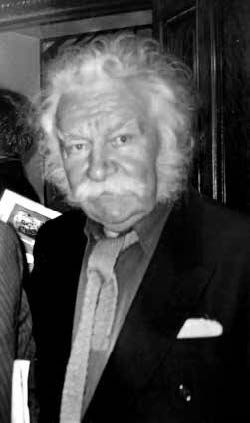
Born: 1927 Wilno, Poland
Died: 2014 London, England
Year of Migration to the UK: 1948
Other name/s: Aleksander Paweł Prus-Klecki
Biography
Architect, sculptor, graphic artist and stained-glass designer Alexander Paul Klecki, also known as Aleksander Paweł Prus-Klecki, was born in Wilno, Poland (now Vilnius, Lithuania) on 26 January 1927. His family had a tradition of resistance to Russian imperial rule across several generations: his great-grandfather was exiled to Siberia for his part in the November Uprising of 1830, and his grandfather for his part in the January Uprising of 1863. His parents, Aleksander and Maria (née Nowicka), were themselves children of deportees. In June 1941, Klecki was deported, along with his mother, from Wilno to Siberia for forced labour in forest clearing. Following the Soviet amnesty of August 1941, he began a journey with the so-called Anders Army which took him through Uzbekistan, Persia, Pakistan and, finally, to a Polish refugee camp in India, where he spent six years completing his secondary education. In 1948 he reached England via Africa. Shortly after arriving, Klecki enrolled at the Faculty of Architecture at the Polish University College, affiliated with the University of London, graduating in 1954, qualifying as an architect the following year.
In 1955 he received the title of engineer-architect from the Council of Academic Technical Schools (RAST). In 1958 he joined the office of the prominent modern British architect, Frederick Gibberd, and worked on the design of Terminal 3 at Heathrow Airport. Working subsequently with Gable Construction between 1964 and 1967, he won the 'House of the Year' award in 1965 and the 'Housing of the Year' award for a development in Walton-on-Thames, Surrey. While working for Louis de Soissons Architects from 1967 to 1971, he won first prize in a competition for a marina in Brighton, and in 1974 received the 'Office of the Year' award for a City of London project in collaboration with Ley Colbeck and Partners. He also worked internationally in France, Saudi Arabia and Poland, designing a palace in Dammam and winning first prizes in competitions for the Centre of Horse Breeding and Centre of Art in Dirab, Saudi Arabia, and for the Falcon Club in Abu Dhabi.
In addition to his architectural practice, Klecki worked as an artist/designer and became a member of the Association of Polish Artists in Great Britain (APA). He produced a substantial and sustained body of sacred art for churches in England, working across stained glass, sculpture, relief panels and murals. Two cartoons of Marian stained glass windows created for the Church of Our Lady Immaculate and St Philip Neri in Uckfield, East Sussex, were exhibited at the Royal Academy of Arts, London, in 1959. The completed windows, distinguished by a strong geometrisation of the human figure and a rich symbolic use of colour, remain in situ at Uckfield. His most extensive ecclesiastical commission was the interior redesign of a former Scottish Presbyterian church in Shepherd's Bush, London, which opened as the Church of St Andrew Bobola in 1961, the principal religious and commemorative centre for the Polish exile community in London, and the location of the main Katyn shrine in Britain. Klecki designed the majority of the church's stained glass windows commemorating Polish military formations and their leaders, including General Anders and the Polish Second Corps, the Polish Air Force, and the Independent Carpathian Rifle Brigade, as well as an aluminium-on-steel figure of Christ the King above the altar, figures of St Andrew Bobola and St Maximilian Kolbe on the east wall, and twelve bronzed cement panels depicting the Stations of the Cross.
In 1967 in Poland he created a Katyn obelisk for the church's chapel of Our Lady of Kozielsk, a near two-metre bronze resin panel bearing the dedication 'To the victims of Katyn and other compatriots murdered in Soviet captivity.' He was officially appointed custodian of the church in 1972 and remained in the role until the end of his life. In 1985 Klecki created a second Katyn memorial, a large irregular block of grey granite with a relief panel bearing a skeletal crucified figure and the Polish state emblem, installed in the grounds of the Roman Catholic Cathedral of St Peter and St Paul (Clifton Cathedral) in Bristol, commissioned by the local Polish community. Themes of Polish national martyrdom, deportation to Siberia and the Katyn massacre recur throughout his work and brought him the designation 'Sculptor of national memory' within Polish communities in Britain.
Alexander Paul Klecki died in London, England on 21 January 2014. His output in the UK public domain remains in the buildings and public spaces for which it was created: his stained glass windows, sculpture, relief panels, Stations of the Cross and Katyn obelisk of 1967 can still be seen at the Church of St. Andrew Bobola, Leysfield Road, Hammersmith, London; three stained glass windows are installed at the Church of Our Lady Immaculate and St Philip Neri, Uckfield, East Sussex; and his Katyn memorial of 1985 stands in the grounds of the Cathedral Church of St Peter and St Paul (Clifton Cathedral), Pembroke Road, Bristol. The Ben Uri Research Unit welcomes contributions from researchers or family members who may have further biographical information.
Michal Mel
Related books
- Andrzej Suchcitz, 'St. Andrew Bobola's Polish Roman Catholic Church in London 1961-2011', in Kronika Kościoła św. Andrzeja Boboli w Londynie 1961-2011 (London, 2012), pp 393-403
- Halina Taborska, 'Witraże maryjne Aleksandra P. Kleckiego w kościele Our Lady Immaculate & St Philip Neri w Uckfield', Zeszyty Naukowe PUNO, Seria trzecia, No. 5, 2017, pp 171-182
- Douglas Hall, Art in Exile: Polish Painters in Post-War Britain (Bristol: Sansom & Company, 2008)
- Tina Moran, 'A Mass Murder Poles Won't Forget', Bristol Evening Post, Friday 12 April 1985 p 4
Public collections
Related organisations
- Association of Polish Artists in Great Britain (member)
- Council of Academic Technical Schools (RAST) (member)
- Polish University College (PUC) (student)
- Royal Academy of Arts (exhibitor)
Related web links
Selected exhibitions
- Two Marian cartoons for stained glass windows, Royal Academy of Art, London (1959)
- Royal Academy of Arts, Summer Exhibition, London (1959)