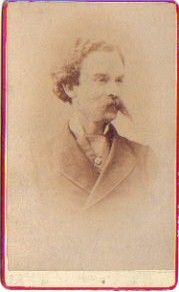
Born: 1841 Leghom, Grand Duchy of Tuscany
Died: 1917 Willesden, London, England
Year of Migration to the UK: 1850
Other name/s: A T Elwes
Biography
Illustrator, engraver, and draughtsman Alfred Thomas Elwes was born in 1841 in Leghorn (now Livorno), in the Grand Duchy of Tuscany, Italy, to Louisa and Alfred Elwes. His father was a British philologist, author, and translator. His father, a prolific writer on languages and children's literature who had studied at Leiden, was residing in Italy at the time of Alfred Thomas's birth, and the family's rootedness in British cultural and intellectual life shaped their son's subsequent career in England. One of Elwes's earliest known artistic credits is the frontispiece to his father's book, The Legend of the Mount; or, the Days of Chivalry (1866), for which he is credited on the title page as 'Alfred Elwes, Jun.', signing the illustration 'A.T. Elwes'. This commission demonstrates that his artistic training was already sufficiently advanced by his mid-twenties to merit publication, and that his career was, at least initially, closely bound up with his father's literary world.
Elwes most likely moved to England in the 1850s with his family. He later built a reputation as a specialist natural history illustrator, working primarily in pen and ink and black and white. The clearest marker of his professional standing came between 1872 and 1877, when he was employed by the Illustrated London News as the principal draftsman responsible for natural history subjects, a role that required both scientific accuracy and the technical skill to produce images reproducible at scale for a mass-circulation periodical. His work in this period brought him into contact with the wider ecosystem of Victorian illustrated publishing, including the engravers, Dalziel Brothers, who engraved numerous works based on his designs for notable publishers, such as Routledge and Frederick Warne & Co., as evidenced by the Dalziel Brothers' india-proof albums now held in the British Museum (BM 1913,0415.198–210). Elwes married Kate Barnard in 1873, and the couple had four children. Census records show Elwes consistently described in terms that reflect his evolving professional identity: 'Artist of Natural History' (1881), 'Artist Animal Painter' and 'Artist in Black and White' (1891), and 'Artist Illustrator of Books and Magazines' (1911).
Elwes's output as an illustrator was extensive. His work encompasses natural history illustration, children's illustration, and general illustration for periodicals and publishers across several decades, beginning in the 1860s. Among the natural history volumes he illustrated are Stories of the Gorilla Country: Narrated for Young People (1868) by Paul Du Chaillu, The Pleasant History of Reynard the Fox, translated by Thomas Roscoe (1873) and several volumes by Charles Dixon, including: The Birds of Our Rambles: A Companion for the Country (1891) and The Game Birds and Wild Fowl of the British Islands (1893). He also illustrated his own publications, including:How to Draw Animals, Birds and Dogs (1882). His illustration work for children's books includes The Book of Animals (1868), issued as part of the Aunt Louisa's London Toy Books series by Frederick Warne & Co., and his own Pictures and Stories of Natural History(1885), published by T. Nelson and Sons. His work also appears in collections engraved by the Dalziel Brothers for Routledge, Chapman and Hall, Warne, and Alexander Strahan.
Elwes died around 1917 in Willesden, London, England. His works are held in UK public collections, including the Victoria and Albert Museum, British Museum, and Aberystwyth University School of Art Museum and Galleries. The Ben Uri Research Unit welcomes contributions from researchers or family members who mayhave further biographical information.
Michal Mel
Related books
- R. K. Engen, Dictionary of Victorian Wood Engravers (Cambridge: Chadwyck-Healey, 1985)
- Charles Dixon, Illustrated by A. T. Elwes. Birds' Nests: An Introduction to the Science of Caliology (London: George Routledge & Sons, 1902)
- Richard Bowdler Sharpe, Illustrated by A. T. Elwes. Wonders of the Bird World (London: Wells Gardner Darton, [1898])
- Charles Dixon, Illustrated by A. T. Elwes. The Game Birds and Wild Fowl of the British Islands: Being a Handbook for the Naturalist and Sportsman (London: Chapman & Hall, 1893)
- Charles Dixon, Illustrated by A. T. Elwes. The Birds of Our Rambles: A Companion for the Country (London: Chapman & Hall, 1891)
- A. Bryan, L. Davis, A. T. Elwes et al. A Book of Drawings (London: Seeley & Co., 1891)
- Joel Chandler Harris, Illustrated by A. T. Elwes. Uncle Remus (London: David Stott, 1888)
- A. T. Elwes, John Gilbert and Harrison Weir. Bed-Time Stories (London: Thomas Nelson & Sons, 1888)
- Alfred Thomas Elwes. Pictures and Stories of Natural History (London: Thomas Nelson & Sons, 1885)
- Parker Gillmore, Illustrated by A. T. Elwes. The Amphibion's Voyage (London: Hurst & Blackett, 1885)
- E. C. Geikie (ed.), Illustrated by A. T. Elwes. The Old Farm Gate (London: George Routledge & Sons, 1882)
- Alfred Thomas Elwes. How to Draw Animals, Birds and Dogs (London: George Routledge & Sons (1882)
- Parker Gillmore, Illustrated by A. T. Elwes. A Ride Through Hostile Africa: With Adventures among the Boers (London: Hurst & Blackett 1881)
- Robert Bloomfield, Illustrated by A. T. Elwes. The Bird and Insects' Post Office (London: Griffith & Farran, 1880)
- Thomas Roscoe (trans.), Illustrated by A. T. Elwes. The Pleasant History of Reynard the Fox (London: Sampson Low, Marston, Low & Searle, 1873)
- E. Burrows, Illustrated by A. T. Elwes. Neptune; or, The Autobiography of a Newfoundland Dog, (London: Griffith & Farran, 1869)
- Paul B. du Chaillu, Illustrated by A. T. Elwes. Stories of the Gorilla Country: Narrated for Young People, (London: Sampson Low, Son & Marston, 1868)
- The Book of Animals. Illustrated by A. T. Elwes (London: Frederick Warne & Co., 1868)
- Alfred Thomas Elwes. The Legend of the Mount; or, The Days of Chivalry, (London: Effingham Wilson, London, 1866)
Public collections
- Aberystwyth University School of Art Museum and Galleries
- British Museum
- V&A
- National Trust Collections