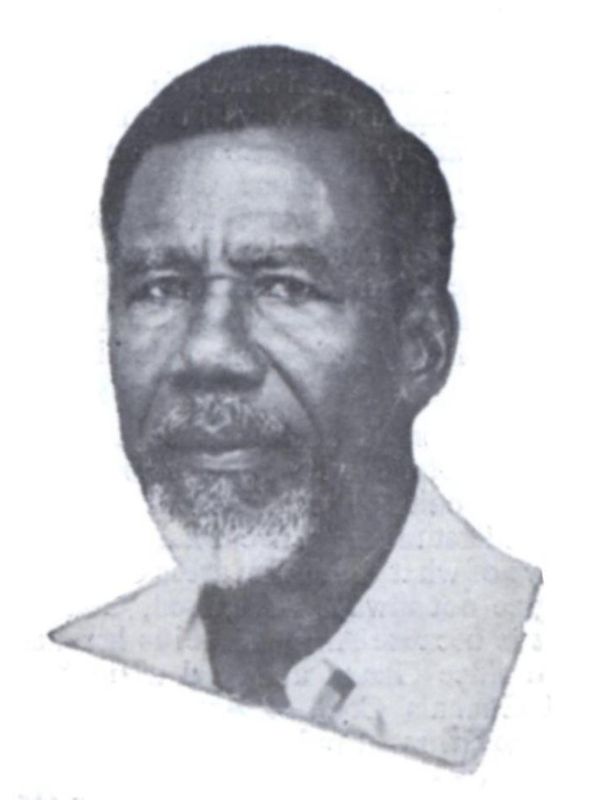
Born: 1915 Ghana
Died: 2011 Accra, Ghana
Year of Migration to the UK: 1949
Other name/s: Nii Amon Kotei
Biography
Painter Nii Amon Kotei was born into a Ga family in Labadi, on the Gold Coast (now Ghana), in 1915. Kotei's early childhood was spent with his grandfather, a Presbyterian catechist, travelling through the towns and villages of Ghana, distributing missionary material. Around. 1926, Kotei began his secondary education at Labadi Presbyterian Boys Boarding School (PRESEC) in Accra. While at PRESEC, Kotei's artistic talents became evident, prompting his father to seek private art tuition. Kotei's art skills impressed his tutor, Kofi Johnson, a respected local artist, who recommended Kotei should pursue training at an established institution. In c.1935, Kotei, undrr the guidance of his tutor, won a scholarship to attend the respected Achimota School (now Achimota College). However, Kotei found the environment and teaching methods unsuitable for his intended artistic direction and decided to leave and continue his art education independently.
In 1939, aged 24, Kotei married Sarah Addoley (née Addo), the couple would have a large family of twelve children. In 1942, following the outbreak of the Second World War, Kotei enlisted in the Gold Coast army as a non-combatant. His artistic talent enabled him to join the Royal West African Frontier Force (RWAFF) as a cartographer producing military maps and charts. (Kotei, 2023, np). The RWAFF was an assembly of contingents from the West African regions of Nigeria, Ghana, Sierra Leone, and the Gambia (Clarke, 1952, p. 223), a professional and organised military regiment established in 1897 by the British Colonial Office. After the war, Corporal Kotei was finally discharged in 1948. During his service, the army recognised the exceptional level of Kotei's cartographic drafting and design skills, leading to his receiving a scholarship to train further overseas.
Kotei arrived in London, England, in 1949 to study at the London School of Printing and Graphic Arts. (now London College of Communication (LCC)). He attended courses in printmaking, graphic design, typography, and lithography, fundamental skills for the communication industry during the postwar recovery years. Kotei spent three years at the College during a significant transitional period in British printing and graphic design, when techniques shifted increasingly towards modernism, partly due to the arrival of a cohort of creative émigrés fleeing Nazi persecution in Central Europe. Kotei would incorporate European techniques and African motifs in his graphic designs. In 1952, Kotei graduated with a City and Guilds of London Institute Certificate.
Kotei returned to Ghana around.1952 and secured a Civial Service position at the Gold Coast Government Printing Office. His specialised training in graphic art and design came to the attention of Ghana's inaugural president, Dr Kwame Nkruma and the newly independent Ghanaian Government commissioned Kotei to design a coat of arms to be the principal Ghanaian motif for government buildings, currency, and academic institutions. Overall, Kotei's artistic repertoire included sculpture, printmaking, and painting, employing surrealist, figurative, and social realist themes. He often captured local village life in paintings such as The Last Supper (1976). Foregrounding native cultural practices in The Herbalist (1961), Kotei depicts an intense night scene, which draws the viewer into a warm space of muted yellows and fiery oranges. There are four central characters in the main body of the artwork. At the top right, three village women in headscarves, conservatively dressed, gaze at the grey-haired herbalist, seated on the floor on the far left, each presenting a different facial expression. The herbalist, unclothed, except for red shorts, remains relaxed in his space, enclosed by a canopy of palm leaves. His pose expresses authority. However, at the very lower right is a mysterious, prostrate female figure, rendered in dark purple and blue tones. The woman cowers in the face of the herbalist's power.
Kotei received numerous lifetime awards in Ghana, including the State Honour of Grand Medal from former President Jerry Rawlings. Nii Amon Kotei died in Accra, Ghana, in 2011. In the UK public domain his work is represented in the Government Art Collection.
Joy Onyejiako.
Related books
- Robin Kinross, 'Emigré Graphic Designers in Britain: Around the Second World War and Afterwards', Journal of Design History, Vol. 3, No. 1, 1990, pp. 35-57
- Brigadier F. A. S. Clark, 'The Story of the Royal West African Frontier Force', Royal United Services Institution Journal, Vol. 97, No. 586, 1952, pp.223-229
Public collections
Related organisations
- Achimota College (Student)
- London School of Printing and Graphic Arts (Student)
- Royal West African Frontier Force (War Cartographer)