Born: 1938 Budapest, Hungary
Died: 2022 England
Year of Migration to the UK: 1957
Other name/s: Káldor András, Andras Laszlo Kaldor
Biography
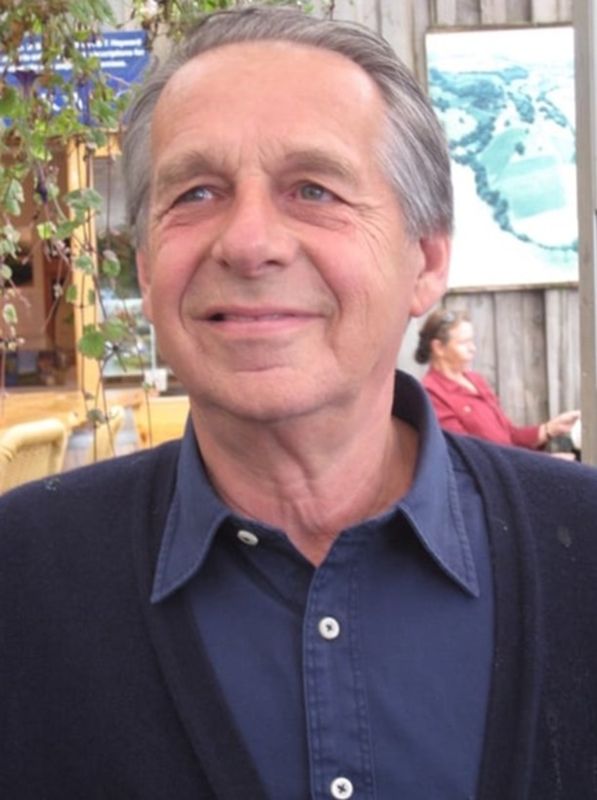
Artist and gallerist Andras Kaldor was born in Budapest, Hungary in 1938. The son of Margit (née Gazdag) and Andras Kaldor, an engineer, he attended the Petőfi Sándor Gimnázium between 1952 and 1956. Growing up in a family of opera enthusiasts, he developed a lasting interest in music and architecture. As a member of Hungary's youth basketball team, he travelled around Eastern Europe in 1956, later that year participating in the Hungarian uprising against Soviet-backed rule. Following its suppression, he escaped across the Austrian border with a friend, leaving his parents and sister behind. From Vienna he travelled to England as a refugee and initially lived with a family in Surrey, where he learned English. He subsequently studied architecture in Edinburgh and Glasgow, completing his training in 1962. He obtained a British passport in 1966, although more than a decade passed before he was able to visit his family in Hungary.
Kaldor practised architecture for approximately twenty years, working in Ilkley, West Yorkshire, London and Plymouth, while continuing to draw, paint and sculpt. His preference for Baroque and classical buildings contrasted with the prevailing architectural styles of the 1960s and 1970s, prompting a growing desire to pursue art professionally. With his second wife, Sally Kempley, he settled in Dartmouth, Devon, where they ran Sally's Bistro in a former photographic shop on Newcomen Road. Intended to allow him time to paint during the day, the restaurant instead required much of his attention and closed after three years. Around 1980 he abandoned architectural practice to become a full-time artist and he subsequently established the Andras Kaldor Gallery at the Newcomen Road premises, where he painted and exhibited his work. His wife worked as an auxiliary nurse to supplement their income and became closely involved in researching his architectural subjects.
Kaldor developed a distinctive practice, depicting buildings in vivid colour, particularly opera houses and opera festivals (including Glyndebourne), theatres and historic landmarks. Drawing freehand without a ruler, he aimed for lively, individual interpretations, rather than mechanically precise copies. His architectural training informed the detailed structures of his paintings, which encompassed acrylics, watercolours, pen and ink and gouache; he also painted boats and coastal scenes. An early solo exhibition took place in France at Galerie Cabaret, Villefranche-sur-Mer, in 1983, followed by exhibits in Henley-on-Thames, Windsor, Cannes and New York. In Dartmouth he became associated with Simon Drew, John Gillo, John Donaldson and Paul Riley, collectively known as the 'Dartmouth Five'. Exhibiting together locally and nationally, they helped establish the town as an artistic centre. Kaldor participated in their exhibition at Coombe Farm Studios, Dittisham, in December 1986, and in Making Waves, a group exhibition at the Solent Gallery, Cowes, in 1987. His gallery joined a collaborative exhibition of Dartmouth galleries in 1989. He also contributed to Inspired by Gardens at Coombe Farm Studios in 1996 and the Women and Song festival in 1997, while exhibiting new originals and prints alongside Michael Wood at his gallery in 1998. The following year, the gallery presented a retrospective of his work.
Commissions and publications brought Kaldor wider recognition. British Airways commissioned a series of twelve architectural paintings for its Regent Street Collection in 1989, while London Contemporary Art exhibited his London buildings and watercolours, including the exhibition Masterpieces or Carbuncles. In 1990 he exhibited paintings of European opera houses at Coe Kerr Gallery, New York, and Galerie Gasnier Camien, Paris. He was also commissioned to depict French châteaux and notable Southwark buildings, produced printed material for the Tower of London and Hampton Court Palace, and created a mural for Fingals Hotel in Dittisham. In 1990 he illustrated the ace of spades for a Friends of the Earth fundraising pack of playing cards, supporting rainforest conservation. His book Opera Houses of Europe appeared in 1996, accompanied by an exhibition at Gallery 19, London. Further exhibitions included the Opera House, Budapest in 1997 and the Metropolitan Opera at Lincoln Center, New York, in 1998, where 21 original pen-and-ink and gouache drawings were shown. He also undertook design commissions for the Victoria and Albert Museum and the Guggenheim Museum.
The opera-house project combined his lifelong enthusiasm for music with extensive research journeys across Europe, frequently undertaken with his wife, who contributed to the accompanying texts. Kaldor subsequently published New York, Masterpieces of Architecture (1999) and Berlin, Masterpieces of Architecture (2002), with related exhibitions at Berlin's Rathaus in 2002 and East Hampton, USA in 2004. Remaining active in Dartmouth, he continued drawing and painting at his gallery, maintaining friendships with local artists and membership of the Chelsea Arts Club. Although he embraced life in Britain, Kaldor maintained strong ties with Hungary and acknowledged retaining something of a refugee mentality (Drew 2022). He valued artistic recognition more than material success, and his distinctive architectural images circulated through original paintings, prints, posters and museum publications. Andras Kaldor died in England in 2022. His work is not currently represented in UK public collections.
Irene Iacono
Related books
- Hungarian Refugee Who Became Part of a Band Of Artists in Devon, The Times, 25 June 2022, p. 81
- Adriana Kiss-Davies, The Exile Experience: Hungarian and Czech Cold War Refugee Artists in Britain, PhD thesis, Aberystwyth University, 2011
- Andras Kaldor, Berlin: Masterpieces of Architecture (Woodbridge: Antique Collectors' Club, 2002)
- ‘Going Places’, The Daily Telegraph, 17 October 1998, p. 290
- ‘Ten out of Ten for Artistic Content’, Herald Express, 12 May 1998, p. 15
- Mila Andre, ‘A Gem of a Year’, Daily News, 9 January 1998, p. 53
- ‘Festival Success’, Torbay Express and South Devon Echo, 24 June 1997, p. 17
- ‘‘Fascinating’ Look to New Festival!’, Herald Express, 13 May 1997, p. 15
- ‘Festival Success’, Torbay Express and South Devon Echo, 24 June 1997, p. 17
- ‘Inspiration from Bed and Border’, Evening Herald, 21 May 1996, p. 40
- Andras Kaldor, Watercolours of the Opera Houses of Europe (New York; London: Coe Kerr Gallery Inc in association with Stephanie Hoppen, 1991)
- ‘Six S. Devon Artists Get the Pip!’, Torbay Express and South Devon Echo, 24 April 1990, p. 7
- ‘Galleries Unique Art Link’, Herald Express, 25 April 1989, p. 30
- Graham Hughes, ‘Andras Kaldor: Masterpieces or Carburicles?’ Arts Review, 1989
- ‘It's a Fowl’ Exhibition’, Herald Express, 18 May 1987, p. 28
- ‘Five Artists Go on Show’, Herald Express, 8 December 1986, p. 34
- ‘Artist ‘Catches’ Thief’, Torbay Express and South Devon Echo, 26 July 1986, p. 2
Related organisations
- Andras Kaldor Gallery (founder)
- Chelsea Arts Club (member)
Related web links
- ‘Glyndebourne festival opera’, The British Antique Dealers' Association
- ‘Andras Kaldor’, RoGallery
- Artists’ Biogs
- Artists’ Collecting Society
- Kate Cotton, ‘Tributes to Dartmouth Artist Andras Laszlo Kaldor’, South Hams Today, 11 May 2022
- Naturalisation Notice, London Gazette, 28 June 1966
- Phil Scoble, ‘Andras Kaldor – Escape to Art and Architecture’, Phil Scoble Historian, 26 March 2014
- Simon Drew, ‘Andras Kaldor Obituary’, The Guardian, 22 May 2022
Selected exhibitions
- Solo exhibition, Eastend Gallery, East Hampton, New York, USA (2004)
- Solo exhibition, Berliner Rathaus, Berlin, Germany (2002)
- Andras Kaldor Retrospective, Andras Kaldor Gallery, Dartmouth, Devon (1999)
- Michael Wood and Andras Kaldor, Andras Kaldor Gallery, Darmouth, Devon (1998)
- Exhibition of opera-house paintings, Metropolitan Opera, Lincoln Center, New York, USA (1998)
- Women and Song, Festival Art Exhibition, Andras Kaldor Gallery, DArtmouth, Devon (1997)
- Solo exhibition, Budapest Opera House, Budapest, Hungary (1997)
- Inspired by Gardens, group exhibition, Coombe Farm Studios, Dittisham, Devon (1996)
- Opera Houses of Europe, Gallery 19, London (1996)
- Group exhibition, Simon Drew Gallery, part of Dartmouth Arts and Crafts Festival, Dartmouth, Devon (1996)
- Andras Kaldor and Chrissie Vaudrey, Andras Kaldor Gallery, Dartmouth, Devon (1990)
- Les Opera de L'Europa, Galerie Gasnier Camien, Paris, France (1990)
- Opera Houses of Europe, Coe Kerr Gallery, New York, USA (1990)
- ‘Masterpieces or Carbuncles?’, Gouache and Watercolours of London Architecture by Andras Kaldor, London Contemporary Art, London (1989)
- Fowl, group exhibition, Simon Drew Gallery, Dartmouth, Devon (1987)
- Making Waves: Exhibition by 5 artists from Dartmouth, The Solent Gallery, Ancasta Marina, Cowes, Isle of Wight (1987)
- Art Expo, New York, USA (1986)
- Group exhibition, Lymington Gallery, Hampshire (1985)
- Group exhibition, Compton Gallery, Windsor, Berkshire (1984)
- Solo exhibition, Galerie Cabaret, Villefranche-sur-Mer, France (1983)
- Group exhibition, Century Gallery, Henley-on-Thames, Berkshire (1983)
Ben Uri archive
Consult items in the Ben Uri archive related to [Andras Kaldor]
Ben Uri library
Publications related to [Andras Kaldor] in the Ben Uri Library