Born: 1844 Philadelphia, USA
Died: 1930 Hurstbourne Tarrant, Hampshire, England
Year of Migration to the UK: 1870
Other name/s: Anna Massey Lea Merritt, Anna Lea Merritt, RBA, ARE
Biography
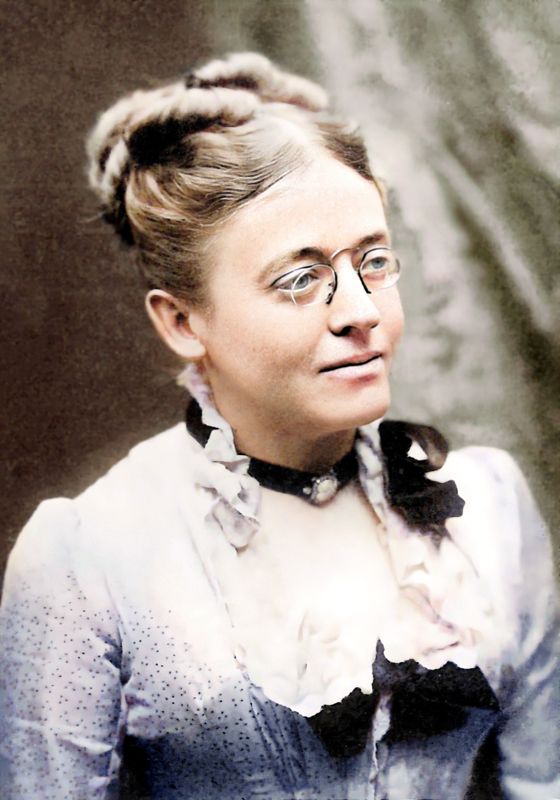
Painter and etcher, Anna Massey Lea Merritt was born in Philadelphia, Pennsylvania. USA, on 13 September 1844, the eldest of six daughters of Joseph Lea Jr. and Susanna Massey, a prosperous Quaker couple, who owned cotton manufacturing and printing factories (Stieber, 2006). She attended Eagleswood School in Bryn Mawr, Pennsylvania, and the Agassiz School in Cambridge, Massachusetts, and was largely self-taught as a painter, having been excluded, as a woman, from the Pennsylvania Academy of the Fine Arts (Stieber, 2006). In 1865, her family travelled to Europe in search of medical treatment for her sister Julia. Before their departure, Anna studied anatomy at the Woman's Medical College of Philadelphia, and in Europe she received private instruction from the Italian painter, Stefano Ussi, in Florence, German painter Heinrich Hoffmann in Dresden, and French painter and etcher, Alphonse Legros (Stieber, 2006; Slatkin, 1993). In 1870, she moved to London, settling in Chelsea, first on Tite Street and later at Cheyne Walk, among artistic neighbours who included notable painters and Pre-Raphaelites, James McNeill Whistler, Edward Burne-Jones, William Holman Hunt and Frederic Leighton (Stieber, 2006).
In 1871, she began studies with the painter, restorer and writer, Henry Merritt (1822-1877), who became her mentor. Their relationship developed from tuition into romance, and the couple married on 17 April 1877, but Henry died only three months later (Slatkin, 1993). As a memorial, Merritt taught herself to etch and compiled a two-volume edition of her husband's writings, Henry Merritt: Art Criticism and Romance (London: C. Kegan Paul, 1879), illustrated with 23 of her own etchings (Merritt, 1879); a second edition, with an additional leaflet by the author responding to public criticism, was issued by Bernard Quaritch in 1891 (Merritt, 1891). This publication launched her career as a printmaker. Her etched portraits, including those of the architect Sir George Gilbert Scott (1879) and the actress Madge Kendal (about 1880), are now held by the Metropolitan Museum of Art, New York.
Merritt first exhibited at the Royal Academy of Arts in 1871, showing a religious-themed work entitled St Cecilia in 1875, and she continued to exhibit in its annual summer exhibitions until 1917. In 1886, she wrote to The Standard newspaper to protest the Academy's exclusion of women from its full membership (Merritt, 1886). She also exhibited at the Society of Lady Artists (1887, 1890-91) and at the exhibition, Work of the Women Etchers of America at the Union League Club, New York, USA (1888) (Stieber, 2006), and helped to arrange the exhibition American Artists at Home and in Europe for the Pennsylvania Academy of the Fine Arts in 1881 (Stieber, 2006). At the Philadelphia Centennial Exhibition of 1876, she won medals for St Genevieve (1875) and Patrician Mother (1876) (Stieber, 2006), and her nude study Eve, exhibited at the Royal Academy in 1885, won a further medal, despite contemporary criticism of its subject. In 1889, she received an honourable mention for Camilla at the Exposition Universelle in Paris (Stieber, 2006). Her best-known work, Love Locked Out, a memorial to her husband, was exhibited at the Royal Academy in 1890 and purchased for the Tate collection under the Chantrey Bequest, the first painting by a woman artist to be acquired for the British national collection. At the World's Columbian Exposition in Chicago in 1893, she painted murals of Benevolence, Needlework and Education for the Woman's Building, and received a further medal for Eve (Stieber, 2006; Rubinstein, 1982). Her mural commissions included a cycle on the life of Christ for the Arts & Crafts church, St Martin's Church, Blackheath, Surrey (1893-94). She was elected a member of the Royal Society of British Artists in 1902 (Gentlewoman, 1902) and an Associate of the Royal Society of Painter-Etchers and Engravers in 1905 (Westminster Gazette, 1905). In 1901, she exhibited at the Pan-American Exposition in Buffalo, New York, where she received an award (Stieber, 2006), and in 1906, she showed a landscape at the Cheltenham and County Fine Art Society's exhibition (Cheltenham Looker-On, 1906).
In 1891, Merritt withdrew from London society and settled permanently in the Hampshire village of Hurstbourne Tarrant (Slatkin, 1993). She continued to write, publishing A Hamlet in Old Hampshire (1902), an essay, 'A Letter to Artists: Especially Women Artists', in Lippincott's Monthly Magazine (1900) (Merritt, 1900), and An Artist's Garden (London: George Allen and Sons, 1908). Her own memoir, completed in 1926, was not published until 1982 (Slatkin, 1993; Gorokhoff, 1982).
Anna Lea Merritt died in Hurstbourne Tarrant, Hampshire, England on 7 April 1930 (Stieber, 2006). Her work is held in UK public collections, including Tate, British Museum, National Portrait Gallery, Ashmolean Museum, Victoria and Albert Museum, National Maritime Museum, National Museum Cardiff, Royal Academy of Arts, and the William Morris Gallery, as well as in the Metropolitan Museum of Art and the National Museum of Women in the Arts in the USA.
Michal Mel
Related books
- Sean Burns, Death (London: Tate Publishing, 2023)
- Kirsty Stonell Walker, Pre-Raphaelite Girl Gang: Fifty Makers, Shakers and Heartbreakers from the Victorian Era (London: Unicorn, 2018)
- Tom Duffy, 'Anna Lea Merritt (1844-1930) and "The Irish Question"', The British Art Journal, Vol. 18, 2017, p. 60
- 'Anna Lea Merritt', in Gertrude Bosler Biddle and Sarah Dickinson Lowrie, Notable Women of Pennsylvania (Philadelphia: University of Pennsylvania Press, 2016), p. 221
- Olive Maggs, Anna Lea Merritt's Murals: Wall Paintings in a Surrey Church (Surrey: Society for the Arts and Crafts Movement in Surrey, 2011)
- Joan M. Marter ed., The Grove Encyclopedia of American Art (Oxford: Oxford University Press, 2011)
- Kimberly Rhodes, Ophelia and Victorian Visual Culture: Representing Body Politics in the Nineteenth Century (Aldershot: Ashgate, 2008)
- Jason Stieber, Finding Aid to the Anna Lea Merritt Papers, 1863-1922, Archives of Women Artists (Washington, DC: National Museum of Women in the Arts, 2006)
- Wendy Slatkin, The Voices of Women Artists (Englewood Cliffs, N.J.: Prentice Hall, 1993), pp. 105-109
- Sibyl James, Galina Gorokhoff and Frances Spalding, 'Love Locked Out: The Memoirs of Anna Lea Merritt', Woman's Art Journal, Vol. 6, 1985, p. 49
- Galina Gorokhoff, Love Locked Out: The Memoirs of Anna Lea Merritt with a Checklist of Her Works (Boston: Museum of Fine Arts, 1982)
- Charlotte Streifer Rubinstein, American Women Artists: From Early Indian Times to the Present (Boston: G.K. Hall; New York: Avon Books, c1982)
- [Probate notice for Anna Lea Merritt] Daily Herald (London), 7 July 1930
- 'Cheltenham and County Fine Art Society's Exhibition', Cheltenham Looker-On, 3 March 1906
- [Notice of election to the Royal Society of Painter-Etchers and Engravers], Westminster Gazette, 14 January 1905
- [Notice of election to the Royal Society of British Artists], Gentlewoman (London), 17 May 1902
- Anna Lea Merritt, 'A Letter to Artists: Especially Women Artists', Lippincott's Monthly Magazine, Vol. 65 (1900), pp. 463-69
- Anna Lea Merritt, The Life and Literary Remains of Henry Merritt, 2nd ed., with an additional leaflet by the author (London: Bernard Quaritch, 1891)
- Anna Lea Merritt, letter to the editor, 'The Royal Academy', The Standard (London), 6 November 1886
- S. R. Koehler, 'The Works of the American Etchers: VIII. Anna Lea Merritt', The American Art Review, Vol. 1, 1880, p. 229
- Anna Lea Merritt, Henry Merritt: Art Criticism and Romance, with Recollections and Twenty-three Etchings (London: C. Kegan Paul, 1879)
Public collections
- Ashmolean Museum, Oxford
- British Museum
- National Maritime Museum
- National Museum Cardiff
- Metropolitan Museum of Art, New York
- National Museum of Women in the Arts, Washington DC
- National Portrait Gallery
- Royal Academy of Arts
- Tate
- V&A
- William Morris Gallery
Related organisations
- Royal Academy of Arts (exhibitor)
- Royal Society of British Artists (member)
- Royal Society of Painter-etchers and Engravers (associate)
Related web links
- Annex Galleries
- Art Renewal Center
- Bagshawe Fine Art
- Christie's 'Eve'
- My Daily Art Display
- National Museum of Women in the Arts
- Olive Maggs, Anna Lea Merritt's Murals: Wall Paintings in a Surrey Church
- Royal Academy of Arts online resources
- Surrey Hills, St. Martin’s Church
- The Eclectic Light Company
Selected exhibitions
- Royal Academy Summer Exhibition, Royal Academy of Arts, London (1871; 1875; 1881; 1884; 1885; 1886; 1887; 1890; 1906; 1916; 1917)
- Group exhibition, Cheltenham and County Fine Art Society, Cheltenham, England (1906)
- Group exhibition, World's Columbian Exposition, Chicago, USA (1893)
- Group exhibition, Society of Lady Artists, London (1887; 1890; 1891)
- Group exhibition, Exposition Universelle, Paris, France (1889)
- Group exhibition, Work of the Women Etchers of America, Union League Club, New York, USA (1888)
- Group exhibition, American Artists at Home and in Europe, Pennsylvania Academy of the Fine Arts, Philadelphia, USA (1881)
Ben Uri archive
Consult items in the Ben Uri archive related to [Anna Lea Merritt]
Ben Uri library
Publications related to [Anna Lea Merritt] in the Ben Uri Library