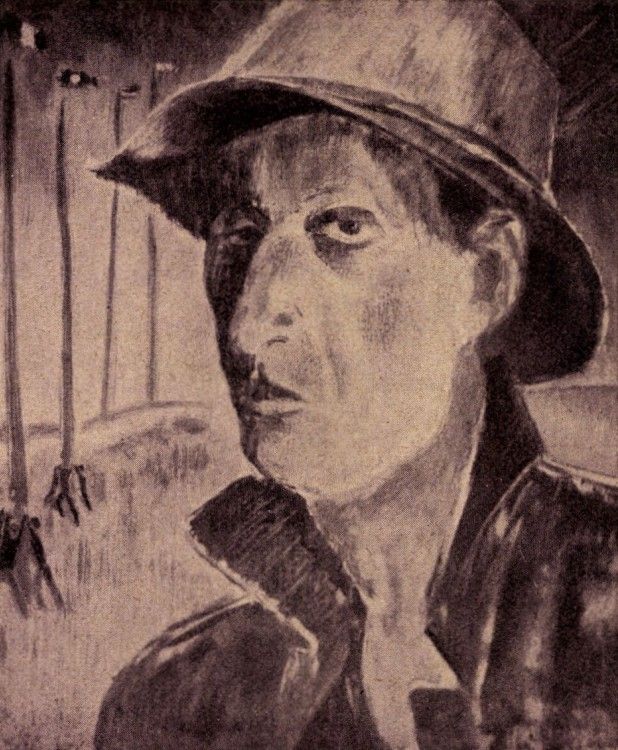
Born: 1889 Budapest, Austria-Hungary (now Hungary)
Died: 1942 Auschwitz, Poland
Year of Migration to the UK: 1910
Other name/s: Bela Meszoly Munkas, Bela Munkas Meszoly, Béla Munkás Mészöly , Bela Messinger
Biography
Artist Béla Mészöly Munkás (né Messinger) was born in Budapest, Austro-Hungary (now Hungary) on 5 June 1889. The son of a book printer, he grew up in a large family that adopted the surname Mészöly in 1909. Encouraged by a teacher at the Jewish Gymnasium in Budapest, he began professional training at the Munich Academy of Fine Arts in 1907. From 1910-12 he lived in London, returning to Budapest in 1912. His career was interrupted by the First World War, during which he was wounded at the front and subsequently discharged. In 1920, Mészöly embarked on a European tour, spending significant time in the Netherlands, before settling in Paris. Though living in modest conditions, he established a reputation as an exhibiting artist, while maintaining ties to the Hungarian National Salon until 1938. In 1921 he married Kornélia Sinayberger in Budapest; their son, Sándor, was born the following year.
Mészöly is best known as a landscape painter, but his work encompassed flower still lifes, city views, portraits, and scenes of children and workers. Social themes recur throughout his oeuvre, particularly poverty, labour, and the vulnerability of ordinary lives. His left-wing convictions led him to adopt the name ‘Munkás’ (‘Worker’), signalling political commitment as much as artistic identity. This focus is powerfully summarised in one of his last works, depicting mothers holding children before smoking chimneys, an image of hardship under modern industrial conditions. From 1924 he took part in group exhibitions at the National Salon, where critics praised the elegiac quality of his Dutch landscapes and the psychological depth of his portraits. In 1930 he co-founded the Képzőművészeti Szalon with László Schalk, an artist-run initiative remembered for its hands-on ethos, in which painters undertook every aspect of mounting exhibitions, from construction and installation to publicity. He exhibited at the National Salon Association’s watercolour and pastel exhibition in Budapest (1932), the Kunstzaal Van Lier, Amsterdam (1933), and mounted a solo exhibition of oils and pastels at Galerias Layetanas, Barcelona (1934). He also showed at the Salon de Noël of the Société des Beaux-Arts, Nice (1934, 1939). Back in Budapest, his 1935 exhibition at the Műterem Gallery was reviewed as an encounter with multiple ‘atmospheres’ in paint, in which earlier heavier and darker works gave way to more light-filled, colour-rich Mediterranean scenes (Emődy 1935).
Mészöly’s contribution in England is most clearly documented in 1937. In January he exhibited at the New Rembrandt Gallery. The following month he held a solo exhibition of pastels at the Bloomsbury Gallery. A review noted charcoal and pastel drawings of London, Spain, Holland, France, and Hungary, praising their breadth and simplicity of handling. Two London subjects—Narrow Street and The Thames, London —were singled out as ‘delightful’, and the reviewer admired how convincingly he captured the character of each place, finding the charm of the works in their directness rather than in display (Western Mail 1937, p. 11). The Jewish Chronicle offered a sharper assessment of his colour sense, judging it less distinctive, while praising his technique and drawing. It highlighted small sketches such as Rain in Paris and The Murken Island, dark-toned Narrow Street, and other works, including Washwomen, Forest, and The Thames, the last described as a strong treatment of a subject that reliably holds interest (Jewish Chronicle 1937, p. 54).
Hungarian criticism in 1937 placed his London exhibitions within a longer trajectory of artistic development. Edith Patai attributed the impact of his work to a tension between contemporary realities and his sensitivity to colour, light, and atmosphere, noting that Spain lightened his formerly darker palette, while London introduced a greater delicacy of touch. Although London critics invoked Turner in relation to his handling of light and mist, Patai emphasised continuity and ongoing artistic searching across media. Later assessments situate Munkás' work within Hungarian post-impressionism, moving toward fauvism and shaped by French art nouveau, characterised by a contemplative tone and recurring motifs of solitude. After the outbreak of the Second World War, his paintings took on a more dramatic mood.
Tragically, the rise of fascism cut short Mészöly’s life and career. He was arrested in Paris on 22 June 1942 by French authorities, taken to the Drancy transit camp, deported to Auschwitz on 28 September 1942, where he was subsequently murdered. Béla Mészöly Munkás died in Auschwitz, Poland on 3 October 1942. Posthumously, a memorial exhibition was organised in Paris in 1947 at the Galerie de Bussy by the writer and resistance figure Jean Cassou, honouring artists who perished as victims of the Holocaust. For decades, much of his work was thought destroyed or lost, but later it became clear that part of his oeuvre survived in family hands in Paris. In 2010, at the close of the exhibition Késői hazatérés (‘Late Homecoming’), Mészöly’s painting Hajó (Boat)—a Dutch work associated with Nijmegen and dated to the early 1920s—was donated by his grandson Jean-Claude Mészöly to the Hungarian National Gallery. Mészöly’s work is not currently represented in UK public collections.
Irene Iacono
Related books
- Art en Exil, Retour Tardif = Késoi hazatérés szamuzott muveszet: Oeuvres de Edit Ban Kiss, Béla Mészoly Munkas et Zsigmond Wittmann (Budapest: Holokauszt emlekkozpont, 2010)
- ‘Holland utca-részlet’ by Munkás-Mészöly Béla, reproduced in <em>Múlt és Jövő</em>, Vol. XXVIII, March 1938, p. 81
- Edith Patai, ‘Munkás-Mészöly Béla’, Múlt és Jövő, Vol. XXVII, October 1937, p. 276
- 'The Bloomsbury Gallery', Western Mail, 27 February 1937, p. 11
- ‘Bela Munkas Meszoly’, Jewish Chronicle, 26 February 1937, p. 54
- 'Béla Mészöly Munkás', Art (Barcelona), Vol. II, No. 5, February 1935, p. 146
Related organisations
- Képzőművészeti Szalon (Fine Arts Salon) (founder)
- Nemzeti Szalon (National Salon), Budapest (member)
Related web links
- Blog des Mardis hongrois de Paris, ‘Art proscrit – Száműzött művészet’, blog post, April 2010
- Holocaust Memorial Center
- ‘Késői hazatérés’[‘Late Homecoming’], Szombat online magazine, 28 June 2010
- Kieselbach Gallery and Auction House
- Mészöly Munkás Hajója révbe ért…
- MILEV – Hungarian Jewish Museum and Archives
- Nagyházi Gallery and Auction House – Auction 300, 9–10 December 2025, p. 146
- November Gallery
- Portrait of a man smoking a cigar by Béla Mészöly Munkás, Proantic
- Press release of the Holocaust Memorial Center, 11 August 2010
- Rafael Benet, Cròniques d’Art a la Veu de Catalunya, pp. 134–135
- Wikipedia entry
Selected exhibitions
- Késői Hazatérés/Száműzött Művészet (Late Homecoming/Art in Exile), Holocaust Memorial Center, Budapest (2010)
- Memorial exhibition, Galerie de Bussy, Paris (1947)
- Salon de Noël, Société des Beaux-Arts, Nice (1939)
- National Salon, Winter Exhibition, Budapest (1938)
- Solo exhibition, Bloomsbury Gallery, London (1937)
- Solo exhibition, New Rembrandt Gallery, London (1936)
- Munkácsy Céh, group exhibition, Budapest, Hungary (1936, 1935)
- Műterem Gallery, Budapest, Hungary (1935)
- Salon de Noël, Société des Beaux-Arts, Nice, France (1934)
- Solo exhibition, Galerias Layetanas, Barcelona, Spain (1934)
- Group exhibition, Kunstzaal Van Lier, Amsterdam, Netherlands (1933)
- National Salon, Watercolour and Pastel Exhibition, Budapest, Hungary (1932)
- Képzőművészeti Szalon, Budapest, Hungary (1930)
- National Salon, Budapest, Hungary (1924)
- Solo exhibition, Műcsarnok (Kunsthalle), Budapest, Hungary (1924)