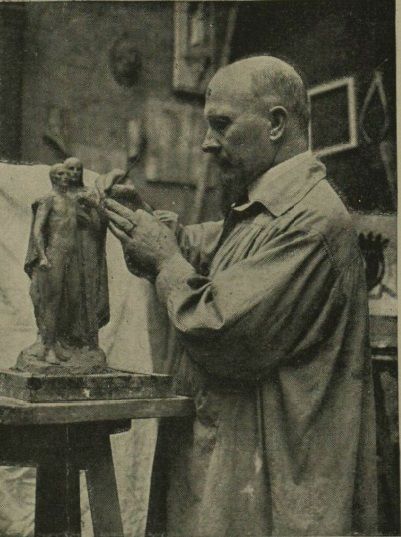
Born: 1863 Melbourne, Australia
Died: 1931 Torquay, England
Year of Migration to the UK: 1883
Other name/s: Sir Bertram Mackennal, Edgar Bertram Mackennal, Edgar Bertram Mackennal RA, Sir Edgar Bertram Mackennal, KCVO, RA
Biography
Sculptor Edgar Bertram Mackennal was born in Fitzroy, Melbourne, Australia, on 12 June 1863, second son of the Ayrshire-born architectural sculptor, John Simpson Mackennal, and his wife Annabella, née Hyde, also from Ayrshire, Scotland. He was educated at the Melbourne Model School and King's College, Melbourne, before training under his father and studying from 1878 at the National Gallery School of Design, Melbourne, under O. R. Campbell. Encouraged to pursue further training in Europe, he left Australia in 1882, arriving in England in early 1883, hoping to work under the sculptor Marshall Wood, who had died shortly before Mackennal's arrival. He enrolled at the Royal Academy Schools on 4 December 1883, but soon left for Paris, where he studied informally in artists' studios and, through his fellow Australian, John Peter Russell, spent a short period working alongside Auguste Rodin. In 1884, he secured a portrait bust commission that brought him back to London, where he married Agnes Spooner; the couple then travelled to Italy before returning to Paris.
Mackennal worked primarily in bronze and marble, producing portrait busts, allegorical figures and public monuments in a style that drew on the classicising tendencies of the English New Sculpture movement, while retaining a Symbolist and Art Nouveau sensibility absorbed during his time in Paris. His 1893 marble figure Circe, exhibited at the Royal Academy of Arts in 1894, and For She Sitteth on a Seat in the High Places of the City, shown in 1895, established his reputation in London as an inventive and technically accomplished modeller of the female nude, informed by his exposure to Rodin's work. Over the following decades, his practice broadened into royal and civic portraiture, ceremonial monuments and coin design; two of his Symbolist marbles, The Earth and the Elements and Diana Wounded, were acquired for the Tate Gallery under the Chantrey Bequest in 1907 and 1908 respectively and remain in the Tate collection today. Although based in London for almost the entirety of his career, Mackennal retained close professional ties with Australia, returning on three occasions to install major public commissions and maintaining, in works such as the Sydney Cenotaph and the Shakespeare Memorial, a distinctly Australian strand within his otherwise British royal and civic output.
Mackennal exhibited regularly at the Royal Academy Exhibitions, showing there in 1886, from 1894 to 1898, from 1903 to 1916, from 1918 to 1925, and in 1928 and 1929, with the gaps largely reflecting periods spent working in Australia and Paris; his relief The Five Foolish Virgins, accepted for the 1886 exhibition, marked his first appearance there. He was elected an Associate of the Royal Academy (ARA) on 27 January 1909, the first Australian to be so honoured, and a full Royal Academician (RA) on 23 November 1922, submitting the bronze group The Dawn of a New Age as his diploma work; he later served on the Academy's Council from 1925 to 1926. He was elected an Honorary Royal Scottish Academician (RSA) in 1920.
His public commissions in Britain included the tomb of King Edward VII at St George's Chapel, Windsor, unveiled in 1927, the equestrian statue of Edward VII in London, the coinage, coronation medal and postage stamps of George V, the medals for the 1908 London Olympic Games, and war memorials at Eton College, in Blackburn, Lancashire, and in the Houses of Parliament, Westminster. He was appointed a Member of the Royal Victorian Order in 1912 and, in 1921, was knighted, becoming the first Australian-born artist to receive that honour. Between 1926 and 1927, Mackennal made an extended visit to Australia, exhibiting a group of small sculptures at the Macquarie Galleries, Sydney, in October 1926, overseeing the installation of his Shakespeare Memorial there, and securing the commission for the Sydney Cenotaph in Martin Place, unveiled in 1929, as well as figures of Cardinal Moran and Archbishop Kelly for St Mary's Cathedral, Sydney. His bronze pedimental group Phoebus Driving the Horses of the Sun, for Australia House, London, was installed in 1923. In 1933, the Royal Academy held a joint retrospective exhibition of his work alongside that of the painter George Lambert.
Edgar Mackennal died suddenly at his home, Watcombe Hall, near Torquay, Devon on 10 October 1931. Mackennal's sculpture is held in UK public collections, including Tate, Royal Academy of Arts, National Portrait Gallery, Victoria and Albert Museum, and the Ashmolean Museum, Oxford, as well as in major Australian institutions such as the National Gallery of Victoria and the Art Gallery of New South Wales.
Michal Mel
Related books
- Denise Mimmocchi, Australian Symbolism: The Art of Dreams (Sydney: Art Gallery of New South Wales, 2012)
- Mark Stocker, 'A Monumental Agreement: Lord Curzon, Bertram Mackennal and the Curzon Monument at Kedleston', Sculpture Journal, Vol. 20, 2011, p. 71
- Mark Stocker, 'Love, Sympathy and Tenderness: Bertram Mackennal's Monument to Lord and Lady Curzon', The Burlington Magazine, Vol. 151, 2009, p. 755
- Jason Edwards, 'Review of Bertram Mackennal', Deborah Edwards editor, Visual Culture in Britain, Vol. 10, 2009, p. 201
- Deborah Edwards and Benedict Read, Bertram Mackennal: The Fifth Balnaves Foundation Sculpture Project (Sydney: Art Gallery of New South Wales, 2007)
- Mark Stocker, 'Bertram Mackennal, Sydney and Melbourne', The Burlington Magazine, Vol. 149, 2007, p. 889
- Deborah Edwards, 'Bertram Mackennal: Australia's Most Successful Sculptor', World of Antiques & Art, 2006, p. 94
- Gael Ramsay and Gordon Morrison, Ballarat Fine Art Gallery: Highlights from the Collection (Ballarat: Ballarat Fine Art Gallery, 2006)
- Charles Marriott, 'Mackennal, Sir (Edgar) Bertram (1863-1931)', rev. Juliet Peers, Oxford Dictionary of National Biography (Oxford: Oxford University Press, 2004)
- R. R. Tranter, Bertram Mackennal: A Career (Sydney: Parker Pattinson, 2004) Peter Yule and Chris McAuliffe, Treasures: Highlights of the Cultural Collections of the University of Melbourne (Carlton: Miegunyah Press, 2003)
- Daniel Thomas, Outlines of Australian Art: The Joseph Brown Collection, 3rd ed. (South Melbourne: Macmillan, 1989)
- Susan Beattie, The New Sculpture (New Haven: Yale University Press, 1983)
- James Gleeson, Aspects of Australian Art, 1900–1940 (Canberra: Australian National Gallery, 1978)
- Noel Hutchison, Bertram Mackennal (Melbourne: Oxford University Press, 1973)
- Fine Art Society, Catalogue of a Memorial Exhibition of Statuettes by the Late Sir Bertram Mackennal, K.C.V.O., R.A. (London: Fine Art Society, 1932)
- W. K. West, 'The Sculpture of Bertram Mackennal', The Studio, 1908, p. 262
Public collections
- Art Gallery of New South Wales, Australia
- Ashmolean Museum, Oxford
- British Museum
- National Gallery of Victoria
- Parliamentary Art Collection
- Royal Academy of Arts
- Tate
- V&A
Related organisations
- Art Workers' Guild (member)
- Royal Academy of Art, London (student)
- Royal Academy of Arts (fellow)
- Royal Society of British Sculptors (member)
- Royal Victorian Order (member)
Related web links
- Australian Dictionary of Biography
- British Library catalogue listing
- Mapping the Practice and Profession of Sculpture in Britain and Ireland 1851-1951, University of Glasgow
- Royal Academy of Arts online collection and catalogues
Selected exhibitions
- Mackennal and Lambert (retrospective), Royal Academy, London (1933)
- Royal Academy of Arts Summer Exhibition, Burlington House, London (exhibited 1886, 1894-1898; 1903-1916; 1918-1925; 1928-1929)
- Exhibition of small sculptures, Macquarie Galleries, Sydney, Australia (1926)
- For She Sitteth on a Seat in the High Places of the City, Royal Academy of Arts, Burlington House, London (1895)
- Circe, Royal Academy, of Arts, Burlington House, London (1894)
- The Five Foolish Virgins, Royal Academy of Arts, Burlington House,, London (1886)