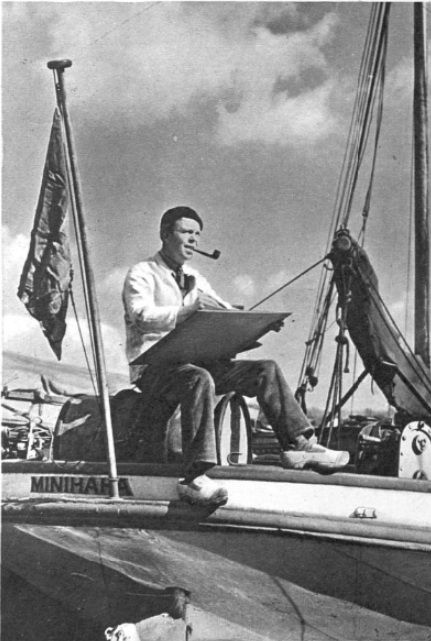
Born: 1903 Spaarndam, Netherlands
Died: 1982 Ipswich, Suffolk, England
Year of Migration to the UK: 1937
Other name/s: Cornelis Visser
Biography
Printmaker and painter Cor (Cornelis) Visser was born in Spaarndam, near Haarlem, in the Netherlands, on 26 August 1903, the fourth child of Siebe Visser, a water-lock builder, and his wife Alida Francina, née Kipperman, whose home stood amid the region's canals and waterways (suffolkartists.co.uk). He entered the Haarlem Academy of Art at fourteen, where his teacher was Samuel Jessurun de Mesquita, who also taught Maurits Escher, later known for his prints of geometric illusions. The two students remained close friends. Two years later, the Rijksmuseum purchased two of Visser's works, and from 1927 he exhibited regularly in towns across the Netherlands and Belgium, with further purchases made by the Teylers Museum, Haarlem, and the Museum voor Schone Kunsten, Antwerp (suffolkartists.co.uk). He married Emma Nieuwstad, and the couple lived aboard a series of boats. In 1937 Visser sailed to Pin Mill, near Ipswich, Suffolk, England and by 1939 the couple were living aboard at nearby Woodbridge, where the outbreak of the Second World War left them unable to return home (suffolkartists.co.uk).
Visser worked across print, drawing and painting media, moving from early woodcuts, linocuts and drawings of plants, animals and rural scenes, to later oils, watercolours and charcoals, for which he became well-known (Buckman, Artists in Britain Since 1945). A reviewer of his 1938 London exhibition at the Cooling Galleries praised the strength of his watercolours and charcoal drawings of Bruges, describing him as standing out 'as a giant among the pygmies' (Saturday Review of Politics, Literature, Science and Art, 1938). Estuary scenery, boats and portraiture were recurring subjects, reflecting his life on the water and his continuing connection to the Low Countries after settling in England. His sitters ranged from the Dutch royal family to Suffolk residents, including the Sutton Hoo landowner Edith Pretty and her young son Robert, painted in 1940 (Mudskipper Press, 2025).
During the Second World War, Visser was appointed official war artist to the Dutch government-in-exile in London, a role he undertook between 1942 and 1945 (Buckman, Artists in Britain Since 1945). He was commissioned to paint portraits of Queen Wilhelmina, other members of the Dutch royal family, government ministers and army officials. Leaflets bearing his portrait of the Queen were dropped over the Netherlands by the Royal Air Force in support of the liberation (Ibid.). After the war, Visser settled permanently in Ipswich and, at the invitation of the painter Anna Airy, then president of the Ipswich Art Club, was elected a member, remaining active until his retirement in 1974, when he was made a life member. He showed the watercolour Barges on Pin Mill Hard and the black chalk drawing Looking at the Finished Picture at the club's 1974 centenary exhibition (suffolkartists.co.uk).
Visser also opened the Fore Street Gallery, at 44 Fore Street, Ipswich, where he taught small groups of student and led evening classes for the Felixstowe Evening Institute and the East Suffolk County Education Committee; he also instructed a painting group formed by the wives of American officers at the United States Air Force base at Woodbridge (suffolkartists.co.uk). He held a one-man exhibition at the YMCA in Ipswich in March 1949 and showed with the Deben Art Group and at the Deben Gallery, Woodbridge, including in the 1983 group exhibition Critic's Choice (Bury Free Press, 1983). His portrait of the naval officer Commander Evelyn George Martin was acquired by the National Portrait Gallery (Suffolk Chronicle, 1961).
Cor Visser died in Ipswich, Suffolk, England, on 27 September 1982. His work continued to be shown posthumously. An exhibition of portraits was held at Christchurch Mansion, Ipswich (1987); a retrospective was shown at the Haste Gallery, Ipswich (1989), a further exhibition, Cor Visser (1903-1982), was presented in The Room Upstairs at Christchurch Mansion, Ipswich, from 22 October to 4 December 1994, and his painting Houses on Silent Street was shown in Art at the Heart of Ipswich, marking the Ipswich Art Society's 150th anniversary at venues across Ipswich in 2024 (Ipswich Borough Council).
Cor VIsser's work is held in UK public collections including the Ashmolean Museum, Oxford; British Museum; National Portrait Gallery; Norfolk Museums Collections; and the Victoria and Albert Museum;. He is alos represented in the collection of, the Rijksmuseum, Amsterdam, the Netherlands.
Michal Mel
Related books
- David Buckman, Artists in Britain Since 1945, 2nd ed., 2 vols (Bristol: Art Dictionaries Ltd, in association with Sansom & Company, 2006)
- Retrospective exhibition of the work of Cor Visser (1903-1982) (Ipswich: Haste Gallery, 1989)
- Billericay Gazette, 22 May 1987, p. 12
- Bury Free Press, 25 November 1983, p. 8
- Suffolk Chronicle, 27 October 1961, p. 11
- Felixstowe Times, 12 March 1949, p. 3
- Saturday Review of Politics, Literature, Science and Art, 30 April 1938, p. 274
Public collections
- Ashmolean Museum, Oxford
- British Museum
- National Portrait Gallery
- Norfolk Museums Collections
- Rijksmuseum, Amsterdam, Netherlands,
- V&A Museum
Related organisations
- East Suffolk County Education Committee (evening class instructor)
- Felixstowe Evening Institute (teacher)
- Fore Street Gallery (founder and teacher)
- Ipswich Art Club (member)
Related web links
Selected exhibitions
- Art at the Heart of Ipswich (Ipswich Art Society 150th Anniversary), venues across Ipswich, Suffolk (2024)
- Cor Visser (1903-1982), The Room Upstairs, Christchurch Mansion, Ipswich, Suffolk (1994)
- Retrospective exhibition of the work of Cor Visser, Haste Gallery, Ipswich, Suffolk (1989)
- Exhibition of portraits, Christchurch Mansion, Ipswich, Suffolk (1987)
- Critic's Choice, Deben Gallery, Woodbridge, Suffolk (1983)
- Ipswich Art Club Centenary Exhibition, Ipswich, Suffolk (1974)
- One-man exhibition, YMCA, Ipswich, Suffolk (1949)
- Group exhibition, Cooling Galleries, London (1938)