Born: 1929 China
Died: 2024 England
Year of Migration to the UK: 1931
Other name/s: David Frederick Bates
Biography
Artist David Bates was born in China in 1929. The son of a Methodist missionary and headmaster, he returned to England with his family in 1931, after the rise of the Kuomintang forced his parents to leave. Over the next few years the family moved several times, before settling in Stockport in Cheshire in 1940. Bates attended Stockport Polytechnic and, in 1945, enrolled at the West of England College of Art in Bristol, where he studied for four years.
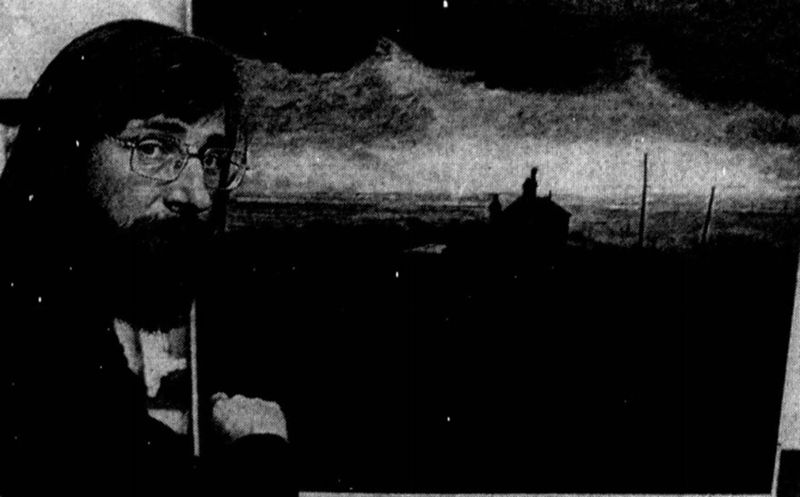
By the late 1940s the family had moved to Millom, in south Cumbria, where Bates’s father, the Rev. W. P. Bates, was minister of Newton Street Methodist Chapel. Bates spent the year 1949–50 there during a break between art studies, and the period proved formative. He explored the town and its surroundings on foot and by bicycle, drawing and painting its workmen, children, train travellers, ironworks, mines, fells and wider landscapes. In 1950, aged 21, he held a one-man exhibition at Holborn Hill School, showing more than 50 paintings, drawings and sketches. He explained that he wanted to find ‘beauty in life’s everyday things’, from local scenery ‘to the kitchen sink’ (North Western Evening Mail 1950, p. 3). In September 1950 Bates entered the Royal College of Art (RCA) in London. There he maintained a strong commitment to realism and naturalism at a time when abstraction was increasingly dominant. According to later accounts, he argued with his tutor, Francis Bacon and with the young critic, David Sylvester, who was dismissive of the so-called ‘Kitchen Sink School’ and of Bates’s fellow student and friend John Bratby (Olympia Auctions). Bates’s political views also informed his art. He joined the Communist Party, held socialist convictions, campaigned for nuclear disarmament and later protested against the Vietnam War. In the 1950s his work often focused on labour, industry and the position of the worker in society. In London he studied navvies removing tramlines and painted industrial objects, such as cement mixers; after his family moved to Stoke-on-Trent in Staffordshire in 1951, he also drew and painted the famous local Potteries. At the RCA Bates met fellow student June Moss, whom he married in 1957, while he was teaching at Boots College in Nottingham. They first lived together in Yeovil, Somerset, before moving in 1961 with their young family to Preston, Lancashire, where Bates became senior lecturer in painting at the Harris School of Art. He was also active as a tutor beyond the college: in 1963 he was listed among the tutors for a painting schoolnearby at Grange-over-Sands, and in 1967 he was named as a tutor for a Furness Federation of Artists painting school at Ulverston.
Bates continued to exhibit work rooted in landscape, industry and the built environment. In 1967 Keele University held a spring exhibition of 23 oil paintings and 27 drawings in watercolour or line and wash. Reviewing the show, R. G. Haggar described it as the most obviously realistic exhibition held at the university for some time. Bates wrote in the catalogue foreword that ‘the artist should be caught up in a great theme’; for Haggar, that theme was ‘detritus’, including both natural erosion and the waste of industrial civilization (Haggar 1967, p. 8). Many works drew on the landscape of North Staffordshire, with subjects including Longport, Mow Cop, Scholar Green, Etruria and Middleport. Haggar praised the drawings in particular, while noting that the oils included portraits, still lifes and images of industrial debris. In 1972 Bates exhibited 45 works at the Lewis Art Gallery, Blackburn. The show included a large oil painting of skulls and apples, as well as several paintings of concrete mixers. Bates acknowledged that he had previously had ‘a fixation with industrial subjects’, but also stressed his interest in old buildings, natural beauty and tradition, describing himself as ‘a traditionalist in the true sense of the word’ (Lancashire Telegraph 1972, p. 6). In 1975 his exhibition at Tib Lane Gallery, Manchester, was reviewed in The Guardian, where his work was described as rooted in academic technique but capable of giving particular subjects emotional intensity. Works such as Tilery, Stoke-on-Trent and Etruria were seen as part of his distinctive northern expression (The Guardian 1975, p. 10).
By the late 1970s Bates was directing Preston Arts Centre, overseeing a broad programme of music, film, art and events. In 1978 he took early retirement, and he and June moved to Newbiggin Hall, near Carlisle in Cumbria. They also renewed their connection with Millom in the 1970s, buying a house on Devonshire Road and continuing to explore and paint the area. In 1986 Bates was among the artists included in Art à la Carte at Abbot Hall Art Gallery, Kendal. David Bates died in England in 2024. After his death, his Millom works were shown again in 2025 in an exhibition organised by Millom and District Local History Society with Holy Trinity Church. In the UK public domain his work is represented in the Royal College of Art collection.
Irene Iacono
Related books
- ‘Don’t Miss’, Evening Mail, 22 November 1986, p. 5
- Merete Bates, ‘Exhibitions in Manchester’, The Guardian, 25 February 1975, p. 10
- ‘Art Can be So Very Expensive...’, Lancashire Telegraph, 7 October 1972, p. 6
- R. G. Haggar, ‘Artist ‘Caught Up in a Great Theme’’, Evening Sentinel, 18 May 1967, p. 8
- ‘Painting School at Ulverston’, Evening Mail, 9 May 1967, p. 5
- ‘Painting School at Bardsea’, North Western Evening Mail, 22 July 1963, p. 6
- ‘One-man Show by Young Millom Artist’, North Western Evening Mail, 3 August 1950, p. 3
Related organisations
- Boots College, Nottingham (student)
- Harris School of Art, Preston (student)
- Preston Arts Centre (director)
- Royal College of Art, London (student)
- Stockport Polytechnic (student)
- West of England College of Art, Bristol (student)
Related web links
- Andrew Cunningham, ‘Exhibition to Showcase Work of Celebrated Millom Artist’, The Whitehaven News
- Catherine Mackinlay, ‘Millom: Art Exhibition Set to Bring Town's Industrial Past to Life’, The Mail, 29 May 2025
- Millom History
- Millom History News
- Olympia Auctions
Selected exhibitions
- Solo exhibition, Hill Village Hall, Millom; Holy Trinity Church, Millom, Cumbria (2025)
- Art à la Carte, group exhibition, Abbot Hall Art Gallery, Kendal, Cumbria (1986)
- Painting, Watercolours and Drawings by David Bates, Tib Lane Gallery, Manchester (1972)
- Solo exhibition, Lewis Art Gallery, Blackburn, Lancashire (1972)
- Paintings and Drawings by David Bates, Chancellor’s Building, Keele University, Keele, Staffordshire (1967)
- Solo exhibition, Holborn Hill School, Millom, Cumbria (1950)
Ben Uri archive
Consult items in the Ben Uri archive related to [David Bates]
Ben Uri library
Publications related to [David Bates] in the Ben Uri Library