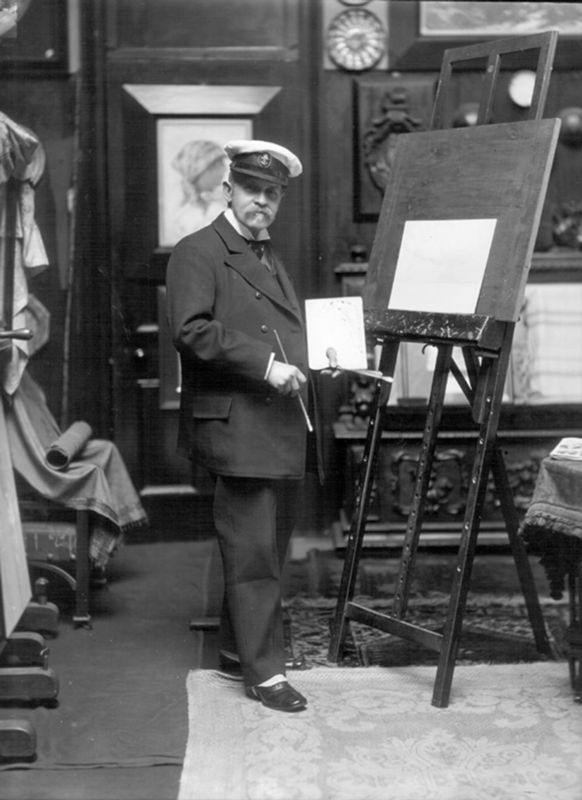
Born: 1838 Meta, Kingdom of the Two Sicilies
Died: 1912 London, England
Year of Migration to the UK: 1875
Other name/s: Chevalier de Martino, Commendatore de Martino, Edoardo Federico de Martino CVO
Biography
Marine painter Edoardo de Martino was born in Meta, near Naples, in the Kingdom of the Two Sicilies (now Italy), on 29 March 1838. Growing up on the Sorrentine coast, he was drawn to the artistic community associated with the School of Resina, a group of painters near Naples known for their naturalistic, open-air depictions of coastal and maritime subjects. He studied at the art school of Naples before entering the Italian Navy, attending the Naval Academy and serving as navigating officer on the corvette Ercole in South American waters. During the Italian wars of independence of 1849-55 he also worked in a documentary capacity as a naval painter.
Following his departure from the Italian Navy, de Martino settled in South America, living in Montevideo before moving to Brazil, where he lived in Rio de Janeiro, with a period of study in Porto Alegre. In July 1868, when the Paraguayan War (1865-70) was nearing its military conclusion, the Imperial Brazilian Navy commissioned de Martino and the Brazilian painter Victor Meirelles to record the most significant episodes of the conflict. He also married a Brazilian during this period and became closely attached to the court of Emperor Dom Pedro II, for whom he produced numerous marine subjects. In 1870 he exhibited at the General Exhibition of Fine Arts in Rio de Janeiro, and in 1871 was appointed a corresponding member of the Imperial Academy of Fine Arts there. His painting of a naval battle scene from the Paraguayan War was shown in the Spanish pavilion at the Vienna Universal Exhibition of 1873. In 1875 he immigrated to England, settling in London; he also spent time at Cowes on the Isle of Wight, where the royal yacht was regularly moored.
In England, de Martino worked principally in oils and watercolour, producing large-scale oil canvases of naval battles and fleet manoeuvres, alongside an extensive body of pencil drawings, watercolour studies, and occasional gouaches that researcher Luigina de Vito Puglia has characterised as a travel diary, recording ships, seascapes, and private observations. In 1883 he sent works to the International Exhibition in Rome, including Vapore in mare and Bastimento a vela, and his painting La Stella Polare al Polo Nord is held at the Accademia Navale in Livorno. His appointment as Marine Painter in Ordinary to Queen Victoria, succeeding Sir Oswald Brierly, was announced in early 1895 and attracted comment in the press: critics argued that, while de Martino's draughtsmanship of rigging and fittings was precise, his qualities were those of the accurate recorder rather than the artistic interpreter. He was subsequently reappointed under King Edward VII, accompanying him on naval tours and recording the Diamond Jubilee Naval Review at Spithead in 1897. In the 1902 Birthday Honours he was appointed an Honorary Commander of the Royal Victorian Order (CVO). From 1905 onwards he also painted Italian naval vessels, including the Regia corazzata italiana Lepanto. He gifted oils and graphic works to the Comune di Meta, his birthplace, where they remain in the municipal collection.
His principal works include large-scale canvases of the Battle of Trafalgar, the Battle of the Nile, and the Battle of Cape St Vincent, as well as HMS Edinburgh on Anti-Torpedo Exercise and The Channel Squadron (1898), the latter two held by the National Maritime Museum, Greenwich, which also holds his Naval Review at Spithead, 26 June 1897.
Edoardo De Martino died in London, England, on 12 May 1912. Following his death, his funeral was held at Kensal Green, with a Requiem Mass at the Italian Church in Hatton Garden. In 1983, a century since his own exhibitions, his work featured in a marine painting show held by London dealer, N.R. Omell. Edoardo de Martino's works are held in UK public collections, including the National Maritime Museum, Greenwich; Discovery Museum, Newcastle;, National Museum Cardiff and The Royal Collections Trust.
The Ben Uri Research Unit welcomes contributions from researchers or family members who may have further biographical information.
Michal Mel
Related books
- Luigina de Vito Puglia, Eduardo de Martino: Da ufficiale di marina a pittore di corte (con-fine edizioni, 2013)
- Ugo Fleres, 'De Martino, Edoardo', Enciclopedia Italiana (Rome: Istituto della Enciclopedia Italiana, 1931)
- A. M. Bessone-Aurelj, Dizionario dei Pittori Italiani, 2nd ed. (Milan: 1928)
- 'Death of Chevalier de Martino', Monitor and New Era, 25 May 1912, p. 1
- 'Sandringham' [Court Circular], The Times, 10 November 1902, p. 10
- 'The Art Journal', Star, 9 February 1895, p. 4
- 'Boudoir Gossip', Lady's Pictorial, 19 January 1895, p. 70
Public collections
- Discovery Museum, Newcastle upon Tyne
- Museum Wales
- National Museum Cardiff
- Royal Collections Trust
- Royal Museums Greenwich
Related web links
- Brasilaina Iconografica
- con-fine
- Dictionary of Falklands Biographies
- Enciclopedia Treccani
- Istituto Matteucci
Selected exhibitions
- Group exhibition, N.R. Omell Marine Exhibition, London (1983)
- Group exhibition, Royal Institute of Painters in Water Colours, London (1895)
- Group exhibition ,International Exhibition, Rome (1883)
- Group exhibition, Universal Exhibition, Vienna (1873)
- General Exhibition of Fine Arts, Rio de Janeiro, Brazil (1870)