Born: 22 Naples, Italy
Died: 2018 Rome, Italy
Year of Migration to the UK: 1954
Other name/s: Vincenzo Apicella
Biography
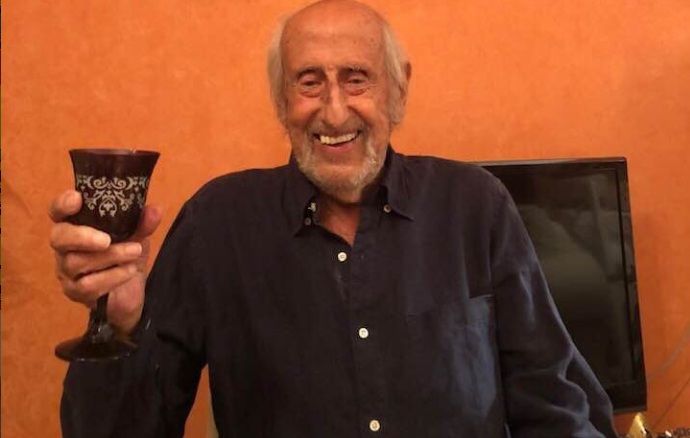
Cartoonist, interior designer and restaurateur, Vincenzo Apicella, known as Enzo Apicella, was born on 26 June 1922 in Naples, to Salvatore and Concetta Apicella. His father, a local councillor, had a love of literature that Apicella later credited as a formative influence on his creative imagination. He was educated at the Liceo di Napoli and subsequently studied languages at the Università degli Studi in Naples. As a young man he wrote comic sketches for Neapolitan variety companies, including the De Vico brothers, Fanfulla and Nino Taranto, and during the Second World War he supported himself by drawing caricatures for American soldiers. He joined the Italian Air Force in 1942 and contributed articles to aviation periodicals, including Le Vie dell'Aria and Ali di Guerra. After the war he travelled to Rome to sit the entrance examination at the Centro Sperimentale di Cinematografia, with the ambition of becoming a film director. He was admitted as a costume designer, but shortly afterwards suspended his studies. He subsequently worked for Arnoldo Mondadori as a layout editor at Epoca, a current affairs journal, and by 1950 had risen to art director. In 1953 he co-founded Melodramma, an opera magazine, in Venice.
When the magazine folded the following year, he relocated to England in 1954 at the invitation of his close friend, Lucio Manisco, who was then working at the BBC in London. On settling in London, Apicella produced cartoon films, designed sets for television programmes, including ABC TV's Bid for Fame, and created commercial posters. Shortly after his arrival he noticed a Schweppes advertising campaign on the Underground; he prepared four unsolicited sketches for the agency and all four were accepted. His formation as a practitioner was largely self-directed. 'I've never been to the proper schools, never been to a school of journalism, design, or art,' he observed (Jamie Mitchell, 2012). Living in Soho, he became a regular at the Trattoria Terrazza on Romilly Street, opened by Mario Cassandro and Franco Lagattolla in 1959, where he socialised with writers and creatives, such as Len Deighton, Mark Boxer, Willie Landels and Germano Facetti. His persistent criticism of the restaurant's décor eventually led Cassandro and Lagattolla to commission him to redesign the dining room in 1962. As an interior designer, Apicella transformed the visual culture of London's restaurant scene. His approach at La Trattoria Terrazza replaced conventional Italian restaurant décor with green glazed floor tiles from Naples, white-painted walls, round tables and black cylindrical downlights positioned over each table, a device he had first noticed in a Piccadilly magazine shop and which he adapted for restaurant use. Len Deighton recalled that Apicella would work out his designs by doodling on the pink tablecloths, never taking them away with him (Telegraph obituary, 8 November 2018). The food critic Fay Maschler credited him with being 'the first to throw out the raffia-clad Chianti bottles and plastic grapes hanging on fabric vines from London trattorie' (British Cartoon Archive, University of Kent). In 1967, with Alvaro Maccioni, he opened the Arethusa Club on the King's Road, which quickly became one of the most fashionable clubs in Europe, frequented by the Beatles, the Rolling Stones and Frank Sinatra. He also designed Tiberio in Mayfair, San Frediano on the Fulham Road and, with Maccioni, La Famiglia in Chelsea. His collaboration with Peter Boizot, founder of Pizza Express, began with the Coptic Street branch near the British Museum; more than 70 further branches followed, with the Fulham branch incorporating murals by Eduardo Paolozzi. Apicella co-founded the Meridiana Restaurant in Chelsea, where in 1974 he installed a life-size waxwork of himself, made by the sculptor Lynn Kramer, to establish a presence in the dining room. He later co-owned the Condotti Restaurant in Mayfair, which displayed an inscribed Andy Warhol Campbell's Soup print. Over his career he designed approximately 150 restaurants in total Alongside notable contemporaries, including David Bailey and Terence Conran, he was described by Vogue's Bevis Hillier as one of 'the creators of the Swinging Sixties'.
As a cartoonist, Apicella developed what George Melly described, in his introduction to Apicella's 1993 collection, Mouthfool, as 'an economy of line and the exploitation of space' that placed him 'in the same class as our mutual friend, the late Mark Boxer' (Telegraph obituary, 8 November 2018). His work encompassed captionless cartoons on food and restaurant life, alongside mordant political satire. He was published in the Observer,The Guardian, Punch (including covers), Economist, Private Eye, Harpers and Queen, Corriere della Sera, La Stampa, Krokodil, Il Manifesto and Liberazione, among others. He also designed covers for Penguin Books during the 1960s and illustrated cookery books, as well as Jonathan Routh's Good Loo Guide. In November 1975 he held a solo exhibition at DM Gallery, London. He married Sophie Jegado in 2006. In recognition of his contribution to design, Apicella was elected a Fellow of the Chartered Society of Designers (FCSD).
Enzo Apicella died in Rome, Italy, on 31 October 2018, aged 96. In the UK public domain, his works are held in the British Cartoon Archive at the University of Kent, Canterbury, and in the Victoria and Albert Museum, London.
The Ben Uri Research Unit welcomes contributions from researchers or family members who may have further biographical information.
Michal Mel
Related books
- Stephen Bayley, 'Enzo Apicella Obituary', The Guardian, 14 November 2018
- 'Enzo Apicella, designer for PizzaExpress, Cartoonist and Restaurateur who Became a Leading Light of the Swinging Sixties - obituary', The Telegraph, 8 November 2018
- 'Smoking Guns: Illustrating the Sizties' Lever Gallery exhibition review, Financial Times, 12 January 2017
- Gilad Atzmon and Enzo Apicella, A to Zion: The Definitive Israeli Lexicon ([N.P]: Fanfare Publications, 2015)
- Enzo Apicella, Senza Censure ([N.P]: Sotto il Vulcano; Zambon, 2011)
- Alasdair Scott Sutherland, The Spaghetti Tree: Mario and Franco and the Trattoria Revolution (London: Primavera Books, 2009)
- Enzo Apicella, God Bless America (Italy: Zambon, 2007)
- Riccardo Pazzaglia, Gabriele Benincasa and Enzo Apicella, Il Quattro Di Maggio (Rome: Benincasa, 2004)
- Enzo Apicella and Tariq Ali, Apicella Versus the United States of America (Rome: Fazi, 2003)
- Bonhams, The Kimpton Sale: Modern Pictures and Sculpture and the Collection of Enzo Apicella (London: Bonhams, 2002)
- Sholto Byrnes, 'They Came, They Saw, They Created', Independent on Sunday, 7 January 2001, p. 18
- Mark Bryant, Dictionary of Twentieth-Century British Cartoonists and Caricaturists (Aldershot: Ashgate, 2000)
- 'Cartoonists who Break the Mould', Hammersmith and Shepherds Bush Gazette, 21 January 1994, p. 56
- Enzo Apicella and George Melly, Mouthfool: A Gourmet Collection of Culinary Cartoons (London: Grub Street, 1993)
- D Studio, Ero-Politics: New Graphics by Enzo Apicella (London: D Studio, 1992)
- Riccardo Pazzaglia (trans.), Il Guarracino (Rome: G. M. Benincasa, 1991)
- Enzo Apicella, Don’t Talk, Kiss (London: Banyan, 1988)
- Jane Mitchell and Enzo Apicella, What Mummy Said (London: Robin Clark, 1984)
- Franco Lagattolla and Enzo Apicella, The Recipes That Made a Million (London: Orbis Books, 1978)
- 'Art', Enzo Apicella New Works at DM Gallery', Illustrated London News, 1 November 1975, p. 13
- Enzo Apicella and Gaio Valerio Catullo, Non Parlare, Baciami (Rome: Trevi Editore, 1967)
Public collections
Related organisations
- Chartered Society of Designers (fellow)
Related web links
- British Cartoon Archive, University of Kent
- Chairmag
- Dyer Grimes Architects, Remembering Enzo Apicella
- Enzo Apicella Website
- FX Design
- Lever Gallery, 'Smoking Guns: Illustrating the Sixties' review in the FT
- The Guardian, Obituary
Selected exhibitions
- Solo exhibitionת DM Gallery, London (1975)
Ben Uri archive
Consult items in the Ben Uri archive related to [Enzo Apicella]
Ben Uri library
Publications related to [Enzo Apicella] in the Ben Uri Library