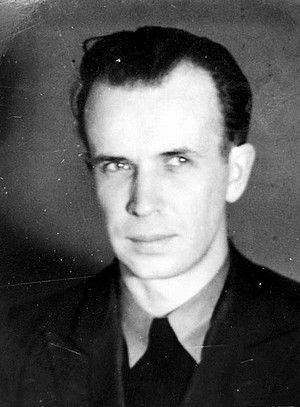
Born: 1912 Jēkabpils, Russian Empire
Died: 1990 London, UK
Year of Migration to the UK: 1946
Other name/s: Ēriks Žilinskis
Biography
Painter and diplomat Ēriks Rudolfs Žilinskis was born on 6 February 1912 in Jēkabpils, Russian Empire (now Latvia). He was studying at the University of Latvia in Riga, where he enrolled simultaneously in the Faculty of Economics and Law, from where he graduated in 1943 with the degree of magister iuris and in drawing and painting classes in the Faculty of Architecture. He also pursued his interest in painting informally, attending lectures on art history, drawing and painting, and training at the private studio of Konstantīns Visockis. Žilinskis's unusual educational path distinguished him from most Latvian painters of his generation, who received their academic training at the Latvian Academy of Art.
During the Second World War Žilinskis served as a lieutenant in the Latvian Legion. In 1944, as Soviet forces re-occupied Latvia, he fled westward. Following the German capitulation in 1945, he was interned in neutral Sweden as military personnel, together with other Latvians. In January 1946 he was officially recognised as a civilian refugee and released. The same year, fearing extradition to the Soviet Union, which Sweden had agreed to carry out for other internees, Žilinskis crossed to the UK in a small fishing boat, with a group of fellow Latvian refugees. In 1947 Žilinskis obtained a position at the Latvian Legation in London, where he worked for 40 years as an archivist and consular secretary, until 1987. This role required travel to cultural centres in France and Italy, enabling him to absorb new impressions and influences. He was a co-founder of the Latvian Press Association of England, and one of the founders and a board member of the Daugavas Vanagi Fund.
Alongside his consular career in exile, Žilinskis simultaneously pursued his interest in painting. working primarily in oil on canvas, with colour as the dominant element of his practice. A profile published in Londonas Avīze records the artist's own position: 'The foundation of all painting is colour. Colour and colour again' (Margareta Ausalā). His work encompassed portraiture, still life, flower studies, and landscape, as well as compositions of an increasingly abstract character from the late 1950s onwards. The principal subjects of his earlier work in Latvia, and of the two paintings he had saved from Riga, were portraits. Reviewers consistently noted that portraiture remained a central and expressive genre within his output, with one 1959 critic observing that his portraits appeared more vivid and expressive than his still life. A review of his 1966 Birmingham exhibition singles out the portrait Saimnieks (The Farmer) as an image whose formal restraint and concentrated use of white conveyed, in the reviewer's words, a quality expressive of the clarity and integrity of the Latvian rural character. His still life and flower paintings, especially roses, were widely acquired by members of the Latvian exile community in England and were noted for their presence in Latvian homes across many cities. Žilinskis described his own painting process in musical terms, comparing it to a Chopin nocturne or etude, beginning with a light accompaniment and gradually developing into melody, harmony, and mood. Reviewers also drew attention to the influence of his repeated travels to Italy, Spain, and Greece, reflected in a series of southern landscapes and architectural studies, including views of Toledo, Amalfi, Iraklion, and Greek motifs. He was also a keen fencer and drew a connection between precision of movement and the discipline of painting.
Žilinskis participated in exhibitions of the Latvian Arts and Crafts Society of Great Britain, founded in Leicester in 1949, which provided a collective framework for Latvian artists in exile. He also contributed to major Latvian exile group exhibitions abroad, including the ALA Cultural Fund Latvian Visual Art Exhibition in New York, USA in 1963 and in Chicago and New York in 1965. He exhibited at the Hampstead open-air exhibition in London, where his works included Portrait and Yellow Roses (1956) and flower studies with a Prussian blue ground (1957). He held a solo exhibition of 30 paintings in Birmingham in 1959 and 33 paintings in 1966. He exhibited at the Latvian Arts and Crafts Society exhibition in Corby in 1957. In 1983 he exhibited 37 works at Straumēni, the Daugavas Vanagi property in England, in a solo exhibition.
Ēriks Rudolfs Žilinskis died in Golders Green, London, England on 18 October 1990. His work is not currently represented in the UK public domain. The Ben Uri Research Unit welcomes contributions from researchers or family members who might have more biographical information.
Michal Mel
Related books
- Valija Berkina, 'Pieminām Diplomātu Ēriku Rūdolfu Žilinski', Brīvā Latvija, nr. 20, 28 May 2016
- A.L., 'Krāšņa un Bagāta Nedēļas Nogale Latviskai Kultūrai', Latvija Amerikā, 28 May 1983
- L., 'Krāšņa un Bagāta Nedēļas Nogale', Latvija, 9 May 1983
- G. Janovskis, 'Ērika Žilinska gleznu izstāde Birminghamā', Londonas Avīze, 7 October 1966
- A. Šīmanis, 'KF 1965. Gada Izstāde Čikagā un Ņujorkā', ALA Kultūras Biroja Biļetens, 1 April 1966
- Margareta Ausalā, 'Māja zem Varavīksnes', Londonas Avīze, 21 October 1966
- A. Annus, 'ALA Kultūras Biroja Latvju Tēlotājas Mākslas Izstāde Ņujorkā', ALA Kultūras Biroja Biļetens, 1 November 1963
- P. Aigars, 'Ēriks Žilinskis Pošas Izstādei', Londonas Avīze, 9 October 1959
- Ēriks Žilinskis, 'Izstāde Korbijā', Londonas Avīze, 11 October 1957
Related organisations
- Latvian Arts and Crafts Society of Great Britain (member)
- Latvian Press Association of England (co-founder)
Related web links
Selected exhibitions
- Centenary solo exhibition, Jēkabpils, Latvia (2012)
- Solo exhibition, Straumēni, Daugavas Vanagi property, England (1983)
- Group exhibition, ALA Cultural Fund Latvian Visual Art Exhibition, Barbizon Plaza Art Gallery, New York, USA (1963, 1965)
- Solo exhibition, Civic Hall, Birmingham, UK (1966)
- Solo exhibition, Polish Invalid Association Club, Birmingham, UK (1959)
- Group exhibition, Latvian Arts and Crafts Society, Corby, Northamptonshire (1957)
- Group exhibition, Hampstead open-air exhibition, London (1957)
- Group exhibition, Hampstead open-air exhibition, London (1956)