Born: 1873 Naples, Italy
Died: 1960 Milan, Italy
Year of Migration to the UK: 1922
Biography
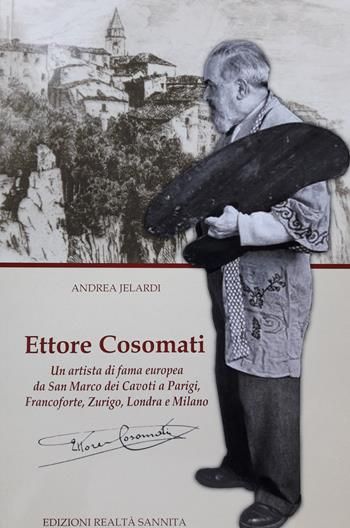
Painter and etcher Ettore Cosomati was born on 24 December 1873 in Naples, Italy, to Sabino Cosomati and Maria Illuminata Borrillo. He spent his early childhood in the rural hill town of San Marco dei Cavoti in the province of Benevento, where his father ran a grocery business, and where he first developed a lasting sensibility for the natural landscape. Orphaned by the age of ten, he was taken in by his paternal uncle, Filippo Cosomati, a chemist, in Naples, where he qualified in accounting and commerce at the Istituto Tecnico e Nautico di Napoli and taught mathematics at the city's international lyceum for two years. In 1894 he began a series of European travels, settling in Frankfurt am Main in Germany in 1895, where he presented pen drawings at the Schneider Gallery and came to the attention of the etcher and painter Karl Julius Bernhard Mannfeld. Under Mannfeld's instruction he mastered the technique of etching. He also encountered the painter Hans Thoma, several of whose canvases he reproduced as etchings, and also became associated with the Frankfurt Secession. He married Ida Forcellini; they had two sons, Mario De Luca and Aldo. After exhibiting his works in London, England, Cosomati settled there in 1922. Cosomati remained in London until after the outbreak of the Second World War in 1939, where he settled in Milan in 1940.
Cosomati worked primarily in etching during his Frankfurt years, his first tempera paintings dating to around 1909 and his first oils to 1912. However, he became known, above all, as a landscape painter who worked exclusively with a palette knife, which lent his canvases a distinctly impastoed, sculptural surface; he was consequently described as the painter 'without a brush'. His preferred subjects included Alpine landscapes, particularly the Engadine valley in Switzerland, the Lombardy lakes in Italy, and urban views of London. Notable works from his London years include Regent's Park (1934) and Porto di Londra (1936). The critic Vittorio Costantini observed that whereas Cosomati's earlier Milan canvases displayed sharp contours and somewhat unnatural colour, his London garden paintings exhibited a 'fluid and limpid' integration of tones (Costantini, p. 353).
Between 1896 and 1914 he exhibited regularly at the International Exhibition at the Glaspalast in Munich, Germany, also receiving a bronze medal at the St Louis World's Fair, USA in 1904, a diploma of honour at the Milan Simplon Tunnel Exhibition in 1906, and a gold medal at the International Exhibition in Barcelona in 1911. In 1921 he had held an exhibition of paintings at the Small Aeolian Hall in London's West End; a poster for the exhibition, designed by his son Aldo, is held in the Victoria and Albert Museum. In 1923 he held his first Milan solo exhibition at Bottega di Poesia and participated in the II Roman Biennale with 20 paintings. That same year the Futurist painter Carlo Carrà published a monograph on his work. Writing in Emporium in July 1925, the critic Piero Torriano characterised Cosomati's fundamental aim as 'to preserve a maximum of light together with a maximum of volume', and noted that he 'does not paint sensations but objects', imposing on the transience of appearances a broader vision, orientated towards the underlying structure of things (Torriano, pp. 3-16). In 1925 he co-organised with his son Aldo the English section of the Monza Biennale.
Cosomati also participated in the annual exhibitions of the Hampstead Society of Artists, showing Ken Wood [sic] in 1933. In 1934 he was invited to the XIX Venice Biennale, exhibiting Inverno a Zurigo and Bianco e nero, and in 1939 held a solo exhibition at the Galleria Neupert in Zurich. He settled in Milan in 1940, holding a solo exhibition of 41 oil paintings and 10 woodcuts at the Galleria di Roma. In parallel with his painting, Cosomati maintained a prolific career as a printmaker, wood engraver, illustrator and art journalist. From 1924 to 1932 he contributed a London art chronicle to the Italian journal, Le Arti Plastiche, and from 1931 he also wrote criticism for L'Ambrosiano and Il Mattino.
Ettore Cosomati died in Milan, Italy on 14 February 1960, having collapsed on the eve of the inauguration of his retrospective at the Palazzo Reale. In the UK public domain his work is represented in the collection of the British Museum, London.
The Ben Uri Research Unit welcomes contributions from researchers or family members who may have further biographical information.
Michal Mel
Related books
- Alessandro Bosco, 'Arte e propaganda', in Alessandro Bosco, et. al. eds., S/confinare: I rapporti culturali italo-svizzeri tra associazionismo, editoria e propaganda (1935-1965) (Bern: Peter Lang, 2024), pp. 130-132
- Alessandra Uguccioni, 'Cosomati, Ettore', in Dizionario Biografico degli Italiani, vol. XXX (Rome: Istituto della Enciclopedia Italiana, 1984)
- Civico Museo d’Arte Contemporanea, Ettore Cosomati (Milan: Civico Museo d’Arte Contemporanea, 1960)
- Ettore Cosomati and Palazzo Reale di Milano, Mostra di Ettore Cosomati: Milano, Palazzo Reale, Sala delle Cariatidi, Febbraio 1960 (Milan: Alfieri & Lacroix, 1960)
- Galerie Neupert, Werke von Ettore Cosomati (Zürich: Galerie Neupert, 1947)
- Renato Simoni and Ettore Cosomati, Cina e Giappone: Illustr. di Ettore Cosomati (Milan: Istituto per gli Studi di Politica Internazionale, 1942)
- Ettore Cosomati et al., XXXVII Mostra della Galleria di Roma con opere del pittore Ettore Cosomati, incisioni e disegni di Lorenzo d’Ardia Caracciolo e sculture di Aurelio de Felice: Novembre-Dicembre 1940-XIX (Rome: Istituto Grafico Tiberino, 1940)
- Ettore Cosomati and Galerie Neupert, Esposizione dipinti di Ettore Cosomati: Galleria Neupert, Zürich, Marzo-Aprile 1939 Ausstellung Werke von Ettore Cosomati (Zürich: Galerie Neupert, 1939)
- 'Hampstead Society of Artists Annual Exhibition', Hampstead and St. John's Wood Advertiser, 30 May 1935, p. 3
- Vittorio Costantini, La pittura italiana contemporanea (Milan, 1934)
- Bucci Anselmo and Ettore Cosomati, Esposizione del pittore Ettore Cosomati: Galleria Pesaro, Milano, 29 Dicembre 1933-10 Gennaio 1934 (Milan: Bestetti, 1933)
- 'Hampstead Society of Artists Annual Exhibition', Hampstead News, 22 June 1933, p. 5
- Esposizione delle opere dei pittori Cosomati Ettore, Feltrinelli Antonio, Zandomeneghi Federico e dello scultore Amman Mario, Esposizione delle opere dei pittori Cosomati Ettore, Feltrinelli Antonio, Zandomeneghi Federico e dello scultore Amman Mario: Galleria Pesaro, Milano, Dicembre 1930 (Milan: Casa Editrice d’Arte Bestetti e Tumminelli, 1930)
- Ettore Cosomati, La Calabria (Milan: Fratelli Treves, 1928)
- Piero Torriano, 'Artisti contemporanei: Ettore Cosomati', Emporium, Vol. LXII, No. 367, 1925, pp. 3-16
- Giulio Caprin and Ettore Cosomati, Ettore Cosomati: I laghi lombardi (Milan: Bottega di Poesia, 1924)
- Carlo Carrà and Ettore Cosomati, Ettore Cosomati: Con 33 riproduzioni di quadri acqueforti e silografie (Milan: Bottega di Poesia, 1923)
- 'Art Exhibitions', The Times, 13 May 1921, Issue 42719, p. 8
Public collections
Related web links
- Contemporary Art Society biography
- Dizionario Biografico degli Italiani - Volume 30
- Emporium, July 1925
- V&A
Selected exhibitions
- Retrospective, Palazzo Reale, Sala delle Cariatidi, Milan, Italy (1960)
- Group exhibition, Galleria di Roma, Rome, Italy (1940)
- Solo exhibition, Galleria Neupert, Zurich, Switzerland (1947, 1939)
- XIX Esposizione Internazionale d'Arte, Biennale di Venezia, Venice, Italy (1934)
- Annual Exhibition, Hampstead Society of Artists, Hampstead Town Hall, London (1935, 1933)
- English section, II Biennale di Monza, Monza, Italy (1925)
- Esposizione del Pittore Ettore Cosomati, Galleria Pesaro, Milan (1934, 1933, 1930, 1926, 1924, 1923)
- Solo exhibition, Bottega di Poesia, Milan, Italy (1923)
- II Biennale di Roma, Rome, Italy (1923)
- Paintings by Ettore Cosomati, Small Aeolian Hall, London (1921)
- International Exhibition, Glaspalast, Munich, Germany (between 1896-1914)
- International Exhibition, Barcelona, Spain (1911)
- St Louis World's Fair, St Louis, USA (1904)
Ben Uri archive
Consult items in the Ben Uri archive related to [Ettore Cosomati ]
Ben Uri library
Publications related to [Ettore Cosomati ] in the Ben Uri Library