Born: 1988 Bohar, East Bengal (now Bangladesh)
Died: Scotland
Year of Migration to the UK: 1904
Other name/s: Fanindranath Bose
Biography
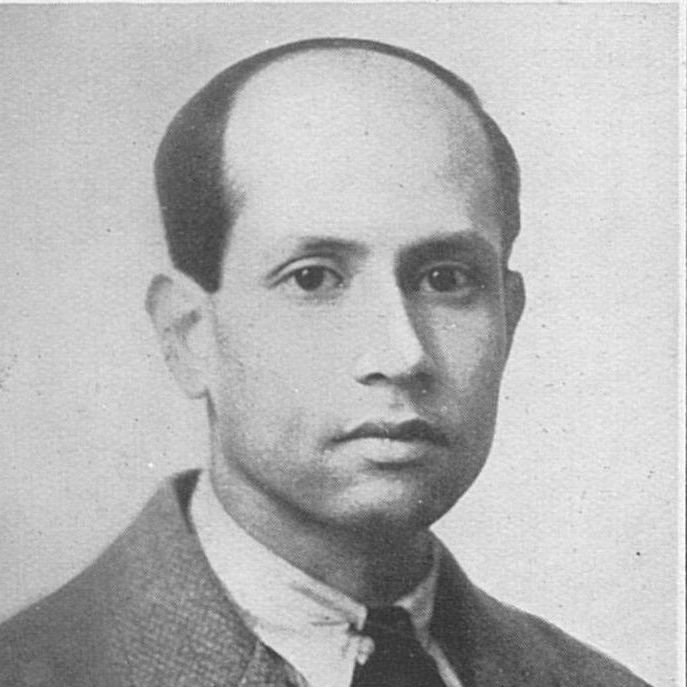
Sculptor Fanindra Bose was born in Bohar, East Bengal, British India (now Bangladesh) on 2 March 1888. He showed an early aptitude for art and received his first training in Calcutta (now Kolkata), attending the private Jubilee Art Academy and the Government School of Art. In 1904, aged sixteen, he left India, intending to continue his artistic education in Europe. After unsuccessful attempts to gain admission to an Italian academy and the Royal College of Art in London, he settled in Edinburgh, Scotland. In 1905 he entered Edinburgh School of Art, and the following year joined the Royal Scottish Academy (RSA) Life School. In 1907 he was joint winner of the RSA’s Stuart Prize for figure drawing, while in 1908 he received a silver medal in the National Art Examinations. That year he joined the first cohort of the newly opened Edinburgh College of Art (ECA), studying sculpture under Percy Portsmouth. Portsmouth later remembered Bose as an ‘exquisite craftsman’ distinguished by his remarkable control of minute detail (Royal Scottish Academy).
Bose graduated with a Diploma in Sculpture in 1911 and received a travelling scholarship, which enabled him to spend a year studying in France and Italy. He was in Paris by September of that year and subsequently visited Versailles, Rome, Florence and Naples. His surviving sketchbooks record his close observation of classical and medieval sculpture, seventeenth-century statuary at Versailles, and works by Jean-Baptiste Carpeaux and Auguste Rodin, alongside detailed architectural and animal studies. He also appears to have attended life classes at Antoine Bourdelle’s Académie de la Grande Chaumière. Bose later stated that he met Rodin in Paris and that the French sculptor took considerable interest in his work; a later account in The Scotsman added that Rodin set him exercises and criticised the results, although no documentary evidence of their contact has been located in the Musée Rodin archives (The Scotsman 1927, p. 7; Royal Scottish Academy). The influence of Rodin’s textured surfaces and concern with movement, together with that of Marius-Jean-Antonin Mercié, is nevertheless evident in Bose’s bronzes, and his work has subsequently been associated with the British ‘New Sculpture’ movement.
Returning to Edinburgh, Bose established himself professionally and exhibited regularly at the RSA, Royal Glasgow Institute and Society of Scottish Artists. He also showed at the Royal Academy of Arts in London (RA). His RSA debut came in 1913, while Boy in Pain was shown at the RA in 1914 and The Hunter in 1916. Both were acquired by the prominent sculptor Sir William Goscombe John and later entered the collection of the National Museum of Wales. By 1916 Bose had established his own studio in Edinburgh.
Bose also maintained important professional connections with India. In 1915 he was appointed sculptor to Sayajirao Gaekwad III, Maharaja of Baroda, who commissioned eight bronze figures of historical figures for the gardens of the Laxmi Vilas Palace and two statuettes for the Baroda Art Gallery. During a visit to Baroda Bose taught briefly at the Fine Arts Faculty of Baroda College and advised the Gaekwad on plans to develop bronze casting at the technical schools. As suitable foundry facilities were unavailable locally, he returned to Edinburgh to complete the commissions. He continued his association with Baroda and, in November 1925, was among those who accompanied the Maharaja to Laxmi Vilas Palace on his return to the city.
Contemporary criticism frequently considered the relationship between Bose’s European training and his Indian identity. In 1920 St Nihal Singh described his work as combining Western influences with an essentially Indian artistic impulse, while a critic writing in the Modern Review the following year argued that Bose’s work did not sufficiently express an Indian artistic identity, questioning the effects of prolonged European training on Indian artists (Singh 1920, p. 20; Bhushan and Garfield, 2011).
Bose's major Scottish public works include First World War memorial commissions. For the Ormiston War Memorial in East Lothian he produced the bronze figure Sacrifice of Youth, a nude male figure whose pose recalls Rodin’s Age of Bronze. His life-size bronze St John the Baptist forms part of the war memorial shrine at St John’s Church, Perth, created during a restoration overseen by architect Sir Robert Lorimer. Installed shortly after Bose’s death, its textured surface reflects the influence of Rodin.
In 1925 Bose was elected an Associate of the RSA by 31 votes to eight, becoming the first Asian artist elected to the institution and, according to contemporary accounts, the first Indian sculptor to receive official recognition in Great Britain (The Scotsman 1927, p. 7). Responding to the honour during a period of strained Anglo-Indian relations, Bose expressed the hope that his election would reassure Indians that Scotland did not wish to obstruct their legitimate aspirations (Mitter 1994, p. 118). His career was still advancing when he suffered a fatal cardiac arrest while on a fishing holiday near Peebles in Scotland on 1 August 1926. In the UK public domain, Bose’s work is represented in the collections of Amgueddfa Cymru – Museum Wales, Cardiff, and the Royal Scottish Academy, Edinburgh.
Irene Iacono
Related books
- Amy Harris, Forming a National Collection: Sculpture in the Chantrey Bequest, 1875–1917, PhD thesis, University of York, 2018, pp. 159-163
- Priya Maholay-Jaradi, ‘Collecting the High Arts’, in Fashioning a National Art: Baroda's Royal Collection and Art Institutions (1875–1924) (Oxford: Oxford University Press, 2016)
- ‘Down Memory Lane’, East Lothian Courier, 17 December 2015, p. 30
- ‘Two Specimens of Art-Appreciation’, in Nalini Bhushan and Jay L. Garfield eds., Indian Philosophy in English. From Renaissance to Independence (Oxford: Oxford University Press, 2011)
- Lala Rukh Selim, ‘Sculpture: Colonial to Contemporary Period’, Art and Crafts, Cultural Survey of Bangladesh, Vol. 8, Asiatic Society of Bangladesh, 2007, p.125
- Partha Mitter, Art and Nationalism in Colonial India, 1850–1922 (Cambridge: Cambridge University Press, 1994)
- ‘Perthshire War Memorial’, The Times, 5 November 1928, p. 11
- ‘Perthshire’s Fallen’, Perthshire Advertiser, 31 October 1928, p. 13
- ‘St John’s Church, Perth: A Notable War Memorial’, The Scotsman, 21 January 1928, p. 16
- ‘Royal Scottish Academy’, The Scotsman, 10 March 1927, p. 7
- ‘Perth Church Restoration’, Dundee Courier, 21 September 1926, p. 11
- ‘Designer of St. John’s Shrine’, Perthshire Advertiser, 7 August 1926, p. 12
- ‘News in Brief’, The Times, 7 August 1926, p. 13
- ‘Edinburgh Artist’s Funeral’, Edinburgh Evening News, 5 August 1926, p. 6
- ‘The Maharaja Gaekwar’, Times of India, 23 November 1925, p. 10
- ‘New Academy Associates’, Civil & Military Gazette, 16 April 1925, p. 10
- ‘An Indian A.R.S.A.’, Daily Mirror, 26 March 1925, p. 9
- Agastya Ordhendra Coomar Gangoly, ‘The Art of a Bengali Sculptor’, The Modern Review, May 1921, pp. 650–652
- St. Nihal Singh, ‘A Bengali Sculptor Trained in Europe’, The Graphic, 1 May 1920, p. 20
Related organisations
- Baroda College, India (teacher)
- Edinburgh College of Art (student)
- Edinburgh School of Art (student)
- Government School of Art, Calcutta (student)
- Jubilee Art Academy, Calcutta (student)
- Royal Scottish Academy Life School, Edinburgh (student)
Related web links
- ‘A Memorial for Fanindra Nath Bose’, Royal Scottish Academy
- Boy in Pain, Amgueddfa Cymru – Museum Wales
- ‘Fanindranath Bose’, Making Britain. Discover How South Asians Shaped the Nation database, 1870-1950, retrieved via The Wayback Machine
- 'Fanindra Nath Bose ARSA', Mapping the Practice and Profession of Sculpture in Britain and Ireland 1851-1951, University of Glasgow History of Art and HATII
- Natasha Ruwona, ‘Fanindra Nath Bose’, Edinburgh University, 24 June 2024
- Royal Academy exhibition catalogues
- South Asian Britain database
- The Royal Scottish Academy, 1826-1916
Selected exhibitions
- Royal Scottish Academy, Edinburgh, Scotland (1927, 1926, 1925)
- Society of Eight, Edinburgh, Scotland (1925)
- Royal Academy of Arts, Burlington House, London (1924)
- Royal Scottish Academy, Edinburgh, Scotland (1924, 1923)
- Glasgow Society of Painters and Sculptors, McLellan Galleries, Glasgow, Scotland (1923)
- Laing Art Gallery and Museum, Newcastle upon Tyne (1923)
- Royal Scottish Academy, Edinburgh, Scotland (1922)
- Royal Academy of Arts, Burlington House, London (1919)
- Royal Glasgow Institute of the Fine Arts, Glasgow, Scotland (1918)
- Royal Scottish Academy, Edinburgh, Scotland (1918)
- Royal Glasgow Institute of the Fine Arts, Glasgow, Scotland (1916)
- Royal Academy of Arts, Burlington House, London (1916)
- Royal Scottish Academy, Edinburgh, Scotland (1915)
- Royal Academy of Arts, Burlington House, London (1914)
- Royal Scottish Academy, Edinburgh, Scotland (1913)
Ben Uri archive
Consult items in the Ben Uri archive related to [Fanindra Bose ]
Ben Uri library
Publications related to [Fanindra Bose ] in the Ben Uri Library