Born: 1912 Budapest, Austria-Hungary (now Hungary)
Died: 1996 Bury St Edmunds, England
Other name/s: George Fejér
Biography
Designer George Fejer was born into a Jewish family in Budapest, Austria-Hungary (now Hungary) in 1912. He trained as an architect at the Eidgenössische Technische Hochschule (ETH) in Zürich from 1931, studying under Otto Rudolf Salvisberg and William Dunkel. Following his studies, he pursued postgraduate research, submitting a thesis on thermal insulation in translucent constructions and beginning early work on plastics. In the late 1930s he worked in Hungary with architect, Lajos Kozma and also assisted his father, Alexander Fejér, in his Budapest antiques and interior-design business, including redesigning the shop stationery.
In 1939, in the face of rising danger for Jews in Hungary, Fejér left first for Zürich, Switzerland, and then for England. He never saw his parents again; his mother died during the war and his father died in a concentration camp (correspondence with Juli Fejer). Fejér’s first British work built directly on his Zürich research. Continuing experiments with translucent constructions, he developed a new translucent sheet material he called ‘Iso-lumen’ and demonstrated it to the Ministry of Aircraft Production after arriving in England. In 1940 Iso-lumen was manufactured by Pharoah-Gane & Co. Ltd., which employed him as a consultant; the material was used for repairing bomb damage. Production ended when the factory itself was bombed, and Fejér redirected his technical knowledge toward industrial and interior design, while writing articles—especially on plastics and design—for specialist journals. From 1943–47 he worked with the Selection Engineering Company on huts for the armed forces and on prefabricated buildings, notably the Uni-Seco prefab, part of Britain’s emergency response to wartime bombing and a severe housing shortage. Uni-Seco’s system used a timber frame with asbestos cement, and plywood elements for floors and components. A drawing by Fejér for Uni-Seco (dyeline with coloured chalks and ink (1945), V&A), imagines a prosperous postwar life with moulded plywood furniture and presents prefabrication as a modern, aspirational solution to crisis housing (V&A entry). One of his most influential contributions was the ‘Selection System’, which he developed from 1944 onward, launched in 1946 and shown at the Britain Can Make It exhibition at the V&A in the same year. It was described as among the first—possibly the first—large-scale modular, flat-pack system designed with enough flexibility for ordinary domestic living and functional spaces (Richard Crisp obituary). By October 1946 he had become a naturalised British subject, and in 1947 he joined the Society of Industrial Artists and Designers, later becoming a fellow (FSIAD) and also a Fellow of the Royal Society of Arts (FRSA).
Fejer’s post-war practice ranged widely across products and interiors, but he became especially associated with fitted kitchens and mass-market domestic systems. He worked for Venesta (a plywood manufacturer) from 1946–49, and designed the Plastics, Rubber and Commerce sections for the Power and Production pavilion on the South Bank at the 1951 Festival of Britain. By 1953 he was appointed consultant designer to Hygena, the Liverpool-based kitchen manufacturers, where his modular approach helped define British fitted kitchens. By the late 1950s, Fejer helped transition the designs from metal carcasses (a result of wartime surpluses) to wooden carcasses with plastic or wood facings. Hygena’s best-known Fejer ranges were repeatedly presented as milestones. The Hygena System 70, launched in the early 1960s, was praised for bringing ergonomics, hygiene and aesthetics into the mass market; it became highly visible at the Daily Mail Ideal Home Exhibition, where critics noted its streamlined, ‘expensive and beautiful’ presence (The Observer 1965, p. 29). In parallel, Fejer became consultant designer to Guy Rogers Ltd. in 1955, working with the resident designer Eric Pamphilon and a studio team that included assistant Frank Watkins and textile consultant, fellow refugee, Margaret Leischner. In interviews he argued that furniture was increasingly ‘a product of light engineering’, requiring the designer to coordinate engineers and specialists (Hodgson 1965, p. 10).
Fejer also pursued forward-looking systems design. In 1968, at the Ideal Home Exhibition, he and Watkins presented a speculative ‘power pack’ concept —a pre-packaged kitchen/bathroom/services core envisioned as a central ‘engine room’ for future housing. The project captured his persistent interest in integrating components and improving everyday life through ergonomics and practical coordination. Across his career he designed a wide range of domestic products, including the Hotpoint ‘Ice Diamond’ refrigerator, Crown Merton cookware, Leisure sinks (including a triple sink), Aqualon modular bathrooms, and kitchen ranges for British Steel. He was also publicly active in design education and debate, speaking at the Council of Industrial Design’s Designers at Work exhibition in London in 1956 and later participating in a 1972 conference at the London College of Furniture to establish formal training in toy design. Fejer lived for many years in Wimbledon, later working from a home in Suffolk. George Fejer died at his home in Bury St Edmunds, Suffolk, England on 9 January 1996. His work is represented in the UK public domain in the collection of the V&A, Lodon. In 2012 his work was featured in British Design 1948–2012: Innovation in the Modern Age, and in 2017 his Uni-Seco interior design drawing was shown in Plywood: Material of the Modern World, both held at the Victoria and Albert Museum.
Irene Iacono
Related books
- Anne Massey, ‘Mass Production’, in Joanna Banham ed., Encyclopedia of Interior Design (London: Fitzroy Dearborn, 1997), pp. 1682-1683
- ‘George Fejér’, The Daily Telegraph, 5 February 1996, p. 21
- ‘A Few Home Comforts’, ‘Liz Knight’, Wolverhampton Express and Star, 22 November 1975, p. 31
- ‘Seven Miles’, The Guardian Journal, 4 November 1968, p. 6
- ‘For 1980’s—A ‘Power Pack’ Kitchen and Bathroom’, Southern Daily Echo, 25 November 1968, p. 7
- ‘The Power Pack Kitchen By Priscilla Hodgson… At the Ideal Home Exhibition’, The Birmingham Post, 05 March 1968, p. 10
- Priscilla Hodgson, ‘Now Furniture is Becoming a Product of Engineering’, Daily Post,10 September 1965, p. 10
- ‘In Search of the Ideal’, The Observer, 7 March 1965, p. 29
- ‘Clues to a Kitchen, The Tatler and Bystander, 7 March 1962, p. 48
- Dilys Rowe, ‘Furniture for a Family-Life Cycle’, The Observer, 28 January, 1962, p. 34
- ‘Designers' Growing Role in Industry’, Times, 11 September 1956, p. 10
Related organisations
- Eidgenössische Technische Hochschule, Zürich (student)
- Royal Society of Arts (Fellow)
- Society of Industrial Artists and Designers (Fellow)
Related web links
- ‘Death of Industry Design Guru’, in Juli Feier Website
- ‘Fejér, George 1912 – 1996’, Biographical Dictionary of British and Irish Architects 1800-1950
- 'Manhattan' Lounge Chair’, Lawson Park Collection
- Richard Crisp, obituary for Kitchens & Bathrooms Magazine, digital copy in Juli Feier Website
- ‘The Fejers’, Juli Feier Website
Selected exhibitions
- Plywood: Material of the Modern World, Victoria & Albert Museum, London (2017)
- British Design 1948-2012: Innovation in the Modern Age, Victoria & Albert Museum, London (2012)
- Daily Mail Ideal Home Exhibition, London (1965)
- Daily Express Brighter Home Exhibition, City Hall, Manchester (1961)
- Festival of Britain, South Bank, London (1951)
- Britain Can Make It, Victoria & Albert Museum, London (1946)
- Designers at Work, Design Centre, 28 Haymarket, London (1956)
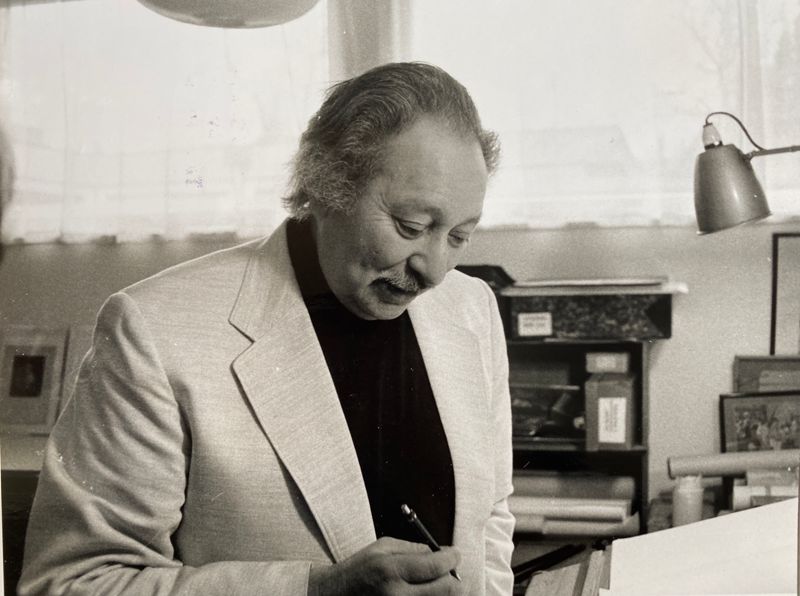
Ben Uri archive
Consult items in the Ben Uri archive related to [George Fejer]
Ben Uri library
Publications related to [George Fejer] in the Ben Uri Library