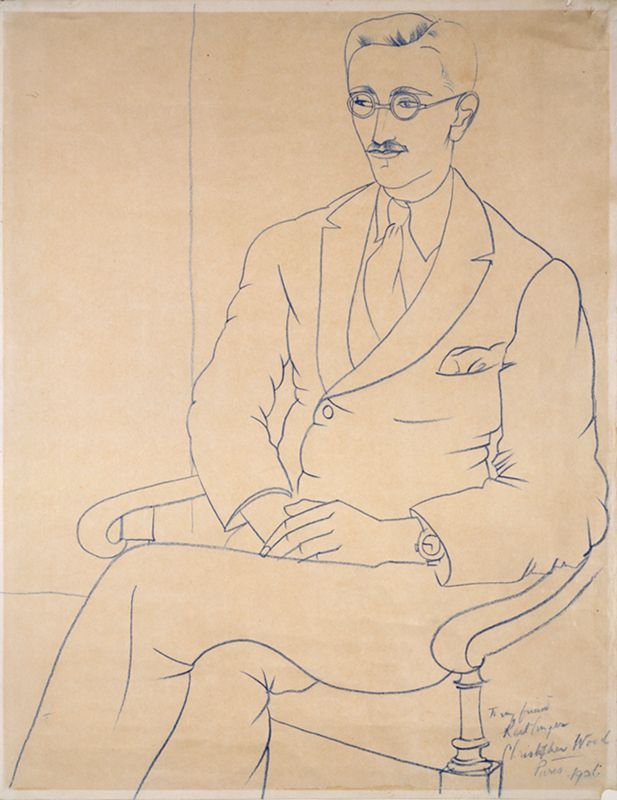
Born: 1900 London, England
Died: 1978 St. Leonards, England
Biography
Art historian, collector, writer and artist Gerald Reitlinger was born into a family with Jewish roots, on 2 March 1900, in London, England, to a German father and Austrian mother. He was educated at Westminster School, before attending Christ Church, University of Oxford, where he initially developed an interest in archaeology and cultural studies, under the influence of Edward Thurlow Leeds of the Ashmolean Museum. Aiming to establish himself as an artist, he subsequently studied at the Slade School of Fine Art and Westminster Art School in the 1920s and early 1930s. Early on, Reitlinger's solo exhibition at the Independent Gallery in 1925 showcased his unique approach to colour, particularly in his depictions of the tropics and French landscapes. His work, praised for its vivid use of colour and careful composition, also included The House among the Plantains and Saint Lambert en Chevreuse, which highlighted his ability to bring out the vibrancy of secondary hues through contrast (Times 1925). Reitlinger continued to exhibit throughout his career, including a notable solo exhibition at the Cooling Galleries in 1934. In 1937, he also participated in the Annual Exhibition of Works by Jewish Artists held at the Ben Uri Gallery. Additionally, in 1933 he contributed a landscape painting to the Tel Aviv Museum through the British Committee for the Tel Aviv Museum, reflecting his involvement in the broader Jewish art community.
In addition to his career as an artist, Reitlinger pursued writing and editing. From 1927–29, he edited the art journal Drawing and Design. His writing extended beyond the art world, including several travel-based texts, such as A Tower of Skulls (1932), recounting his experiences in Armenia and the Middle East, and South of the Clouds (1939), based on his travels in China's Yunnan province. Reitlinger also had a keen interest in archaeology, participating in two significant excavations. In 1930–1931, he joined a Field Museum (Chicago)-sponsored excavation at Kish in Iraq, and in 1932, he co-directed an Oxford-funded excavation at Hira with David Talbot Rice. His archaeological activities influenced his later passion for collecting, leading him to acquire a substantial collection of Syrian and Persian pottery from the Timurid, Iznik, and Safavid periods.
Reitlinger briefly served in the Middlesex Regiment during the First World War and returned to military service in the Second World War in a gunnery battery, lecturing troops before being discharged due to ill health. Postwar, he contributed articles on art and antiques to journals and newspapers. and graduually turned his focus to the impact of Nazi Germany and the Holocaust, authoring The Final Solution (1953) and The SS: Alibi of a Nation (1956). He continued his research on art and the history of taste, leading to the publication of The Economics of Taste between 1961 and 1970. This three-volume work examined the art market from the mid-eighteenth century to the 1960s, analysing the rise and fall of art prices and critiquing the modern art market's dependency on the inflated reputations of individual artists. Though Reitlinger was not a formally trained economist or art historian, his writings significantly impacted the field of art market analysis, earning him the reputation as a ‘father figure’ of art market studies. His analysis was less about precise market data and more a critique of the commodification of art, attributing the decline in taste to factors like wealth redistribution and the inflated prominence of individual artistic personalities. The books aroused mixed criticism, with some reviewers appreciating Reitlinger's scepticism, detailed anecdotes, and insightful analysis of the art market, while others criticised the inaccuracies, occasional flippant tone, and lack of scholarly rigour, which undermined the credibility of his work (Roberts 1971; Sutton 1962).
In addition to his writings, Reitlinger was an avid collector of Asian and Islamic ceramics. He collected both Islamic, Japanese and Chinese pieces, with a particular focus on Kakiemon-style Japanese porcelain and 17th-century Chinese ‘transitional’ porcelain. He also acquired European ceramics with Asian influences. Reitlinger housed and curated the collection in his home in Beckley, Sussex, where he personally handled its conservation and display. His collection was one of the most remarkable assemblies of Oriental and Islamic ceramics, which he cautiously built over 50 years. He also acquired Persian and Mughal paintings, medieval Syrian wares, and German stoneware. Unfortunately, his collection suffered a fire shortly before his death, though much of it was saved due to the skill of the firemen. Reitlinger donated his collection to the Ashmolean Museum in Oxford, where it currently forms the Gerald Reitlinger Gallery.
Gerald Reitlinger died in St. Leonards, Sussex on 8 March 1978. Posthumously, in 1981, an exhibition of over 400 pieces from his collection of ceramics was held at the Ashmolean Museum in Oxford, which coincided with the publication of Eastern Ceramics and Other Works from the Collection of Gerald Reitlinger by Sotheby Parke Bernet. In the UK public domain, his collection of ceramics is held by the Ashmolean Museum,
Irene Iacono
Related books
- ‘Eastern Ceramics and Other Works of Art from the Collection of Gerald Reitlinger’ (Oxford: Ashmolean Museum, 1981)
- ‘Ceramics on Show’, Bookseller, 5 September 1981, p. 876
- Keith Roberts. ‘The Economics of Taste: Volume III: The Art Market in the 1960s by Gerald Reitlinger’, The Burlington Magazine, Vol. 113, No. 822, September 1971, pp. 555-556
- Denys Sutton, ‘The Economics of Taste. The Rise and Fall of Picture Prices 1760-1960 by Gerald Reitlinger’, The Burlington Magazine, Vol. 104, No. 715, October 1962, pp. 437-438
- Gerald Reitlinger, The Economics of Taste: The Rise and Fall of Pictures Prices 1760–1960 (London: Barrie and Rockliff, 1961)
- Gerald Reitlinger, 'Islamic Pottery from Kish', Ars Islamica, Vol. 2, No. 2, 1935, pp. 198-218 Paintings by Gerald Reitlinger (London: Cooling Galleries, 1934)
- ‘Seeing Persia in a Ford’, Daily News, 7 June 1932, p. 4
- ‘Art Exhibitions’, The Times, 4 February 1925, p. 12
- Gerald Reitlinger: Paintings of the Tropics and France, exhibition catalogue (London: Independent Gallery, 1925)
Public collections
Related organisations
- American School of Fine Arts (student)
- Christ Church, University of Oxford (student)
- Westminster School of Art (student)
Related web links
- Ben Uri archives
- Eastern Art online, Ashmolean
- Gerald Reitlinger, Ashmolean Museum
- Lee Sorensenm, ‘Reitlinger, Gerald’, Dictionary of Art Historians
- Oxford University Research Archive
- The Last Europeans
Selected exhibitions
- Annual Exhibition of Works by Jewish Artists, Ben Uri Gallery, London (1937)
- Solo exhibition, Cooling Galleries, London (1934)
- Paintings of the Tropics & France by Gerald Reitlinger, Independent Gallery, London (1925)