Born: 1928 Milan, Italy
Died: 2006 Sarzana, Italy
Year of Migration to the UK: 1950
Biography
Graphic designer and art director, Germano Facetti was born in Milan, Italy on 5 May 1926. As a teenager, he was arrested in 1943 for putting up anti-Fascist posters and deported to Mauthausen concentration camp in Austria as a forced labourer. After liberation by the Allies, he returned to Milan where he collaborated with communist organisations to re-establish schools. He later joined his former fellow inmate, Lodovico di Belgiojoso (1909–2004), a founding member of the Peressutti and Rogers (BBPR) architectural firm.
In 1950 he married British architect Mary Crittall (b. 1926), who also worked for BBPR, and moved to London, where he initially did odd jobs alongside design work. He subsequently took evening classes in typography at the Central School of Arts and Crafts (now Central School of Art and Design) and mixed with avant garde artists at Cafe Torino in Old Compton Street, Soho. He started working as an art editor and designer, including for Aldus Books, and contributed to the first exhibitions dedicated to Italian design at the Italian Institute in London. He worked with Theo Crosby (1925-1994) and Ed Wright (1912-1988) in 1956 on the entrance to the seminal exhibition This is Tomorrow at the Whitechapel Art Gallery, also designing the Poetry Bookshop in Soho and a stage set for Lindsay Anderson at the Royal Court Theatre. After a brief period in Paris, he was hired by Penguin Books in 1960, becoming art director in 1962. His significant contribution to the history of British graphic design was the gradual redesign of the entire identity of the publishing house. In particular, he was instrumental in redesigning the Penguin Classics imprint with an austere but distinguished black background. First introduced as a series in 1946, the Classics covers had used simple typography in centred capitals, punctuated in the middle with a specially commissioned illustration, usually a woodcut. In order to identify the book with its historical context, Facetti replaced commissioned graphics with images from the period of the book's first publication, while his proposal to use a black background was initially met with scepticism, if not disapproval, and he had to ask for an opportunity to demonstrate the effectiveness of his new design in selling books. He even wagered a magnum of Champagne on it, which he duly won, when a test display, which filled a window of Blackwell's bookshop in Oxford, resulted in an impressive increase in the shop's Classics sales (Eye Magazine). In 1961 Facetti invited émigré Polish designer, Romek Marber, and two other Penguin illustrators (John Sewell and Derek Birdsall) to propose a design grid for the crime imprint. The ‘Marber Grid’ was eventually chosen and became so successful that it was applied to Penguin’s entire fiction range and later, to all Penguin paperbacks.
Alongside his work at Penguin, which lasted until 1972, Facetti helped to establish the Designers and Art Directors Association (D&AD) to promote excellence in design and advertising, designing their first exhibition in London in 1963. Selected work was displayed on sheets of unpainted shuttering plywood, joined on a hexagonal grid, easy to dismantle for travelling. He also designed books for other publishers, including the influential Private View (1965). Combining Lord Snowdon's photographs of artists in their studios and Facetti's typography, this book ‘established a bold, new visual language’ (NP Gallery). Facetti also designed Cape Editions, a series of small, narrow-format paperbacks with typographic jackets, mainly translations (1967–71). He also re-designed two weekly magazines, New Society and New Scientist, in 1964 and 1965 respectively. In 1962 he appeared in the short science fiction film La Jetee. Facetti was one of the 22 signatories to the original ‘First Things First’ manifesto, published in 1964 in CND Journal, The Guardian, Design and Ark, advocating a return to a humanist aspect of design. In 1960 he became a naturalised British subject and in 1972 he left his post at Penguin and returned to Italy, where he worked as an editorial and design consultant.
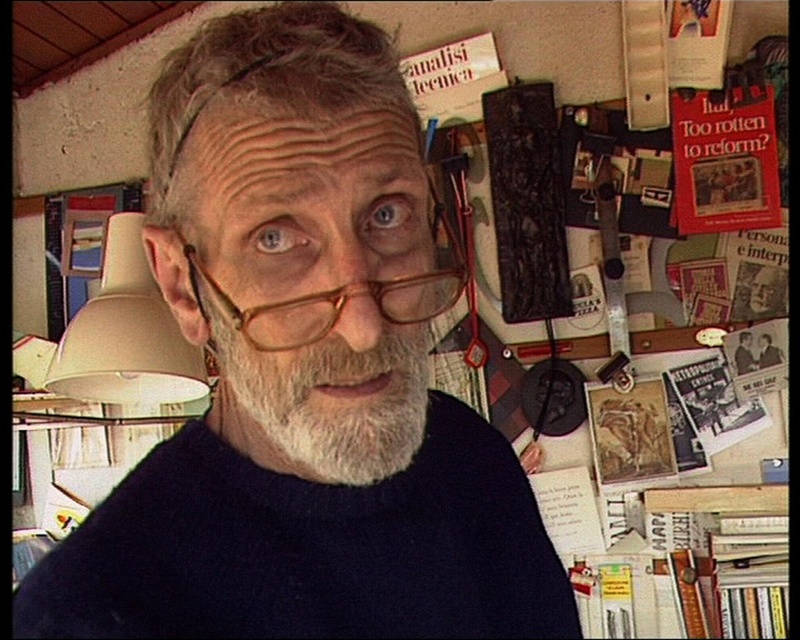
President of the Italian Graphic Design Archive (AGI) from 1967–69, Facetti taught at numerous art educational institutions, including Bath Academy, Chelsea College of Art, London College of Printing, and Yale University. Facetti's internment at Mauthausen inspired the 1998 documentary The Yellow Box: Short History of Hate by Anthony West, in which Facetti recalled his experience as a prisoner, commenting on drawings, pictures and documents he made and collected in camp. Germano Facetti died in Sarzana, Italy on 8 April 2006. His work is not currently represented in UK public collections. A conference on Facetti's life and career, including his experience in Mathausen, was held in the Museo Diffuso della Resistenza, della Deportazione, della Guerra, dei Diritti e della Libertà (Museum of the Resistance, Deportation, War, Rights and Freedom) in Turin, Italy in 2006.
Irene Iacono
Related books
- David Pearson, Steve Hare and Phil Baines, Penguin by Designers (London: Penguin Collectors' Society, 2007), pp. 29-48
- Robin Kinross, 'Émigré Graphic Designers in Britain: Around the Second World War and Afterwards', Journal of Design History, Vol. 3, No. 1, 1990, pp. 35-57
- Germano Facetti, Alan Fletcher and Drukkerij Reclame, Identity Kits a Pictorial Survey of Visual Signals (London: Studio Vista, 1971)
Related organisations
- Aldus Books (designer)
- Bath Academy (teacher)
- Central School of Arts and Crafts (student)
- Chelsea College of Art (teacher)
- Designers and Art Directors Association (founding member)
- London College of Printing (teacher)
- New Scientist (designer)
- New Society (art director)
- Penguin Books (art director)
- Yale University (teacher)
Related web links
- 'Germano Facetti, Cover Art Director for Penguin', The Independent, 15 April 2006
- Germano Facetti, Lux Arts Agency
- Germano Facetti's biography in Italian, Archivio Grafica Italiana
- Richard Hollis, 'The Image as Evidence', Eye Magazine
- Nazi persecution claim in the National Archives
- 'Nazi Slave Camp Survivor and Penguin Redesigner', Irish Times, 15 April 2006
- Paolo Gori on Germano Facetti
- Private View book, National Portrait Gallery
- Richard Hollis, 'Germano Facetti', The Guardian, 10 April 2006
- The First Things First Manifesto, Design History
Selected exhibitions
- Designers and Art Directors Association exhibition, London (1963)
- This is Tomorrow, Whitechapel Art Gallery, London (1956)
Ben Uri archive
Consult items in the Ben Uri archive related to [Germano Facetti]
Ben Uri library
Publications related to [Germano Facetti] in the Ben Uri Library