Born: 1967 Warsaw, Poland
Year of Migration to the UK: 1989
Other name/s: Małgorzata Macuga, Goshka Macuga RA
Biography
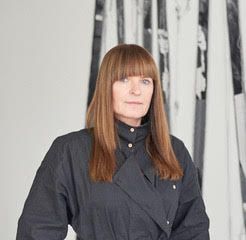
Interdisciplinary artist Goshka Macuga (nee Małgorzata Macuga) was born in Warsaw, Poland in 1967 and grew up in the Polish People's Republic, a communist state under Soviet influence. Her firsthand experience in postwar Poland uniquely positioned her to examine communism and the mechanisms by which political systems shape cultural life. She has lived in London since 1989, the year Poland's communist government collapsed, following the Round Table Agreement and the country's first partially free elections. She completed a BA (Hons) in Fine Art at Central Saint Martins College of Art and Design (1991-95) and an MA in Fine Arts at Goldsmiths, University of London (1994-96).
Macuga's practice is based on historical and archival research, which informs her installations, sculptures, tapestries and collages. As an artist she simultaneously assumes the roles of curator, historian and exhibition designer, questioning historiography, political structures and the pressing issues of our time. Her working method has been described as an 'archaeology of culture' (Krasoń, 2017): each project is preceded by intensive archival investigation, frequently connected to the specific institution for which the work is being created. Her engagement with the continuous recycling of images and accounts is a method inspired by art historian Aby Warburg, who juxtaposed thematically or aesthetically related images from different historical periods to create a visual continuum. Macuga has characterised her own role as that of curator, storyteller, archivist, designer, sociologist and photographer simultaneously (Krasoń, 2017). As a child of socialist Poland, her work has been said to combine a post-Warholian approach with the aesthetic inheritance of Warsaw Pact socialism. Her dual identity as a Polish émigré working in Britain informs her sustained interest in censorship, collective memory and the ways in which art is appropriated by political power.
Macuga's earlier solo exhibitions included presentations at Galeria Foksal, Warsaw, and Transmission Gallery, Glasgow, in 2002; Gasworks, London, in 2003; A Foundation, Liverpool, in 2006; and Kunsthalle Basel in 2008. She was one of the four nominees for the 2008 Turner Prize. The following year she received the inaugural Bloomberg Commission at the newly reopened Whitechapel Gallery, London, presenting The Nature of the Beast (2009-10). The installation responded to the Whitechapel's 1939 exhibition of Pablo Picasso's Guernica in support of the Republican forces in the Spanish Civil War; it incorporated a tapestry version of Picasso's painting, commissioned by Nelson Rockefeller, which had hung outside the Security Council chamber at the United Nations Headquarters in New York since the 1980s. Macuga conceived a unique venue for public gatherings in which local political groups, university classes and community organisations were invited to hold meetings around a central conference table, with the Guernica tapestry as backdrop. In 2011 she presented It Broke from Within at the Walker Art Center, Minneapolis, USA, investigating the institution's own cultural and political history through its archives. In 2013 she presented When Was Modernism at the Institute of International Visual Arts (InIva), London, an exhibition exploring the work and legacy of Indian philosopher and Nobel laureate, Rabindranath Tagore and his experimental school at Santiniketan, in which Macuga assumed the roles of curator, historian, archivist and researcher (Krasoń, 2017). The following year, Report from the Exhibition at Kate MacGarry, London (2014), recalled the work of Polish photographer, Eustachy Kossakowski, who in the 1960s had photographed works by Kazimir Malevich for a show at the Stedelijk Museum in Amsterdam (Krasoń, 2017). Macuga was included in dOCUMENTA (13) in 2012 in Kassel, Germany, and Kabul, Afghanistan, contributing a two-part photorealistic tapestry, Of what is, that it is; of what is not, that it is not, displayed simultaneously in both locations. In 2019 she was commissioned to make a large-scale tapestry for MoMA, New York, re-staging a well-known photograph of André Malraux taken in 1954, featuring images intrinsically linked to MoMA's history. In December 2023 Macuga was elected an Academician at the Royal Academy of Arts, London.
Macuga lives and works in London. Her work is held in public collections in the UK, including the Arts Council Collection, Government Art Collection, Tate Collection and the Contemporary Art Society, among others.
Michal Mel
Related books
- Marco Costantini et al., Times in Tapestry: Goshka Macuga, Grayson Perry, Mary Toms (Lausanne: mudac Fondation Toms Pauli, 2025)
- Goshka Macuga et al., Goshka Macuga: Stairway to Nowhere (Dortmund: Verlag Kettler, 2019)
- Goshka Macuga and Neues Museum, Goshka Macuga: Intellectual Co-Operation, ed. Eva Kraus (London: Koenig Books, 2018)
- Sylwia Krasoń, 'Exploring Polish Artists in the UK: The Portrait of Two Artists - Goshka Macuga and Alicja Patanowska', Zeszyty Naukowe PUNO, Seria trzecia, No. 5, 2017, pp. 287-292
- The Artist’s Museum, The Artist’s Museum (Boston and Munich: Institute of Contemporary Art and DelMonico Books, Prestel, 2016)
- 'Frieze Art Fair', The Times, 17 September 2016, p. 3
- Dieter Roelstraete, Goshka Macuga and Museum of Contemporary Art Chicago, Goshka Macuga: Exhibit, A (Chicago: Museum of Contemporary Art Chicago, 2013)
- Macuga, Goshka, Kirsty Ogg, and Whitechapel Art Gallery. Goshka Macuga : The Nature of the Beast (London: Whitechapel Gallery, 2010)
- Rachel Campbell-Johnston, 'Portrait of the artists, right now', The Times, 24 May 2010, p. 50
- Rachel Campbell-Johnston, 'A view from the gallery', The Times, 30 March 2009, pp. 13-14
Public collections
Related organisations
- Central Saint Martins College of Art and Design (student)
- Goldsmiths, University of London (student)
- Royal Academy of Arts (Academician)
Related web links
- Contemporary Lynx
- Culture.PL
- Kate MacGarry
- New Museum
- Royal Academy of Arts
- Tate, 'Goshka Macuga: Turner Prize Nominee 2008'
- Whitechapel Gallery
Selected exhibitions
- Tales & Tellers, presented by Miu Miu, Shanghai, China (2026)
- Remember Respond Resist, The Box, Plymouth, Devon (2025)
- Desperate men, men with broken teeth and broken minds and broken ways, Galleria Vistamare, Milan, Italy (2025)
- Born From Stone, Bloomberg Space, London Mithraeum, London (2024)
- When ice melts in a glass of water, Andrew Kreps Gallery, New York, USA (2024)
- In Flux, Fundació Antoni Tàpies, Barcelona, Spain (2022)
- Natural Transformation, Galerie Rudiger Schottle, Munich, Germany (2021)
- Exhibition M, commission for The Museum of Modern Art, New York, USA (2019)
- Goshka Macuga, Kate MacGarry, London (2005; 2012; 2019)
- What Was I ?, Prada Rong Zhai, Shanghai, China (2019)
- Goshka Macuga, Galerie Rüdiger Schöttle, Munich, Germany (2017)
- Goshka Macuga & Ahmet Ögüt Episode 2, Witte de With Center for Contemporary Art, Rotterdam, Netherlands (2017)
- To the Son of Man Who Ate the Scroll, Fondazione Prada, Milan, Italy (2016)
- Group Exhibition, Frieze London (Kate MacGarry, Stand A16), London (2016)
- Turner Prize 2008, Tate Britain, London (2008)
- Objects in Relation, Art Now, Tate Britain, London (2007)
- Sleep of Ulro, The Furnace Commission, A Foundation, Liverpool (2006)
- Kabinett der Abstrakten, Bloomberg Space, London (2003)
- Picture Room, Gasworks Gallery, London (2003)
- Friendship of the Peoples (with Declan Clarke), The Project, Dublin, Ireland (2002)
- Homeless Furniture, Transmission Gallery, Glasgow, Scotland (2002)
- Cave, Sali Gia, London (1999); Kunstakuten, Stockholm, Sweden (2000)
Ben Uri archive
Consult items in the Ben Uri archive related to [Goshka Macuga ]
Ben Uri library
Publications related to [Goshka Macuga ] in the Ben Uri Library