Born: 1898 Frankfurt, Germany
Died: 1998 Camden, London, England
Year of Migration to the UK: 1933
Biography
Artist Hans Feibusch was born into an assimilated Jewish family in Frankfurt, Germany, on 15 August 1898; his mother, Marianne (née Ickelheimer) was an amateur painter. During the First World War he served in the German army (1916–18), then briefly studied medicine before settling in Berlin in 1920 to study painting under Karl Hofer, winning the Prix de Rome. After a period in Italy he spent a year in Paris, studying with Otto Freisz and André Lhote and exhibiting at the Salon d’Automne and the Paris Indépendants. Back in Germany, he received the Prussian State Prize for Painting in 1930 for The Fishmonger, arousing Nazi antagonism. A member of the Frankfurter Künstlerbund, he enjoyed major civic commissions until Hitler’s accession to power and the introduction of anti-Semitic legislation. He ws then expelled from the orgnisation on racial grounds, forbidden to paint and his pictures were publicly burned. In 1933 he found refuge in London with his British fiancée, Sidonie Gestetner, from the noted Jewish Gestetner family.
In 1934 Feibusch exhibited with other Jewish artists at Ben Uri Gallery, London, and in the Exhibition of German-Jewish Artists at the Parsons Gallery, organised by German-Jewish émigré dealer Carl Braunschweig (later Charles Brunswick) to highlight artists persecuted under the Nazi regime. To help fund his first solo show at the Lefevre Galleries in Mayfair (1938) he undertook poster designs and book illustrations; the exhibition, which included biblical subjects, genre scenes and landscapes, prompted Jan Gordon to note that ‘Life almost overwhelms one from his exuberant canvases, and his figures are infused with a titanic energy’ (The Observer, 1934, p. 16). In November he was invited to join the progressive London Group, exhibiting annually until 1939, and also showed with the left-wing Artists’ International Association (AIA) in Artists against Fascism and War (1935). That year he settled at Landseer Studios, Cunningham Place, St John’s Wood (his base until 1998), and was commissioned to decorate Edwin Maxwell’s modernist Sun House in Hampstead. In 1937, in his absence, his work was included in the infamous Degenerate Art exhibition in Munich and, in 1938, in the Burlington Galleries’ Exhibition of Twentieth Century German Art in London, a riposte to the Nazi show; he was granted British citizenship the same year. During the war he worked as a firewatcher and first-aider and exhibited in the AIA For Liberty exhibition (1943), at Victor Waddington Galleries, Dublin (1944), and at the Royal Academy (from 1944).
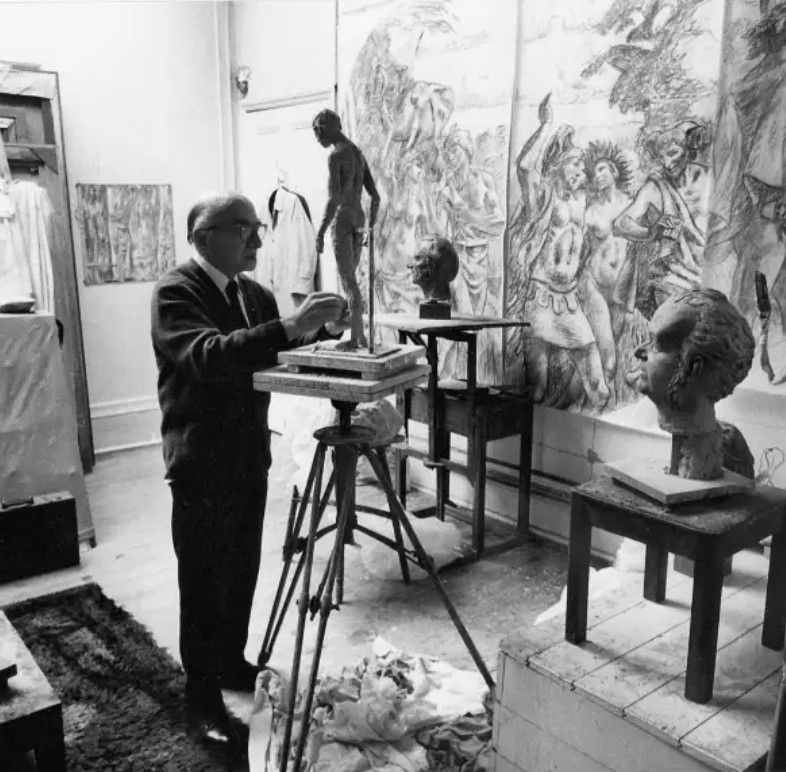
Following a commission from Edward D. Mills in 1937 to create his first public mural, The Footwashing, at the Methodist Chapel, Colliers Wood, south London, Feibusch was championed by Dr. George Bell, Bishop of Chichester, undertaking work for some 35 Anglican churches and cathedrals in all, including a chapel in Brighton and Chichester Cathedral, while his many London commissions included murals for St Ethelburga, Bishopsgate; Saint Vedast, Foster Lane; and the Church of St John the Evangelist, Waterloo. In 1946 he published a book on Mural Painting (A&C Black) and colour lithographs on The Revelation of St John the Divine (Collins), admired for their ‘pagan, folklore quality’ (The Irish Times 1946, p. 6). Following the death of his wife in 1963, Feibusch converted to Christianity in 1965, worshipping at St Alban the Martyr in London, which houses his largest religious mural, Trinity in Glory (1966), and 14 Stations of the Cross; he later produced a bronze figure of Christ for the exterior. He also produced a series of five Old Testament oil paintings, commissioned by Rabbi Hugo Gryn for the West London Synagogue (1973, acquired for Ben Uri Collection in 2012, now on loan to St. Bonifatius, London). Feibusch’s secular commissions included 12 large panels for Newport Civic Centre (almost certainly his largest mural) and a large painting for Dudley's municipal concert hall (1948). From 1950, he showed regularly at the Society of Mural Painters’ exhibitions and his ceiling panel cartoon for Hampstead Town Hall featured in the exhibition Six Places in Search of an Artist organised by the Hampstead Artists’ Council in the same year. In 1951 he participated in the Festival of Britain as both painter and muralist. Postwar he served on the arts committee at Ben Uri, where he also held solo shows in 1970 and 1977 - the latter included sculpture, which he took up after his eyesight began to fail in the early 1970s.
In 1967 he was awarded the Officer's Cross of the Order of Merit of the Federal Republic of Germany (advanced to Commander's Cross or Great Cross of Merit in 1989). Hans Feibusch died in London, England on 19 December 1998, having reverted to Judaism in 1992, and was buried at Golders Green Jewish Cemetery. Following his death, the contents of his north London studio (artwork and ephemera) were bequeathed to Pallant House Gallery, Chichester, which held a touring exhibition in 1995. In the UK public domain Feibusch’s work is represented in the collections of Ben Uri, the National Portrait Gallery and Tate, among others. Posthumously, his work has featured in several Ben Urii exhibituions, including the touring show, Forced Journeys: Artists in Exile in Britain, c. 1933-45 (2009-10) and Art-exit: 1939 - A Very Different Europe, held at the European Commission's 12 Star Gallery, London (2019).
Related books
- Deborah Dash Moore, Todd Endelman, and Zvi Gitelman, 'Crisis and Creativity Between World Wars, 1918-1939', The Posen Library of Jewish Culture and Civilization, Vol. 8 (New Haven: Yale University Press, 2020), p. 678
- Joanna Cheetham, Hans Feibusch Between Germany and Britain: Patronage and the Public Sphere (London: University of London, 2015)
- James Beechey, 'On and off the Wall: British Murals in the Twentieth Century', The Burlington Magazine, Vol. 155, No. 1323, 2013, pp. 408–413
- Joanna Cheetham, A Forgotten Legacy: Iconoclasm and the Church Murals of Hans Feibusch (London: University of London, 2010)
- Rachel Dickson and Sarah Macdougall (eds.), Forced Journeys: Artists in Exile in Britian c. 1933-45 (exh. cat) (London: Ben Uri Gallery, The London Jewish Museum of Art, 2009)
- Andrew Chandler, 'The Church, the Writer and the Artist in the Face of Dictatorship: Bishop Bell and His Allies in Britain during the Middle Twentieth Century', Kirchliche Zeitgeschichte, Vol. 20, No. 2, 2007, pp. 298-315
- Jutta Vinzent, 'List of Refugee Artists (Painters, Sculptors, and Graphic Artists) From Nazi Germany in Britain (1933-1945)', in Identity and Image: Refugee Artists from Nazi Germany in Britain (1933-1945) (Kromsdorf/Weimar: VDG Verlag, 2006), pp. 249-298
- Jean Macrae, The Post-War Revival of Religious Art in the Church of England: the Contribution of Three Jewish Artists, M Phil thesis, London School of Economics and Political Science, 2006 (Vol. II with illustrations available at http://etheses.lse.ac.uk/1968/1/U232526.pdf)
- Paul Foster, 'Feibusch, Hans Nathan', in H C G Matthew and Brian Howard Harrison eds., Oxford Dictionary of National Biography (Oxford: Oxford University Press, 2004)
- 'Hans Feibusch', The Guardian, 20 July 1998, p. 15
- 'Hans Feibusch', The Independent, 20 July 1998, p. 34
- 'Hans Feibusch', The Daily Telegraph, 20 July 1998, p. 23
- Paul G. M. Foster, Feibusch Murals, Chichester and Beyond: an Exploration of Approach (Chichester: Chichester Institute of Higher Education, 1997)
- Marcy Leavitt Bourne, 'Hans Feibusch. Chichester and Northampton', The Burlington Magazine, Vol. 138, No. 1114, 1996, pp. 46-47
- David Coke, Hans Feibusch: The Heat of Vision (London: Lund Humphries, 1995)
- Brian Frederick Foss, 'British Artists and the Second World War. With Particular Reference to the War Artists' Advisory Committee of the Ministry of Information' (PhD Thesis, University College London, 1991)
- James C. Kennedy, Hans Feibusch: An Eightieth Birthday Exhibition of Recent Sculptures with a selection of earlier paintings and drawings (London: The Orangery, 1978)
- Clive Franklin, 'Refugee who Gave Colour to Churches in Britain', Coventry Evening Telegraph, 26 June 1964, p. 20
- 'Bishop Gives Judgment on Mural Petition', The Observer, 16 May 1954, p. 9
- 'Six Places in Search of an Artist', The Manchester Guardian, 6 June 1950, p. 5
- John Wren, 'Municipal Murals', Tribune, Fasc. 587, 9 April 1948, p. 21
- 'A Fine Edition', The Irish Times, 9 November 1946, p. 6
- Hans Feibusch, Mural Painting (London: A & C Black, 1946)
- Jan Gordon, 'Art and Artists. Our Clannish Art. The National Society', The Observer, 13 February 1938, p. 14
- 'London Art Shows', The Scotsman, 14 November 1934, p. 13
- Jan Gordon, 'Art and Artists. Imagination and Invention', The Observer, 15 April 1934, p. 16
- 'Booked Until 1934', Swindon Advertiser, 11 April 1934, p. 4
- Richard Vaughan, Chalk & Cheese, jacket design by Hans Feibusch (London: J. Miles, 1934)
Public collections
Related organisations
- Artists' International Association (AIA) (exhibitor)
- Hampstead Artists` Council (member)
- London Group (member)
- Society of Mural Painters (member)
Related web links
- Ben Uri archives
- Chichester Cathedral
- Hans Feibusch website
- Heritage of London Trust, St John's Waterloo
- 'Hidden Hans Feibusch Church Mural to be Restored', BBC News, 22 March 2017
- Iain Gale, ''You will Never Exhibit in Public Again'', The Guardian, 31 October 1995
- Interior of the living room at Sun House, Frognal Way, featuring murals by Hans Feibusch. RIBAPix
- Lucy Lynch, 'This Incredible Religious Mural was Bricked up for 40 Years - Until Now', Coventry Telegraph, 27 April 2017
- Royal Academy of Arts
- St John's Waterloo, Hans Feibusch murals
- St John's Wood Memories
- Pallant House, Chichester, The Hans Feibusch Archive and Studio
Selected exhibitions
- Art-exit: 1939 - A Very Different Europe, 12 Star Gallery, London (2019)
- Finchleystrasse: German Artists in Exile in Great Britain and Beyond 1933-45, Embassy of the Federal Republic of Germany, London (2018)
- Exodus: Masterworks from the Ben Uri Collection, Bushey Museum, Bushey (2018)
- Refugees: The Lives of Others - German Refugee Artists to the UK, Ben Uri Gallery (2017)
- Uproar: The First 50 Years of The London Group 1913-1963, Ben Uri Gallery (2014)
- Forced Journeys: Artists in Exile in Britain c. 1933-45 (London: Ben Uri Gallery, 2009)
- The Ben Uri Story from Art Society to Museum, Phillip's Auctioneers, London and Edinburgh (2001)
- Royal Academy of Arts, London (1996, 1992, 1989, 1988, 1982, 1973, 1972, 1971, 1970, 1968, 1957, 1955, 19553, 1952, 1950, 1944)
- Hans Feibusch: The Heat of Vision, Pallant House Gallery, Chichester (1995)
- Jewish Artists: The Ben Uri Collection, Ben Uri Art Gallery, London (1994)
- Hans Feibusch: Sculptures and Gouaches, Ben Uri Art Gallery, London (1977)
- Hans Feibusch: Paintings, gouaches, drawings, Ben Uri Art Gallery, London (1970)
- Tercentenary Exhibition of Contemporary Anglo-Jewish Artists, Ben Uri Art Gallery, London (1956)
- Festival of Britain: Anglo-Jewish Exhibition, 1851-1951, Art Section, Ben Uri Art Gallery, London (1951)
- The Artist: Self-Portrait and Environment, Ben Uri Art Gallery, London (1951)
- Six Places in Search of an Artist, organised by the Hampstead Artists' Council, Hampstead, London (1950)
- First Exhibition of the Society of Mural Painters, New Burlington Galleries, London (1950)
- Contemporary Jewish Artists: Exhibition of Paintings, Sculpture, Drawings, Ben Uri Art Gallery, London (1949)
- Autumn Exhibition of Paintings, Sculptures and Drawings by Contemporary Jewish Artists, Ben Uri Art Gallery, London (1945)
- London Group Exhibition, Cooling Galleries, London (1940)
- Hans Feibusch, Lefevre Gallery, London (1938)
- Opening Exhibition, Ben Uri Art Gallery, Portman Street, London (1944)
- Victor Waddington Galleries, Dublin (1944)
- AIA For Liberty exhibition, London (1943)
- Annual Exhibition of Works by Jewish Artists, Ben Uri Jewish Art Gallery, London (1937)
- London Group Exhibitions (1936, 1934)
- Paintings by Hans Feibusch, Lefevre Gallery, London (1934)
- Exhibition of German-Jewish Artists, Parsons Gallery, London (1934)
- Opening of the Ben Uri Jewish Art Gallery and an Exhibition of Works by Jewish Artists, Ben Uri Jewish Art Gallery, London (1934)
Ben Uri collection
Hans Feibusch in the Ben Uri collection
Ben Uri archive
Consult items in the Ben Uri archive related to [Hans Feibusch]
Ben Uri library
Publications related to [Hans Feibusch] in the Ben Uri Library