Born: 1903 New York, USA
Died: 1995 New Orleans, USA
Other name/s: Hazel Guggenheim , Hazel McKinley , Hazel Guggenheim McKinley , Hazel Guggenheim McKinley King-Farlow , Barbara Hazel Guggenheim
Biography
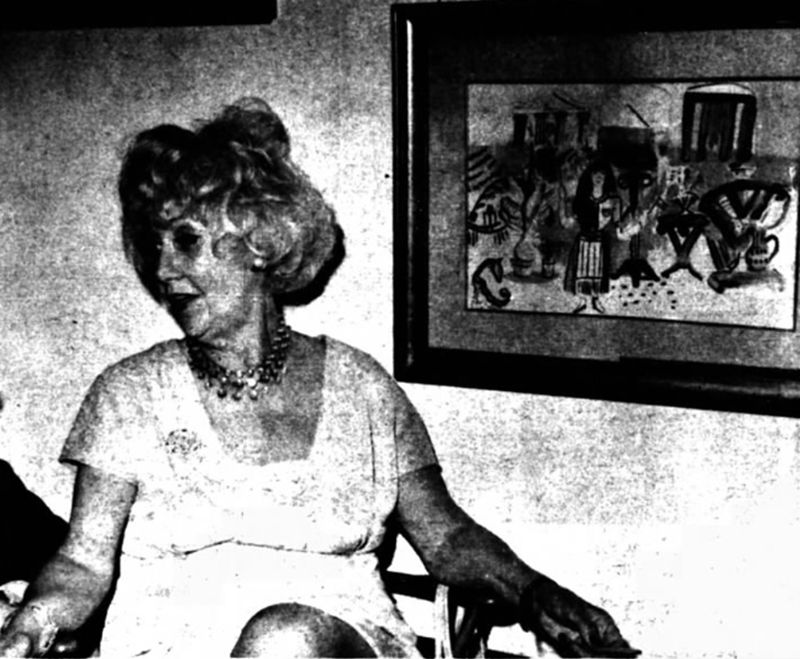
Artist, collector and gallerist, Hazel King-Farlow (née Barbara Hazel Guggenheim) was born into a Jewish family on 30 April 1903 in New York, USA. She was the youngest daughter of Benjamin Guggenheim, who died on the Titanic in 1912 when she was eight, and Florette Seligman Guggenheim, and younger sister of the collector and gallery owner, Peggy Guggenheim. King-Farlow began painting in her teens and, like Peggy, moved to Europe in the 1920s, pursuing a more bohemian life.
After an early, short-lived marriage at the age of 19, King-Farlow moved to Paris, attended the Sorbonne, and married again. She had two sons, both of whom died in a fall from a New York skyscraper during a family visit; the deaths were officially ruled accidental, and King-Farlow suffered a breakdown afterwards. In 1931 she married Denys King-Farlow and settled in Sussex, England, where she had two further children. During the 1930s she became increasingly active as both an artist and a patron. She received tuition from the artists, Rowland Suddaby, Raymond Coxon and Edna Ginesi, and became associated with the London Group and the Euston Road School, where she studied in 1938. Her early work included still lifes, townscapes and landscapes, later becoming brighter and more expressive.
King-Farlow exhibited in the London Group annual exhibition in 1936, where a reviewer noted her as a newcomer, showing two paintings ‘in which fancy is pleasingly directed’ (Yorkshire Post and Leeds Intelligencer 1936, p. 8). Her first solo exhibition opened at the Cooling Galleries, London, in 1937. Contemporary reports emphasised not only her work as a painter but also her philanthropy: she devoted half the proceeds from the exhibition to a travelling art library intended to lend modern pictures to schools, galleries and institutions in northern England. The same year, she contributed to exhibitions supporting Medical Aid for Spain and was described as a vice-president of Wakefield Art Gallery (Huddersfield Daily Examiner 1937, p. 2). Her collecting and patronage were closely linked to her artistic life. She donated works by herself and others to British public collections, including Wakefield, Leeds, Manchester and Hull. Wakefield Art Gallery (later The Hepworth Wakefield), was especially important: she gave more than 20 works to its collection, including examples by European and British modern artists and two paintings of her own, and contributed towards the purchase of Henry Moore’s Reclining Figure. She also acquired German emigre Heinz Henghes’s sculpture Bride from Peggy Guggenheim’s Guggenheim Jeune circle and donated it to Wakefield. Her most significant gift was Wassily Kandinsky’s Cossacks, donated to Tate after its display at Guggenheim Jeune in 1938.
In 1939, with war imminent, King-Farlow returned to the United States. She later married the painter and USAAF pilot, Chick McKinley, with whom she painted side by side; after his death in a wartime plane crash, she continued to use the surname McKinley. In 1943 Peggy Guggenheim included her work in the influential Exhibition by 31 Women at Art of This Century in New York. From the 1950s King-Farlow lived between the United States and Europe, spending time in Paris and continuing to exhibit. By 1955, she was running the Hazel McKinley Gallery in West Cornwall, Connecticut, which showed contemporary British and Irish paintings, as well as works by McKinley herself. The following year Wakefield Art Gallery held an exhibition of her paintings in recognition of her support for the gallery.
By the 1960s she was again exhibiting in England under the name Hazel McKinley. In 1965, she showed 26 oil paintings at the Artists’ Own Gallery, 26 Kingly Street, London, with two thirds of the proceeds assigned to charities and causes, including the Friends of the Tate, Guide Dogs for the Blind and children’s charities. The same year, she also showed with Augustin Booth at the Upper Grosvenor Galleries, London. Critics described her paintings as colourful, vivid and decorative, with a gaiety compared to Raoul Dufy, while The Guardian characterised them as ‘gay, like Matisse; light-hearted, like Dufy; exuberant, like herself’ (Seddon 1965, p. 20; The Guardian 1965, p. 10). In 1969 she exhibited at Hammersmith Town Hall and at the Canaletto Gallery, a barge moored at Little Venice, again linking sales to charitable causes. A further group exhibition followed at the Triad Gallery, Bishop’s Stortford, Hertfordshire in 1970.
After returning from Europe in 1969, King-Farlow settled in New Orleans, where she continued to paint and exhibited at Naomi Marshall’s Downtown Gallery. In old age, she returned to studying art at Newcomb College. Her late works included coloured pen drawings and sketches made while confined to bed. Hazel King-Farlow died on 15 June 1995 in New Orleans, USA. Her work is represented in the collections of the Manchester Art Gallery, Hepworth Wakefield and Leeds Art Galleries, among others.
Irene Iacono
Related books
- Lynne Blackman, Central to Their Lives: Southern Women Artists in the Johnson Collection (Columbia: University of South Carolina Press, 2018), pp. 99-101
- John Pope, Getting off at Elysian Fields: Obituaries from the New Orleans Times-Picayune (Jackson: University Press of Mississippi, 2015), pp. 107-109
- Francine Prose, Peggy Guggenheim: the Shock of the Modern (New Haven: Yale University Press, 2016), p. 66
- ‘I Hope My Paintings…’, Marylebone and Paddington Mercury, 8 August 1969, p. 2
- ‘Fund-Raiser Painting’, Cambridge Evening News, 26 July 1969, p. 8
- ‘An American in Hammersmith’, Hammersmith and Shepherds Bush Gazette, 17 July 1969, p. 22
- ‘Generous Patron’, The Daily Telegraph, 8 July 1969, p. 16
- ‘Peggy’s Sister’s Pictures’, The Guardian, 17 February 1965, p. 10
- Richard Seddon, ‘Pictures Dedicated to Good Causes’, The Birmingham Post, 18 February 1965, p. 20
- ‘Art Galleries’, The Daily Telegraph, 12 February 1965, p. 2
- Aliee O’Meara, ‘Designed for Women’, The Berkshire Eagle, 28 December 1956, p. 8
- ‘McKinley Gallery Reopening with British-Irish Show’, The Berkshire Eagle, 12 August 1955, p. 12
- Hazel McKinley, exhibition catalogue (New York: Carlebach Gallery, 1949)
- Hazel McKinley, exhibition catalogue (New York: Bonestell Gallery, 1946)
- D.S., ‘Manchester City Art Gallery, The Guardian, 31 July 1940, p. 6
- ‘Hull Art Gallery’s Recent Acquisitions’, Hull Daily Mail, 31 August 1939, p. 4
- ‘The Londoner’s Diary’, Evening Standard, 27 May 1939, p. 6
- ‘Art Aids Spain’, Huddersfield Daily Examiner, 21 June 1937, p. 2
- ‘Chelsea and Spain’, Liverpool Daily Post, 7 June 1937, p. 8
- ‘For Sheffield’, Sheffield Independent, p. 14 April 1937, p. 6
- ‘Travelling Art Library’, The Gloucestershire Echo, 7 April 1937, p. 4
- ‘Attercliffe Link’, Sheffield Independent, 7 April 1937, p. 8
- ‘Lead to Painters’, Belfast Telegraph, 3 April 1937, p. 8
- ‘She Lends Pictures’, Swindon Advertiser, 3 April 1937, p. 4
- ‘Art Idea’, Manchester Evening News, 3 April 1937, p. 4
- ‘Northern Artists on Show’, Yorkshire Post and Leeds Intelligencer, 13 November 1936, p. 8
Public collections
Related organisations
- Euston Road School (student)
- Newcomb College, New Orleans (student)
- Sorbonne University (student)
- The London Group (exhibitor)
Related web links
- Artist Biographies database
- Artists’ Own Gallery, 26 Kingly Street, Soho, Drawing Matters
- Contemporary Art Society
- e-flux, Peggy Guggenheim in London: The Making of a Collector, press release
- Hazel Guggenheim McKinley website, WordPress
- Hazel King-Farlow, Swiss Lake, Hepworth Wakefield
- Sue Gilbert, ‘Hazel McKinley; the 31 Women, Number nine’, blog post, 14 April 2013
- Sue Gilbert, ‘Sisters, in and Out of Art: Hazel King-Farlow and Peggy Guggenheim, Art UK, 17 February 2017
Selected exhibitions
- Group exhibition, Triad Gallery, Bishop’s Stortford, Hertfordshire (1970)
- Solo exhibition, Canaletto Gallery, Little Venice, London (1969)
- Paintings by Augustin Booth and Hazel Mckinley, Upper Grosvenor Galleries, London (1965)
- Hazel King-Farlow, Wakefield Art Gallery, Wakefield, Yorkshire (1956)
- Contemporary British and Irish Paintings, Hazel McKinley Gallery, West Cornwall, Connecticut, USA (1955)
- Solo exhibition, Berkshire Museum, Pittsfield, Mass., USA (1954)
- Hazel McKinley, Carlebach Gallery, New York, USA (1949)
- Hazel McKinley, Bonestell Gallery, New York, USA (1946)
- Exhibition by 31 Women, Art of This Century Gallery, New York, USA (1943)
- Recent Paintings by Hazel King-Farlow, Stafford Gallery, London (1939)
- Hazel King-Farlow, Cooling Galleries, London (1937)
- Medical Aid for Spain, Whistler’s House, London (1937)
- London Group annual exhibition, London (1936)