Born: 1932 Natal, South Africa
Died: 2022 Wales, England
Biography
Sculptor Helga Prosser (née van der Riet) was born in Natal, South Africa in 1932. Trained at the Michaelis School of Fine Art at the University of Cape Town, she initially worked in more traditional sculptural materials, including wood, stone, clay and concrete. Before leaving South Africa, she received commissions including a concrete mural for the gateway of a large fruit farm in a grape-growing valley, and later a cement frieze and a Madonna carving.
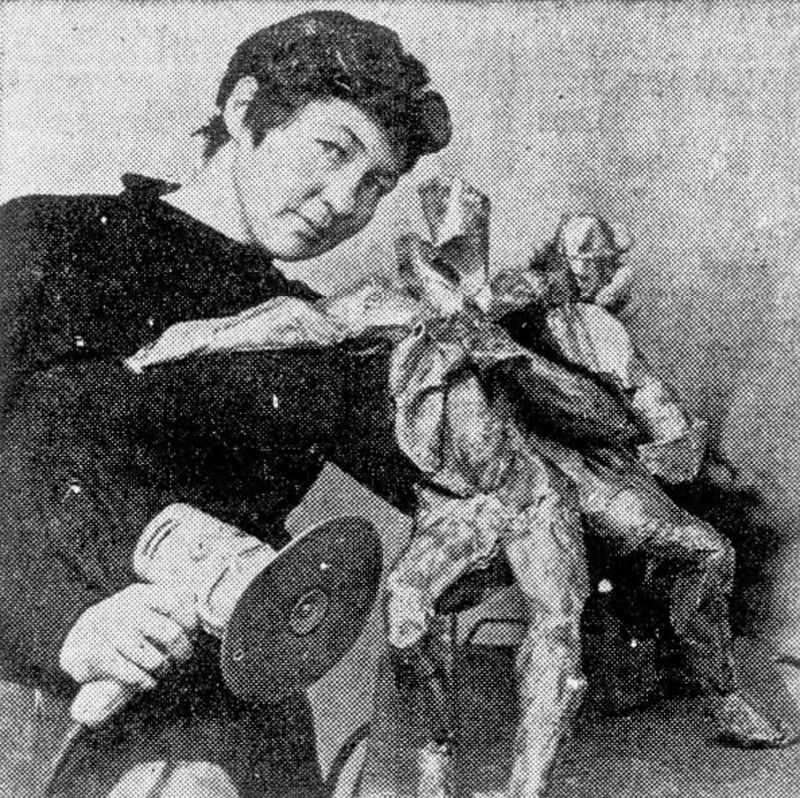
Prosser married Bob Prosser, a South African doctor of Welsh origin, and moved to England in 1959. After a period in London, where she studied at the Central School of Art, she and her family lived in Cambridge, before settling in Wales, first in Cardiff and later at Michaelston-y-Fedw, Caerleon and near Crickhowell. In 1971–72 she spent a year in Zaria, northern Nigeria, where her husband worked at Ahmadu Bello University; there she took a post in the university’s fine arts department and concentrated on wood carving and drawing. Her early Welsh studio was her husband’s garage in Cyncoed, Cardiff, where she worked with oxy-acetylene equipment, cutting and welding 16-gauge mild steel. Contemporary reports noted the unusual nature of this practice for a woman sculptor in Wales in the early 1960s, describing Prosser as one of the few women sculptors in Wales (Williams 1964) and, in some reports, as the only woman artist in South Wales then working in metal.
Although she continued to use other media, Prosser became best known for welded steel sculpture. She valued steel for its lightness, strength and toughness, and explained that it allowed her to make large hollow forms that could appear to fly through the air, balanced on a single point (South Wales Argus 2002, p. 14.). Her technique involved sketching first on paper, cutting sheets of steel into sections, then building the figure through repeated cutting, shaping and welding. She often used scrap or discarded metal bought from merchants, both for economy and because the pieces were a manageable size. Preventing rust was an ongoing technical concern, and she experimented with protective finishes, while later works were often japanned black or given touches of colour.
From the early 1960s, sport, especially football and rugby, became central to Prosser’s imagery. She collected newspaper and magazine photographs of players in action, using them as sources for figures caught in strain, collision, leap or scrum. In 1997 she described herself as fascinated by shapes in transition, especially the moment between one position and an unknown fulfilment. Works such as Football Action, Jumping Jack, Footballer, Line Out, Scrum Relief, Header, Tussle and Movement in Steel established her reputation as an interpreter of dynamic bodies. Critics repeatedly identified this preoccupation: in 1964 Frank Dibb in the South Wales Argus praised the ‘vigorous sense of movement and aggression’ in her Royal Academy of Arts exhibits (Dibb 1964, p. 2), while a 1969 review of her Llantarnam Grange exhibition described her subject as the ‘complex muscular ballet of the football field’ (Breen 1969, p. 8).
Prosser exhibited widely in Wales and beyond. In 1964 two of her Football Action sculptures were shown at the Royal Academy Summer Exhibition, and she was also represented in the Pictures for Welsh Schools exhibition at the National Museum of Wales. She showed with the South Wales Group, the Welsh Arts Council, the Cambridge Society, the Paris Salon and other group exhibitions. She had one-woman exhibitions in South Africa, and in 1969 held a solo exhibition at Llantarnam Grange, Cwmbran, tracing the development of her work over the previous decade. In 1974 she shared a two-woman exhibition there with the German-born painter, Francesca Boehm. Later shows included exhibitions at the Ffwrwm Gallery in Caerleon (1996), Artspace at Aston near Henley-on-Thames (1997), and Parkfields Gallery, Pontshill, Wales (2002). Her public and commissioned works gave her a visible place in the artistic landscape of south-east Wales. Cwmbran Development Corporation bought her five-foot sculpture Footballers, installed outside Llantarnam Grange Arts Centre. Other commissions included steel footballers in Cwmbran, a small abstract sculpture outside Llantarnam Grange, a large Leap Frog sculpture for the Ebbw Vale Garden Festival, and The Battle of Camlan, a five-foot welded steel group at the Ffwrwm, Caerleon, commissioned by Dr Russell Rhys and unveiled in 1997. In 2004 Prosser created the crown for the Newport Eisteddfod, using steel and motifs drawn from roads, railways, canals and Celtic design to reflect the industrial heritage of Newport and South Wales.
Although sculpture remained central, Prosser also produced watercolours and ceramics. Her watercolours included South African scenes, Cape beaches, the Drakensberg mountains and north African subjects. In 2002 the Washington Gallery, Penarth, showed a range of her ceramics. Across these media, however, she repeatedly returned to metal, attracted by its expressive potential and by the physical process of welding itself. Helga Prosser died on 25 May 2022 in Wales. In the UK public domain,her work is represented in the Ffwrwm Arts and Crafts Centre and Margam Country Park, Port Talbot, Wales.
Irene Iacono
Related books
- ‘Eisteddfod Crown Has Awesome Style’, South Wales Argus, 5 May 2004, p. 9
- ‘White-hot Flame of Artistic Talent’, South Wales Argus, 13 November 2002, p. 14
- ‘Ceramic Display’, South Wales Echo, 2 August 2002, p. 38
- ‘Abstract’, Hereford Times, 18 July 2002, p. 32
- ‘A Haven of Tranquillity’, Free Press, 10 July 2002, p. 24
- ‘Meet the Heroes with Real Steel…’, South Wales Argus, 22 November 1997, p. 12
- ‘Caerleon’, South Wales Argus, 22 November 1997, p. 12
- ‘Caerleon’, South Wales Argus, 14 May 1997, p. 6
- ‘Terry Likes a Good Disaster’, South Wales Argus, 8 November 1996, p. 16
- ‘Paris on the Doorstep of……Newport?’, South Wales Echo, 5 August 1995, p. 50
- ‘Exhibition of Art’, South Wales Argus, 1 November 1974, p. 4
- ‘Sculpting Sport in Steel’, Weekly Argus, 31 October 1974, p. 13
- Josephine Type, ‘Back From a Land Where: Parents Absconded from the Hospital with Dying Children’, South Wales Argus, 12 September 1972, p. 6
- Beata Lipman, ‘Muscle Power is As Vital As Talent for This Sculptor’, South Wales Argus, 26 October 1971, p. 6
- ‘Art in Stainless Steel’, Free Press, 21 March 1969, p. 7
- Robert Breen, ‘The ‘Muscular Ballet’ Observed’, Weekly Argus, 13 March 1969, p. 8
- Griffith Williams, ‘She Sculpts in Mild Steel’, The Canberra Times, 9 September 1964, p. 21
- Griffith Williams, ‘Pictures for Welsh Schools’, South Wales Argus, 18 May 1964, p. 2
- Frank Dibb, ‘Welsh Artists at Burlington House’, South Wales Argus, 1 May 1964, p. 2
- Griffith Williams, ‘An Adventurous Exhibition’, South Wales Argus, 6 March 1964, p. 6
- Josephine Type, ‘The Women’s Page’, South Wales Argus, 3 March 1964, p. 6
- Griffith Williams, ‘Woman Sculptor in Mild Steel’, South Wales Argus, 18 February 1964, p. 14
- ‘An Artist…’, Belfast News-Letter, 18 February 1964, p. 7
- ‘Artistry in Scrap Metal’, Wolverhampton Express and Star, 12 February 1964, p. 18
Related web links
- ‘Crickhowell Art Trail Shows Work of More Than 50 Artists’, Abergavenny Chronicle, 19 May 2011
- ‘First Time Entry Wins Top Prize’, BBC News, 3 August 2004
- Ffwrwm Arts and Crafts Centre, High Street, Caerleon
- Royal Academy of Arts exhibition catalgogue
- Sculpture Parks: Margam Country Park, Port Talbot, Wales
- A signed autograph letter sent to Heinz
Selected exhibitions
- Julian Meredith and Helga Prosser, Tower Gallery, Crickhowll, Wales (2019)
- Five Sculptors, Cae’r Lan, Crickhowell, Wales (2016)
- Summer Show, Lion Street Gallery, Hereford (2014)
- Helen Mowat & Helga Prosser: Harlequins, Washington Gallery, Swansea, Wales (2010)
- Helga Prosser: Drakensburg Mountains, Watercolour Paintings, Washington Gallery, Pontypool, Wales (2008)
- Group exhibition, Parkfields Gallery, Pontshill, Wales (2002)
- Ceramics by Helga Prosser, Washington Gallery, Penarth, Wales (2002)
- Helga Prosser: Moving Steel, Barker Gallery, Pontypool (2002)
- Art for Mercy Gala Charity Exhibition, Washington Gallery, Penarth, Wales (2002)
- Mixed Media Exhibition, Parkfields Gallery, Pontshill, Wales (1998)
- Group exhibition, Newport Centre, Wales (1998)
- Group exhibition, Artspace, Barn Galleries, Aston near Henley-on-Thames, Berkshire (1997)
- Paintings and Sculpture by Helga Prosser, Ffwrwm Art Gallery, Caerleon, Wales (1996)
- Helga Prosser, Manor House Fine Arts, Canton, Cardiff, Wales (1994)
- Helga Prosser: Steel Counterpoise, Alwin Gallery, London (1977)
- Francesca Boehm and Helga Prosser, Llantarnam Grange, Cwmbran, Wales (1974)
- Helga Prosser, Woodstock Gallery, London (1971)
- Helga Prosser: Sculpture, Llantarnam Grange, Cwmbran, Wales (1969)
- Contemporary Welsh Painting and Sculpture, National Museum of Wales, Cardiff, Wales (1964)
- Pictures for Welsh Schools, National Museum of Wales, Cardiff, Wales (1964)
- Royal Academy Summer Exhibition, Royal Academy of Arts, London (1964)
Ben Uri archive
Consult items in the Ben Uri archive related to [Helga Prosser]
Ben Uri library
Publications related to [Helga Prosser] in the Ben Uri Library