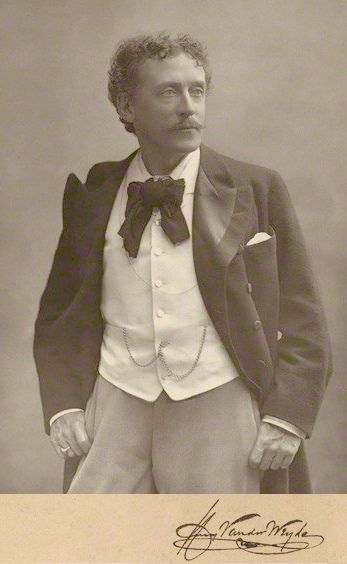
Born: 1838 Zierikzee, Netherlands
Died: 1924 London, England
Year of Migration to the UK: 1870
Biography
Painter and photographer Henry Van der Weyde was born in Zierikzee, Netherlands in 1838, the son of Peter Henri Van der Weyde (1813-1895), a Dutch-American scientist and inventor. His family emigrated to the United States in 1850, where he trained as a painter. During the American Civil War he served with the 7th New York State Militia, rising to the rank of major; he was held as a prisoner of war at Danville in Virginia, and on his release resumed his previous post as an assistant provost marshal. His brother John became a photographer in Uruguay, and his sister Jennie taught in schools in Georgia and Alabama. In 1867 he married Mona Wetherbee; their son Harry later trained as a painter in his own right. Van der Weyde immigrated to England around 1870, possibly so his wife, who was English-born, could return home. He initially supported himself as a portrait painter, working chiefly in pastel, in a fashionable academic manner, before turning decisively to photography.
As he recalled in an 1889 interview, he had trained as an artist and 'often exhibited at the Royal Academy' before a failed sitting for his own photograph, thwarted by fog, prompted him to seek a means of working independently of daylight (Pall Mall Gazette, 1889). He also exhibited at the Paris International Exhibition of 1878. His central technical achievement, however, was the introduction of electric light into the photographic studio. In 1876 he took out a British patent for electric studio lighting and, by September 1877, his Regent Street basement housed a 6,000-candle-power carbon arc light and a six-foot reflector, reducing exposure times for cartes-de-visite to two or three seconds. The Prince of Wales, later King Edward VII, is credited with setting the fashion for being photographed in evening dress at Van der Weyde's studio. On 27 May 1892 VAn der Weyde was one of fifteen photographers who seceded from the Royal Photographic Society to found the Linked Ring Brotherhood, and that same year he described his Rectograph photo-corrector.
As a photographer, as well as a painter, his approach was studio-based and formal, built around controlled artificial lighting. His portraits typically isolate the sitter, often in costume or characteristic pose, against a plain backdrop, prioritising clarity of likeness over pictorial experimentation. Van der Weyde photographed Princess Alexandra of Wales at Marlborough House in 1888, and also painted two portraits of the Prince and Princess of Wales, submitted in 1889 (The Standard, 1889), as well as portraits of Cardinal Manning and Fridtjof Nansen. He was especially active as a theatrical photographer. The Victoria and Albert Museum's Guy Little Theatrical Photograph Collection holds 64 works by him, depicting notable actors of the day, including Mary Anderson, Lillie Langtry, Dorothy Dene, Ellen Terry, Sir Henry Irving and the actor-manager Charles Wyndham. Van der Weyde's photograph of Mary Anderson became the subject of a widely reported 1885 copyright case after a painter was accused of copying it without her consent. He later lent negatives of the images of the Duchess of Devonshire, Princess of Wales and Mrs Langtry for reproduction, a loan that led to a further legal dispute in 1893.
Van der Weyde's business remained financially precarious: in 1879 he reached an arrangement with his creditors, and in 1902 a public bankruptcy examination revealed liabilities of over £13,000, which he attributed to the cost of his experiments and patents, including the failure of his Star Ice Company Limited in 1901. He had filed 58 patent specifications, 20 of them completed. A further discharge application in 1906 was suspended for two years.
Henry Van der Weyde died in Hendon, London, England in 1924. His photographs are represented in UK public collections, including the National Portrait Gallery, British Museum, Victoria and Albert Museum, Wellcome Collection and Ashmolean Museum, Oxford, alongside related family papers held by the New York Public Library, USA. In 2015 a selection of his photographs was included in the National Portrait Gallery's exhibition Curators' Choice: Photographs from the Terence Pepper Gift, London, and his 1888 portrait Richard Mansfield as Dr Jekyll and Mr Hyde was shown in Photography - A Victorian Sensation at the National Museum of Scotland, Edinburgh in the same year.
The Ben Uri Research Unit welcomes contributions from researchers or family members who may have further biographical information.
Michal Mel
Related books
- Michael Pritchard, 'Artificial Lighting', in John Hannavy ed., Encyclopedia of Nineteenth-Century Photography (New York: Routledge, 2008)
- Rogier van der Weyden, 'Henry van der Weyde (1839-1924)', History of Photography, Vol. 23, No. 1 (Spring 1999), pp. 68-71
- L. A. Mannheim ed., The Focal Encyclopedia of Photography (London/Boston: Focal Press, 1965)
- 'Losses on Patents', London Evening Standard, 8 August 1906
- 'Unprofitable Inventions', Cheltenham Chronicle, 22 March 1902
- 'A Weakness for Inventing', Star of Gwent, 21 March 1902
- 'A Weakness for Inventing: Photographer's Explanation of Financial Failure', Sheffield Independent, 19 March 1902
- 'Failure of a Well-Known Photographer', Derby Daily Telegraph, 19 March 1902
- 'A Patentee's Examination', Financial News, 19 March 1902
- 'Soldier - Inventor - Photographer', Gloucester Citizen, 18 March 1902
- 'The Buller Heliogram', Manchester Courier, 20 November 1901
- 'The World's Fair Awards', Sheffield Daily Telegraph, 28 September 1893
- 'The World's Fair Awards', Daily Telegraph & Courier (London), 28 September 1893
- 'The "Negatives" Case', Morning Leader, 2 March 1893
- 'The Anglo American Annual' (notice), American Register, 31 January 1891
- Untitled notice on Van der Weyde's studio, American Register, 8 November 1890
- 'Celebrities and their Portraits: An Interview with Mr. Van der Weyde', Pall Mall Gazette, 30 November 1889
- 'The Prince and Princess of Wales', The Standard (London), 13 August 1889, Issue 20310, p. 5
- 'Miss Mary Anderson's Photograph', Edinburgh Evening News, 24 April 1885
- 'Miss Anderson's Photograph', Western Daily Press, 3 April 1885
- 'New Inventions in Photographic Portraiture', Pateley Bridge & Nidderdale Herald, 14 June 1873
- 'New Inventions in Photographic Portraiture', Knaresborough Post, 12 April 1873
- 'New Inventions in Photographic Portraiture', Pateley Bridge & Nidderdale Herald, 8 March 1873
Public collections
Related web links
- New Zealand National Library
- NYPL Archives and Manuscripts
- NYPL Digital Collection
- Royal Academy of Arts
- Royal Academy of Arts online catalogues
Selected exhibitions
- Photography - A Victorian Sensation, National Museum of Scotland, Edinburgh (2015)
- Curators' Choice: Photographs from the Terence Pepper Gift, National Portrait Gallery, London (2015)
- Paris International Exhibition, Paris, France (1878)
- The Royal Academy of Arts Summer Exhibition, London, (1880; 1879)