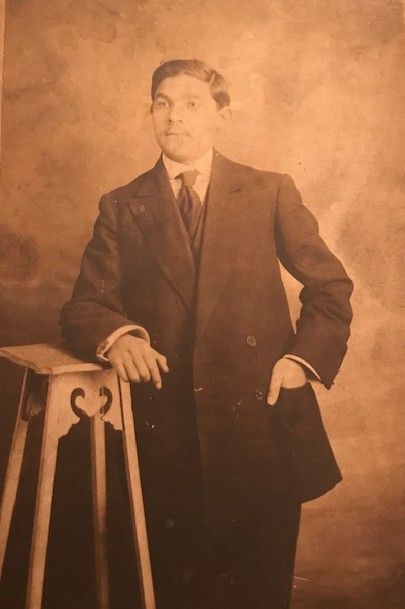
Born: 1892 Salonika, Ottoman Empire (now Thessaloniki, Greece)
Died: 1965 Manchester, England
Year of Migration to the UK: 1919
Biography
Textile designer and painter, Jacob Dimoldenberg was born on 6 October 1892 in Salonika, Ottoman Empire (now Thessaloniki, Greece), into a Jewish family originally from Kerch in Crimea. His father, Moses (Maurice) Dimoldenberg, came from a family of cap-makers and had moved with his wife Esther (née Resnikoff) from Crimea to Salonika, prior to the family relocating to France shortly after Jacob’s birth. The family lived in the Jewish quarter of Paris, first at 3 Rue des Fossés, where the second son, Charles, was born, and later at 9 Rue des Juifs. Between 1907 and 1910, Dimoldenberg apprenticed in print design at A Horr, before enrolling at the École des Arts Décoratifs in 1911, where he was awarded a silver medal. From 1913 until the end of the First World War he worked for Parisian firms, including G George and Engel & Maisch. His early paintings from this period, including still lifes of fruit and flowers, alongside views of urban parks and promenades, reveal a restrained but sensitive painterly language. Soft tonal transitions and careful attention to atmosphere place the works somewhere between late Impressionism and academic naturalism, while their quiet intimacy suggests an artist attentive to the poetics of fleeting ordinary moments.
Although established in France, Dimoldenberg joined the French Foreign Legion during the First World War, as he had been born outside the country. He fought at the Battle of the Somme in July 1916, where he was wounded before later returning to military service. In 1919, after the war, he moved to Manchester, England, to marry Bertha Granat, who had been born in nearby Prestwich in 1896. On the marriage certificate, his profession was listed as ‘cloth designer’, a title that would define most of his professional life. The couple initially lived at 10 Foulkes Street in Cheetham, before later moving to 116 Marlborough Road, Broughton, Salford, where Bertha opened a women’s and children’s clothing shop. Their son, Maurice, was born in 1922. Following his naturalisation as a British citizen on 16 June 1931, the family moved to 53 Leicester Road, Broughton. Dimoldenberg’s first employment in England was with Pilkington & Knott Designers at 34 Charlotte Street, Manchester, though he soon established himself as a freelance textile designer. From the early 1920s until his retirement four decades later, he worked primarily for Tootal Broadhurst Lee, one of Manchester’s leading textile manufacturers, producing designs for ties, scarves, shirts, pyjamas and export febarics. Even after retiring, Dimoldenberg occasionally continued to sell designs his former employer.
Dimoldenberg’s textile patterns demonstrate a sophisticated understanding of rhythm and colour. Many of his designs rely on tightly organised geometric arrangements, in which diamonds, stars, paisley-like motifs and circular forms interlock across dark grounds of navy, burgundy, green, or black. Their crisp symmetry recalls both Art Deco stylisation and the longer history of ornamental textile design, creating a striking visual energy intended to stand out within the small scale of fashion accessories. Although highly decorative, the patterns also reveal precision and control, balancing hand-painted irregularities with the disciplined structure required for industrial textile production. Several designs made for export markets in West Africa demonstrate his sensitivity to bold chromatic contrasts and repeating motifs that could operate dynamically across fabric surfaces.
Following his retirement in the early 1960s, Dimoldenberg returned more fully to painting. His later watercolours and paintings of Salford and Broughton parks possess a clarity and calm assurance in the place of the more impressionistic brushwork of some earlier works. Carefully observed architectural details and controlled perspectives give these mature landscapes a reflective quality, combining documentary attentiveness with a restrained lyricism, shaped by decades spent working through design.
Jacob Dimoldenberg died in Manchester, England on 9 December 1965 from coronary thrombosis and chronic bronchitis and was buried at Blackley Jewish Cemetery on Rochdale Road. In the UK public domain his work is held in the collection of the V&A, while the Science and Industry Museum in Manchester has approximately 525 examples of his work, including designs for ties and export fabrics, sample books, six bound volumes of designs for shirts, scarves, pyjamas and ties, notebooks, and archival material documenting Manchester’s textile industry. In 2017, one of his colourful repeating patterns was adapted for a series of deckchairs produced from historic textile designs in the museum’s archive, selected for its strong graphic rhythm and vibrant use of colour. This profile was written based on notes shared with the author by his grandson, Paul Dimoldenberg (Lord Mayor of Westminster from 14 May 2025 to 20 May 2026).
Ana-Maria Milčić
Related books
- 'Museum Coup', Jewish Chronicle, 3 June 1994, p. 10.
- 'Textile Show for the City', Manchester Evening News, 25 May 1994, p. 17.
- 'Mr Manchester's Diary' column, Manchester Evening News Diary, June 1964 (full detils to be confirmed)
Public collections
Related organisations
- Pilkington & Knott (designer )
- Tootal Broadhurst Lee and Co. (designer )