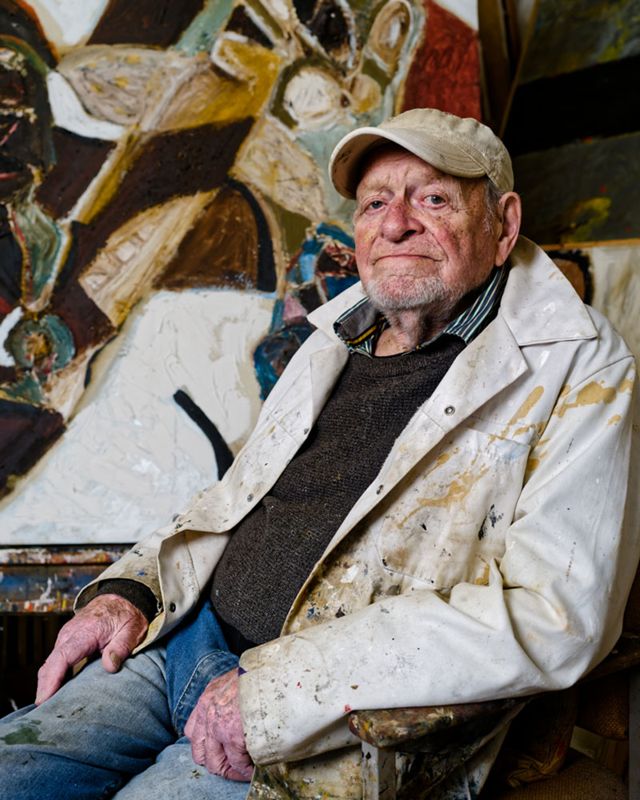
Born: 1926 British India (now Pakistan)
Year of Migration to the UK: 1936
Biography
Painter, sculptor and performance artist Ken Turner was born in British India, in a region now part of Pakistan, in 1926, the son of an army officer. The family immigrated to England in 1936 when he was aged ten, and the following years brought a series of formative dislocations: in 1941 he entered Ealing School of Art, and in 1944 he was conscripted as a Bevin Boy and sent to work in the coal mines; he later served in the army, where he worked on design projects for its headquarters building. After the war he turned down places at the Slade School of Fine Art and the Royal College of Art, enrolling instead in 1947 at the Anglo-French Art Centre in St John's Wood, where he also received a British Council bursary to study in Spain. He subsequently studied at Regent Street Polytechnic (now University of Westminster).
Turner settled in London, running a picture-framing business with his partner, the gilder and designer Mary Turner, while developing his own abstract paintings; the couple had two children together, including their son Huw Wahl, who later became a filmmaker. Turner taught foundation courses at the Central School of Art in London (now UAL) from 1960 to 1980, and in 1961 he established the Environmental Design course at Barnet College, an early sign of his growing interest in art beyond the gallery wall.
Turner's practice has ranged across painting, sculpture, inflatable structures and live performance, and since the early 2000s has extended to computer-assisted drawing. His early work was rooted in figurative and semi-cubist painting, as seen in a 1962 self-portrait, However, from the mid-1960s he moved towards environmental and participatory art, building large inflatable structures that invited audiences to enter, touch and inhabit the work, an approach shaped in part by his teaching at Barnet and his reading of Allan Kaprow's writing on 'happenings'. He has cited the critic and writer, John Berger, whom he met in 1952, and the philosophers, Jacques Derrida, Felix Guattari and Gilles Deleuze, as lasting influences on his thinking about art and identity. Turner has described his recurring self-portraiture as an attempt to move 'beyond the face into the being', rather than record a likeness (Ruth Borchard Collection). Questions of displacement and belonging, shaped by his own childhood migration from British India to England, recur throughout his work, alongside a consistent commitment to art as a vehicle for social and political engagement, rather than a purely aesthetic pursuit.
Turner exhibited widely from the 1950s onward, showing in 1963 at the influential ICA (Institute of Contemporary Arts), then on Dover Street, under Roland Penrose and Herbert Read, and subsequently in 1965 at Heal's Mansard Gallery and, in 1966, at Lord's Gallery, London, in the exhibition Art as Something Public, from which the Arts Council acquired one of his three-dimensional works. He also showed with The London Group, the AIA (Artists International Association) and at Centre 42. Around this time, he also took part, with the artist Maurice Agis, in a BBC Third Programme broadcast on environmental art, arranged through the critic and painter, Andrew Forge. In 1967, working with the playwright Arnold Wesker on the Resolution 42 campaign for arts trade union legislation, he helped found The First Group. This included touring modern art to twelve municipal galleries. In 1968 he built 'Paradise Gardens', an inflatable structure shown as part of Joan Littlewood's 'Bubble City' festival in London, shortly before co-founding Action Space with his wife and the composer, Alan Nisbet; the charitable trust toured the UK and Europe for a decade, with performances at venues including the Academy der Kunste, Berlin, and festivals in Rotterdam, Amsterdam and Bonn. After relocating to Cornwall, he performed Eight Times Four Sides at Newlyn Art Gallery in 1997 and later held the solo exhibitions Climate Change at Fish Factory, Penryn, in 2021, and a show at the Borlase Smart Gallery, Porthmeor Studios, St Ives, in 2024.
In 2025, at the age of 98, Turner gained international attention, when he drove a Second World War Sherman tank over a Tesla car in a protest organised with the campaign group, Led by Donkeys, declaring 'we've crushed fascism before, and we'll crush it again' (Newsweek, 2025). The action, and the paintings it inspired, formed the centrepiece of his centenary retrospective Ken Turner at 100: A Century of Crashing Culture held at Wharfside Arts Hub, Penzance, Cornwall in July and August 2026, alongside Expiry, a film portrait by his son Huw Wahl that premiered at Newlyn Filmhouse on 26 July 2026.
Ken Turner lives and works in St Ives, Cornwall, England where he has been based since the 1990s. His work is held in UK public collections including the Arts Council Collection and Ruth Borchard Collection, while Action Space archives are held at the University of Sheffield.
Michal Mel
Related books
- Ken Turner, A Life Being Ken Turner (Crashing Culture, Book 2) Independently published, 2020)
- Ken Turner, Crashing Culture: An artist reaction to existing authorities (Independently published, 2016)
- Ken Turner, Ken Turner: Construction, Sculpture, Painting, Relative Space, Projects (London: Lord's Gallery, 1966)
- Edward Lucie-Smith, 'Art as Something Public', Studio International, Vol. 171, No. 874, February 1966, pp. 71-73
- Ken Turner, Henry Anderson and Sally Anderson, Advance Group Selection of New Work (London: Artists International Association, 1962)
Public collections
- Arts Council Collection
- Ruth Borchard Collection, 'Ken Turner'
- Action Space archives, University of Sheffield
Related organisations
- Anglo-French Art Centre, St John’s Wood, London (student)
- Architectural Association, London (teacher)
- Artists' International Association (AIA) (exhibitor)
- Barnet College of Art (teacher)
- Central School of Art and Design (teacher)
- Ealing Art School (student)
- Regent Street Polytechnic (student)
- The London Group (exhibitor)
Related web links
- Action Space archives, University of Sheffield
- Art Cornwall
- Axis, 'Ken Turner CV'
- CornishStuff, 'Ken Turner at 100: the St Ives artist who tanked a Tesla'
- HENI profile
- Huw Wahl, 'Ken Turner at 100'
- Newlyn Society of Artists, 'Ken Turner'
- Prospect Magazine, 'Our youngest centenarian'
- The Guardian
- The London Group exhibition 1965
- Trebuchet Magazine, 'Ken Turner: The Oldest Performance Artist In The World
- Visual Arts South West, 'A Life being Ken Turner'
Selected exhibitions
- Ken Turner at 100: A Century of Crashing Culture, Wharfside Arts Hub, Penzance, Cornwall (2026)
- Solo Exhibition, Borlase Smart Gallery, Porthmeor Studios, St Ives, Cornwall (2024)
- Climate Change, Fish Factory, Penryn, Cornwall (2021)
- Eight Times Four Sides, Newlyn Art Gallery, Newlyn, Cornwall (1997)
- Paradise Gardens, Bubble City festival, London (1968)
- Art as Something Public, Lord's Gallery, London (1966)
- The London Group, London (1965)
- ICA, London (1963)