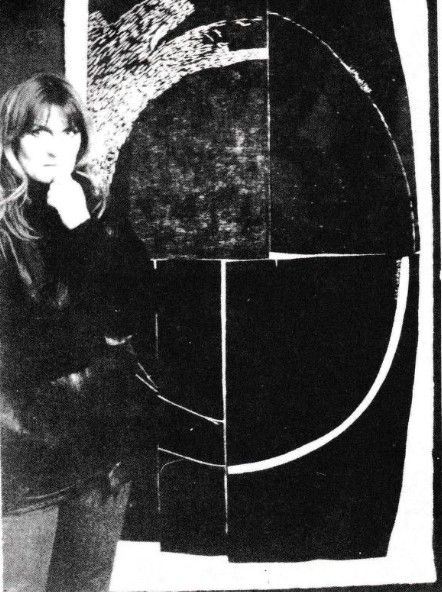
Born: 1954 Warsaw, Poland
Year of Migration to the UK: 1983
Biography
Artist Krystyna Borkowska was born in Warsaw, Poland, in 1954. From 1977–83, she studied painting and graphic art at the State Higher School of Fine Arts in Łódź. Although her practice later encompassed painting, printmaking, photography, collage, installation and interventions in public space, her early training in graphic techniques remained important throughout her career.
Borkowska moved to London, England in 1983, Her arrival coincided with the emergence of a younger and increasingly diverse generation of Polish and Anglo-Polish artists who sought alternatives to the established organisations of the postwar Polish émigré community. Borkowska became closely involved with Bigos, a group founded in the mid-1980s for professional artists of Polish origin. Its membership included recent migrants from communist Poland, second-generation Polish Britons and artists whose relationships with Polish identity varied considerably. The name, taken from the traditional Polish stew made by combining varied ingredients, was intended as a metaphor for the diversity of the group’s members, practices and relationships to Polish identity (Andrzej Borkowski on Bigos, in ‘Activating Brixton Art Gallery’). In 1986, Borkowska participated in Six Polish Women Artists at the Polish Social and Cultural Association (POSK) Gallery in Hammersmith. Her collages were identified with a characteristically Polish use of irony (Szczelkun, 1987), while the exhibition as a whole raised questions about feminism, Jewish identity, homosexuality and the boundaries of Polish cultural belonging. Later that year, she took part in Bigos’s first major group exhibition at Brixton Art Gallery, which subsequently transferred to the Crypt at St George’s Church, Bloomsbury. Borkowska continued to exhibit with Bigos as the group developed an increasingly experimental, collaborative and socially engaged programme. Its subsequent exhibitions included Worcester City Gallery in 1987. During the Worcester exhibition, she also participated in a street action involving banners composed of works by unidentified Polish artists, which some passers-by mistook for a genuine political demonstration (Middlesex Chronicle 1989, p. 12).
Her printmaking was also prominent during this period. A linocut by Borkowska was acquired by the Victoria and Albert Museum, and in 1988 she exhibited in Bigos—Six Printmakers of Polish Origin at St Paul’s Gallery in Leeds. The exhibition brought together abstract works made through linocut, etching, screenprinting and photographic processes. Reviewing her linocuts Triangle, Circle and Square, the Yorkshire Post and Leeds Intelligencer observed that they ‘were also striking, with an overall sense of harmony and balance’ (Yorkshire Post and Leeds Intelligencer, 1988, p. 8). In the same year, Borkowska participated in London’s Festival of Plagiarism, an event that questioned conventional ideas of authorship, originality and artistic genius. She exhibited photocopied drawings derived from works by other Polish artists, layering, enlarging and transforming borrowed fragments until their sources became difficult to identify. Andrzej Garczyński described these graphically striking works as metaphors for creativity in an age of mass reproduction, when artistic practice increasingly involved establishing new relationships between existing cultural materials, rather than inventing entirely unprecedented forms (Garczyński 1988, p. 4). By 1989, Borkowska was living in Chiswick and working to strengthen the artistic community of west London. Her work, which incorporated materials ranging from linoleum and cardboard boxes to street banners, was shown at the Stephen Barclay Gallery in Chelsea and the Polish Cultural Institute. She also participated in the Bigos exhibition at the Castle Museum in Sandomierz, Poland, in 1989. In 1990, she joined the group’s exhibition Aliens at Watermans Arts Centre in Brentford. Extending beyond the gallery to an island in the Thames, the exhibition used banners, graffiti, sound, video and large-scale constructions to explore crossings, borders and the political changes then transforming Eastern Europe.
Borkowska subsequently left England and moved to New York, USA in 1994. There she became active in the city’s gallery and artistic networks and, with her husband Robert Pardo, founded Pardo View Gallery on 51st Street. After initially producing installations, she returned increasingly to painting. She described her art as ‘reductionism’, although critics classified it as minimalism (Rudek-Śmiechowska 2021, p. 112). In 1997, she presented Two Spheres of Proportion at the Florida Gallery, Center for the Arts, Vero Beach, Florida. Combining found wood and stretched canvas with oil paint and gold, copper and aluminium leaf, the works used reflected light and geometric shadows to transform the gallery space. Borkowska linked them to her experience of migration between Poland, England and the United States. More broadly, she applied paint to box-like structures and combined it with metals including silver, copper, aluminium and gold, investigating space, reflected light and the visible effects of time upon materials. Her later works frequently responded to their architectural settings and changed in meaning as they were relocated, continuing the concern with context and transformation that had characterised her collaborative and experimental work in England. In 2026, her work was included in the group exhibition The Unknown at Lichtundfire, New York. In the UK public domain Borkowska’s work is represented in the Victoria and Albert Museum collection.
Related books
- Anna Rudek-Śmiechowska, ‘New York, the Mecca of the Art World. Initial Study on Polish Migrant Artists who Left for the United States, 1986–1995’, Studia Migracyjne Przegląd Polonijny/Migration Studies – Review of Polish Diaspora, No. 3, 2021, pp. 101–118
- ‘Borkowska Exhibit Continues at Center’, Indian River Press Journal, 22 December 1997, p. 28
- ‘Giant’s Progress’, Greenford and Northolt Gazette, 24 August 1990, p. 23
- ‘Feenstra’s Focus’, Middlesex Chronicle, 2 March 1989, p. 12
- ‘St Paul’s Gallery, Bishopgate Street, Leeds: Bigos — Six Printmakers of Polish Origin’, Yorkshire Post and Leeds Intelligencer, 17 June 1988, p. 8
- Andrzej Garczyński, ‘Wystawa Plagiatu’, Dziennik Polski, 15 June 1988, p. 4
- Stefan Szczelkun, Collaborations, Routine Art Co. (London: Aldgate Press, 1987), pp. 88-99
Public collections
Related organisations
- BIGOS (member)
- Pardo View Gallery, New York (co-founder)
- State Higher School of Fine Arts, Łódź (student)
Related web links
- Activating Brixton Art Gallery, 1983-86: Archives and Memories A symposium at University of Westminster on 5th June 2010
- Art Rabbit
- Association of Polish Artists in Great Britain
- Bigos: Artists of Polish Origin-Grupa artystów polskiego pochodzenia z Wielkiej Brytanii [Group of artists of Polish origin from Great Britain], Muzeum Zamek w Sandomierzu [Castle Museum in Sandomierz], July–August 1989, exhibition catalogue
- Exhibition catalogue of Bigos: Artists of Polish Origin, Brixton Art Gallery; The Crypt; 1986
- MINIMAL | MAXIMAL exhibition, Lichtundfire, New York
- Stewart Home ed., Plagiarism, Art as Commodity and Strategies for its Negation, London: Aporia Press,1987
Selected exhibitions
- The Unknown, Lichtundfire, New York, USA (2026)
- Two Spheres of Proportion, Florida Gallery, Vero Beach, Flori8da, USA (1997)
- Aliens, Watermans Arts Centre, Brentford, Middlesex (1990)
- BIGOS. Six Printmakers of Polish Origin, St. Paul’s Gallery, Leeds, Yorkshire (1988)
- Krystyna Borkowska and Andrzej Borkowski, Festival of Plagiarism, Escape Gallery & Coffee House, Greenwich, London (1988)
- Bigos exhibition, Worcester City Gallery, Worcester, Worcestershire (1987)
- Bigos: Artists of Polish Origin, Brixton Art Gallery, London; the Crypt at St George’s Church, Bloomsbury, London (1986)