Born: 1929 Slampe, Latvia
Died: 2011 Shipley, UK
Year of Migration to the UK: 1947
Other name/s: Laimonis Harijs Mieriņš
Biography
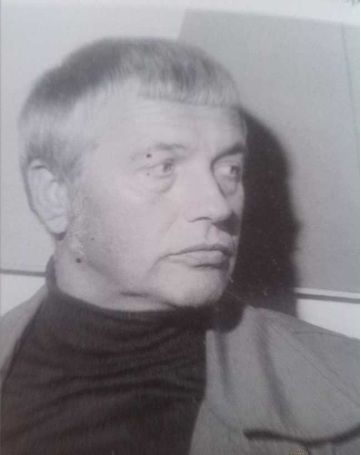
Abstract painter Laimonis Harijs Mieriņš was born on 12 March 1929 in Slampe parish, in the district of Tukums, in the Latvian Republic. His father, Kārlis Mieriņš, was a shop owner and was killed on the battlefield during the Second World War in 1944. His mother was Pauline Milda Mieriņš. When he was 15, during the war, Mieriņš was forced to leave Latvia with his mother. They were eventually relocated to a displaced persons camp in Germany. In 1947, at the age of 18, he accepted an offer to immigrate to the UK under the European Volunteer Worker scheme and was initially employed as an agricultural labourer in Halifax in West Yorkshire, before transitioning to the textile industry and settling nearb in Shipley, He married Ilga Mieriņš.
During his early years in Shipley, Mieriņš pursued his passion for art by attending evening and weekend classes at Bradford College of Art. During this period, he met David Hockney, who at the time was a student at Bradford. Hockney is quoted as encouraging his work, saying: 'You know, you're really quite good. You ought to go to art school. You've got real potential' (Not Just Hockney). Another pivotal encounter occurred in the late 1950s when Mieriņš visited the Latvian painter, Valdemārs Tone, at his home in London, an experience that, 'deeply influenced Mieriņš and his art' (Visit Tukums). In 1961, Mieriņš was admitted to Leeds College of Art, where he studied from 1960 to 1964, eventually earning a National Diploma in Design (NDD). He subsequently trained as an art lecturer at Goldsmiths College, University of London, where he was awarded the Art Teacher's Certificate in 1965. In 1965, following the completion of his studies, Mieriņš took up a teaching post at Leeds College of Art (now Leeds Arts University), where he taught life drawing. He retired from teaching in 1994.
Mieriņš's artwork can be broadly characterised as abstract expressionism, employing acrylic paint, collage and mixed media on canvas. His paintings are marked by bold colours and clearly defined geometric structures. In a 1964 letter to the writer Indra Gubiņa, Mieriņš described his aesthetic philosophy: 'Colour exists as a physical fact. Placed against one another, it can create a certain mood, emotion. Thus, colour can exist on its own, independently of the object. I think this is art, because art is experience, not an object' (Laikraksts Latvietis). His working method was spontaneous and rapid: 'I draw quickly. I enjoy complicated angles, the more complicated the better […] I just want to work quickly and get it over with. It's a spontaneous thing. Six or seven attempts, and then I am at peace' (Not Just Hockney). During the 1970s, Mieriņš settled on the square format, which he found as dynamic as the circle, and began developing the chevron motif, a V-shape formed by two offset squares as the structuring principle of his painting over a period of more than seven years. Later in his career he also produced figurative life drawings in pencil and ink.
His work was exhibited in Britain from 1958 onwards, and subsequently in Germany, the USA, Australia, Canada and Latvia. In 1978 he featured as one of four solo presentations at the Ferens Art Gallery, Hull, and in 1973 he held a solo show at the Drian Gallery in London, established by Polish refugee, Halima Nalecz. In 1995, a major retrospective was held at the National Museum of Art (now the Latvian National Museum of Art) in Riga and was later exhibited at Cartwright Hall in Bradford and the Barbican Centre in London. A further retrospective took place in 2005 at Rīgas Galerija, Riga, followed by exhibitions in Yorkshire at the Portfolio Gallery in Barnsley and at Sewerby Hall in 2005, and in Bridlington in 2006. He also held a solo exhibition at the Curwen Gallery, London, in 2000. In 2004, he was awarded the Anšlavs Eglītis and Veronika Janelsiņa Foundation Prize in California, USA, in recognition of his lifelong contribution to abstract painting.
Laimonis Mieriņš died in Shipley, West Yorkshire, England on 21 December 2011. His works are held in UK public collections, including Bradford Museums and Galleries, Bury Art Museum, Sewerby Hall Museum and Art Gallery, and the University of Leeds. Additional works are held in the collections of the President of Latvia, the Embassy of Latvia in London, the Embassy of the USA in Riga, and the Latvian National Museum of Art in Riga, as well as the Tukums Museum. The Ben Uri Research Unit welcomes contributions from researchers or family members who might have further biographical information.
Michal Mel
Related books
- Māris Brancis and Laimonis Mierins, Krāsa Un Līnija: Laimonis Mieriņš (Riga: Mansards, 2012)
- Eric Roberts, ‘Refugee Artist Who Linked Latvia to the West’, Yorkshire Post and Leeds Intelligencer, 18 July 2003, p. 13
- Laimonis Mierins et al., Laimonis Mierins: A Retrospective Exhibition = Laimonis Mieriņš: Retrospektīva Personālizstāde (London: Sheeran Lock Fine Arts Consultants, 1995)
- Halifax Evening Courier, 13 January 1990, p.19
- Wakefield Express, 9 October 1987, p. 12
- Ferens Art Gallery, 4 One-Man Shows: Chris Atha, Richard McGowan, Laimonis Mierins, John Senior (Hull: Ferens Art Gallery, 1978)
- Drian Galleries, Laimonis Mierins: 21 February - 10 March 1973 (London: Drian Gallery, 1973)
- City Art Gallery, Three Yorkshire Artists: Laimonis Mierins, Marie Walker, Austin Wright (Bradford: City Art Gallery, 1971)
- Goosewell Gallery, Martin Grose: Sculpture; Laimonis Mierins: Paintings (Menston, Yorkshire: Goosewell Gallery, 1967)
- Lane Gallery, Paintings by Laimonis Mierins (Bradford: Lane Gallery, 1966)
Related organisations
- Bradford College of Art (student)
- Goldsmiths College of Art and Design (student)
- Leeds College of Art and Design (student)
- Leeds College of Art and Design (lecturer)
Related web links
- 108 Fine Art, Harrogate
- Changing Identities blog
- Laikraksts Latvietis
- Latvijas Vēstnesis
- Not Just Hockney
- Pilsetas.lv
- Rīgas Galerija
- Tukumas muzejs
- TVNET/Sejas
- Visit Tukums
Selected exhibitions
- For the Love of Art, 108 Fine Art, Harrogate, Yorkshire (2024)
- Solo Exhibition, Sewerby Hall, Bridlington, Yorkshire (2006)
- Solo Exhibition, Portfolio Gallery, Barnsley, Yorkshire (2005)
- Retrospective Exhibition, Riga Gallery, Riga, Latvia (2005)
- Solo Exhibition, Curwen Gallery, London (2000)
- Retrospective Exhibition (touring), State Art Museum, Riga; Cartwright Hall, Bradford; Barbican Centre, London (1995)
- Solo Exhibition, Smith Art Gallery, Brighouse, Yorkshire (1990)
- 4 One-Man Shows: Chris Atha, Richard McGowan, Laimonis Mierins, John Senior, Ferens Art Gallery, Hull, Yorkshire (1978)
- Laimonis Mierins, Drian Gallery, London (1973)
- Three Yorkshire Artists: Laimonis Mierins, Marie Walker, Austin Wright. City Art Gallery, Bradford, Yorkshire (1971)
- Martin Grose: Sculpture; Laimonis Mierins: Paintings, Goosewell Gallery, Menston, Yorkshire (1967)
- Paintings by Laimonis Mierins, Lane Gallery, Braadford, Yorkshire (1966)
Ben Uri archive
Consult items in the Ben Uri archive related to [Lamonis Mieriņš]
Ben Uri library
Publications related to [Lamonis Mieriņš] in the Ben Uri Library