Born: 1901 Paris, France
Died: 1964 London, England
Year of Migration to the UK: 1902
Biography
Sculptor Maurice Lambert was born in Paris, France on 25 June 1901, the son of renowned Russian-born Australian painter and sculptor George Washington Thomas Lambert, moving to England in 1902, when he was only eighteen months old. He developed his artistic skills under the apprenticeship of sculptor Francis Derwent Wood, working as his assistant for five years, beginning at age seventeen. During this time, he helped complete the Machine Gun Corps Memorial at Hyde Park Corner. Between 1920 and 1925, Lambert attended life classes at Chelsea School of Art and briefly assisted his father in his studio.
His career as a sculptor began to gain recognition in 1925, when he first exhibited his work in a mixed exhibition at the Goupil Galleries in London. His early works reflected influences from fellow modern sculptors, Jacob Epstein, Frank Dobson, and Constantin Brancusi, showcasing a range of styles and materials that highlighted his artistic versatility. Later that year, his talent became more evident with his sculpture Ceres (1925, present whereabouts unknown), a head carved from hard red African sandstone, which showcased his focus on simplification and stylisation, linking his approach to that of Matisse's bronze works.
Lambert’s interest in different materials became a hallmark of his oeuvre, as demonstrated in his 1929 solo exhibition at Arthur Tooth's Gallery in London. where he displayed pieces created from marble, alabaster, African hardwood, Portland stone, and metal. One notable work, Hooked Fish, was made using aluminium, plate glass, plywood, cellonite, and concrete. Other significant pieces included Departure of Birds in alabaster and Roman stone, Bird of Paradise in copper, mahogany, and red sandstone, and Fighting Swordfish in bronze and red concrete. Lambert’s innovative use of materials, such as aluminium, concrete, and plate glass, was particularly praised in contemporary reviews, his ability to transform ordinary materials into flowing forms, often described as 'visual music' (The Times, 1929). These works showcased Lambert's skill in capturing dynamic forms, particularly in his depictions of birds and fish, distinguishing his style from that of many other sculptors of his time (The Sketch, 1929). While Lambert’s ambitious mythological works, such as Pegasus and Bellerophon, were sometimes criticised as verging on the grotesque, they were also praised for their ability to evoke dynamic movement and energy (The Spectator, 1929).
In 1928 Lambert participated in the art competition for the Olympics in Amsterdam (a role he reprised for the 1948 London Olympics). In 1932, Lambert’s alabaster carving The Swan was accepted by the Tate Gallery, after being exhibited at his solo show at the Lefevre Galleries. This acceptance marked his emergence as a sculptor of renown, highlighting the recognition of his artistic talent and establishing him as a significant figure in the British art world. Father and Son (1931–32, Leeds City Art Gallery) in verde di prato marble, demonstrated Lambert’s interest in conveying movement, setting his work apart from the figure groups of contemporaries like Henry Moore (Fletcher 2004). Frank Rutter, a former curator of Leeds City Art Gallery, and a supporter of modernism, called it ‘a superb triumph of craftsmanship over a recalcitrant material’, showcasing Lambert’s skill in capturing a dynamic struggle between the figures (Sunday Times 1932).
Lambert’s career continued to flourish with his first exhibition at the Royal Academy of Arts in London in 1935, where he showed regularly until 1965. In 1938 his bronze sculpture Head of Woman was purchased under the Chantrey Bequest and housed at the Tate, making it the second of his works to be added to the museum’s collection. Lambert was also member of the Seven and Five Society and was elected to The London Group in 1930.. During the late 1930s, Lambert took on major commissions for ocean liners, including a 50-foot frieze for the Queen Mary and a bronze sculpture, Oceanides, for the first-class foyer of the Queen Elizabeth. During the Second World War, Lambert served in the military, first with the London Welsh regiment and later as a captain in the Royal Welch Fusiliers. He was elected an Associate of the Royal Academy (ARA) in 1941 and later became a full Royal Academician (RA) in 1952. From 1950 to 1958, Lambert served as the master of the Royal Academy Sculpture School, known for his skill and dedication as a teacher.
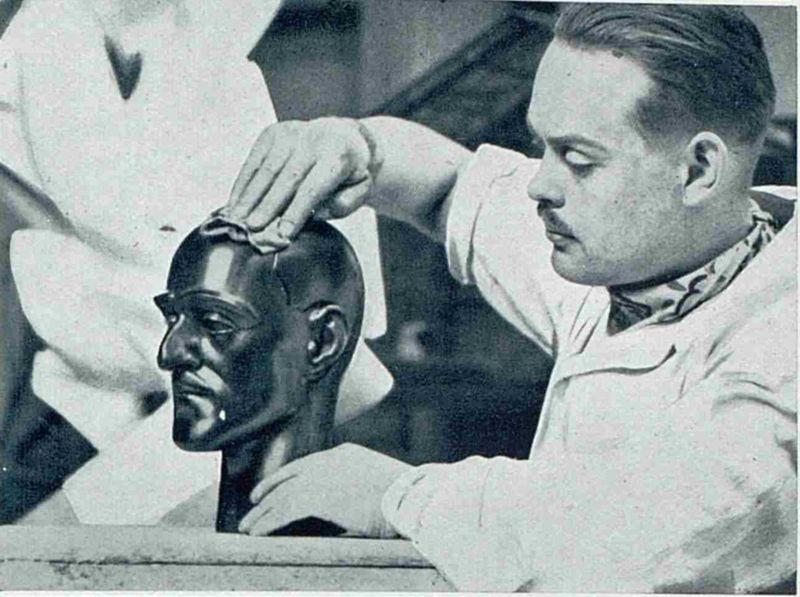
Lambert’s best-known work includes the life-size bronze statue of the ballerina Dame Margot Fonteyn, acquired by the Royal Ballet School in 1956. Another notable work The Lark Ascending, was crafted from a 250-year-old church oak gatepost and became part of the Rutherston Collection at Manchester City Art Gallery. He also created public sculptures, such as the Symbol of Communication for the Time-Life Building in London and a statue of Viscount Nuffield for Guy’s Hospital. His portrait busts included modernist depictions of prominent figures, including William Walton, Dame Edith Sitwell, and J.B. Priestley, with some housed at the National Portrait Gallery. One of his most distinctive busts, created in 1928, was of Stephen Tennant, who described it as having a 'null, poisonous beauty' (Bonhams). Maurice Lambert died on 17 August 1964 in London, England. In the UK public domain, his work is represented in the collections of Tate, Government Art Collection, National Portrait Gallery, and the Royal Academy of Arts, among others and many photographs with Lambert as sitter are held in the collection of the National Portrait Gallery. Posthumously, his work has been reappraised and shown in the context of British Surrealism.
Irene Iacono
Related books
- Hans Fletcher, ‘Lambert, Maurice Prosper’, in Oxford Dictionary of National Biography (2004)
- Vanessa Nicolson, The Sculpture of Maurice Lambert (Hampshire: Henry Moore Foundation in association with Lund Humphries, 2002)
- 20th Century British Paintings and Sculpture (London: Belgrave Gallery, 1991)
- Giles Auty, ‘Exhibitions’, The Spectator, 26 November 1988, p. 56
- ‘Mr. Maurice Lambert’, The Times, 20 August 1964, p. 10
- Illustrated London News, 11 May 1946, p. 10
- Sculpture and Drawings by Maurice Lambert (London: Alex. Reid & Lefevre Ltd., 1932)
- 'Mr. Lambert's Sculpture', The Sunday Times, 5 May 1932
- ‘Maurice Lambert – And His New Half-Flower ‘Narcissus’’, The Sketch, 2 March 1932, p. 361
- ‘Very Modern Sculpture’, The Sketch, 3 February 1932, p. 193
- ‘Sculpture in Aluminium and Plate – Glass: Lambert Innovations’, The Sketch, 7 August 1929, p. 29
- P. G. Konody, ‘Art and Artists: Mr. Maurice Lambert's Sculpture’, The Observer, 16 June 1929, p. 14
- D.C.F., Sculpture By Maurice Lambert: Tense Symbolic Work, The Manchester Guardian, 14 June 1929, p. 8
- ‘High Lights in a Modern Studio’, The Graphic, 8 June 1929, p. 32
- G.G., ‘Art’, The Spectator, 29 June 1929, p. 1005 London Daily Chronicle, 5 March 1929, p. 16
- ‘Beaux Arts Gallery’, The Times, 17 February 1928, p. 20
- ‘The Claridge Gallery’, The Times, 15 June 1927, p. 10
- Edmund Dulac, Exhibition of Sculpture by Maurice Lambert: at the Claridge Gallery (London: Claridge Gallery, 1927)
Public collections
Related organisations
- Chelsea College of Art (student)
- London Group (member)
- Royal Academy of Arts (professor)
- Seven and Five Society (member)
Related web links
- Contemrporary Art Society
- Getty Images
- Olympics
- National Portrait Gallery
- Public Statues and Sculpture Association
- Royal Academy online resource
- University of Glasgow, Mapping the Practice and Profession of Sculpture in Britain and Ireland 1851-1951
Selected exhibitions
- Carving in Britain From 1910 to Now, The Fine Art Society, London (2012-13)
- British Surrealism in Context: A Collector’s Eye, City Art Gallery, Leeds (2009)
- British Surrealism and Other Realities: The Sherwin Collection, Institute of Modern Art, Middlesbrough (2008)
- Shine: Sculpture and Surface in the 1920s and 1930s, City Art Gallery, Leeds (2002)
- Maurice Lambert 1901-1964, Belgrave Gallery, London (1988)
- Diploma Gallery, Royal Academy of Arts, Burlington House,London (1960)
- Sculpture and Drawings by Sculptors, British Art Centre, Stafford Gallery, London (1940)
- Sculpture by O'Connor Barrett, Maurice Lambert, Mrs. R.M. Milward and J.R. Skeaping, City of Birmingham Museum and Art Gallery, Birmingham (1936)
- National Society of Painters, Sculptors, Engravers, and Potters, Royal Institute Galleries, London (1936)
- Royal Scottish Academy, Edinburgh, Scotland (1935)
- Contemporary Sculpture, Wednesday-Thursday Gallery (1934)
- Sculpture and Drawings by Maurice Lambert, Alex, Reid & Lefevre, London (1932)
- National Society, Roayal Institute Galleries, London (1931)
- Maurice Lambert, Tooths Gallery, London (1929)
- Sculpture by Maurice Lambert, Claridge Gallery, London (1927)
- Group exhibition, Mayor Gallery, London (1926)
- Works by Some Unknown and Less-known Artist, Goupil Gallery, London (1925)
Ben Uri archive
Consult items in the Ben Uri archive related to [Maurice Lambert]
Ben Uri library
Publications related to [Maurice Lambert] in the Ben Uri Library