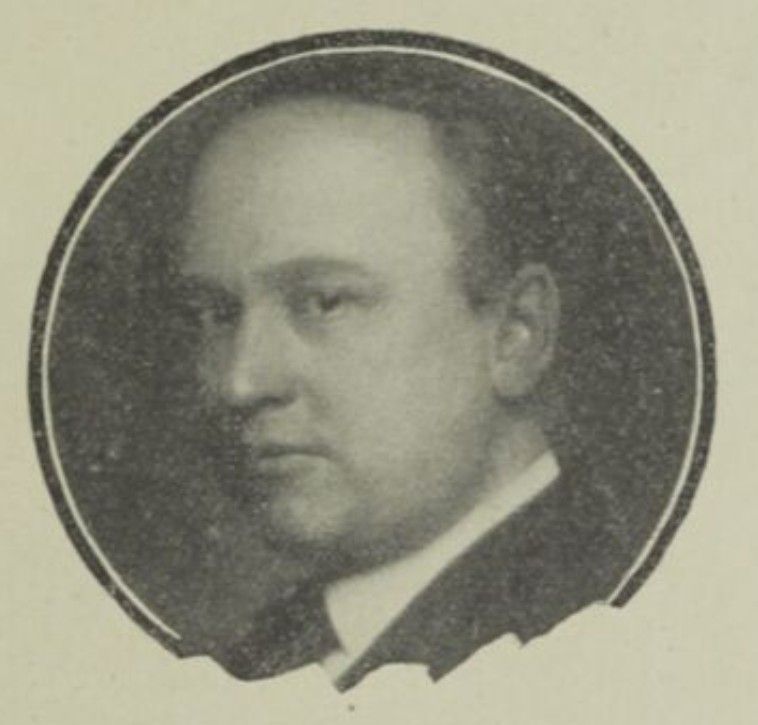
Born: 1988 Wels, Austria-Hungary (now Austria)
Died: 1971 London, England
Year of Migration to the UK: 1928
Biography
Architect Michael Rosenauer was born on 21 July 1884 in Wels, Austria-Hungary (now Austria), the son of the architect and builder Michael Rosenauer. He studied architecture at the Technische Hochschule in Graz and then at the Technische Hochschule in Vienna, where he was taught by Karl König and Max von Ferstel. After qualifying in 1908 as an architect and engineer, Rosenauer established himself as an independent architect in Vienna. His early work was influenced by the architects of the Vienna Ringstrasse and by neo-Romanticism. He worked across domestic, commercial, industrial and public commissions, adapting style to each project, client and function, rather than adhering to a single architectural programme (Benton 2006). Among his early and interwar Austrian works were private houses, factory buildings, film studios, Dorotheum auction-house projects and large schemes for municipal housing in Vienna. He also designed the well-known house for Richard Strauss in Vienna. Housing was central to his reputation. In the 1920s he designed major residential schemes for the municipality of Vienna; a 1928 profile credited him with flat buildings containing over 2,500 apartments for the poor in Vienna (The Sphere 1928, p. 48). These projects helped establish him as a specialist in low-cost housing, attentive not only to economy and planning, but also to the social and psychological qualities of domestic spaces. He argued that housing should be cheerful rather than monumental, and that well-designed flats, with gardens, central services and carefully planned interiors, could provide healthier and more efficient alternatives to cramped urban housing (Evening Post 1931, p. 8).
On the strength of his experience in social housing, he was invited to England in 1928 to advise the Ministry of Health and the London County Council (LCC) on slum clearance and the design of working-class housing, and he subsequently settled in London. He also maintained links with continental Europe, including a Paris office around the turn of the decade, but London became the main centre of his later career. He became a naturalised British citizen in 1934, the year he showed an architectural drawing of Troy Court in Kensignton at the Royal Academy Summer Exhibition. He was elected Fellow of the Royal Institute of British Architects (FRIBA) in 1938. During the 1930s Rosenauer established himself within London’s architectural and social world. He designed apartment buildings and luxury flats, including Arlington House in Westminster, and produced interiors for fashionable restaurants, clubs and theatres. These commissions included work for Ciro’s Club, the Malmaison Restaurant and several West End theatres, among them the Lyric, Cambridge, Globe, St James’s and Her Majesty’s. He also remodelled Cecil Beaton’s country house and was associated with figures from the worlds of theatre, design and performance, such as Beaton, Oliver Messel and Tilly Losch.
The Second World War interrupted his British practice. Faced with poor conditions for commissions, he worked in the United States, where he served in connection with federal public housing and taught urbanism and interior design, including at the University of Pennsylvania; he was also associated with planning conferences in Baltimore. Some of his American proposals, including schemes for airports and high-rise buildings, remained unbuilt. His American period nonetheless reinforced his expertise in large-scale planning, interiors and modern commercial architecture, and in 1941 he became a member of the American Institute of Architects.
Returning to London after the war, Rosenauer entered the most visible phase of his British career. His first major post-war commission was the Time-Life Building in New Bond Street (1951–53), an office building that embodied his long-standing interest in rhythm, collaboration and the integration of architecture with sculpture, interiors and design. It brought together work by leading artists and designers, including Henry Moore and Ben Nichoilson, and was considered one of the most important British architectural projects of the 1950s (Biographical Dictionary of British and Irish Architects 1800–1950). From the 1950s onward he became especially prominent as a designer of hotels. In London these included the Westbury Hotel in Conduit Street, the Carlton Tower in Cadogan Place, the Hotel and International Centre at Portman Square, and the Inn on the Park on Park Lane. Rosenauer’s later interests also extended to writing and theory. In addition to Modern Office Buildings (1955), he wrote on architecture, urbanism, nationalism and internationalism, and maintained a lifelong interest in the relationship between architecture, music and the visual arts.
Michael Rosenauer died in London, England on 11 April 1971. Posthumously, his work was the subject of the exhibition Michael Rosenauer, Architect (1884–1971): Vienna–London–New York, shown at the Building Centre, London, and at the Nordico Stadtmuseum, Linz, Austria (1988), and was also featured that year in Henry Moore and Michael Rosenauer at The Fine Art Society, London, a show focused on his collaboration with Henry Moore on architectural sculpture. In 1995 he was included in the survey exhibition, A Different World: Emigre Architects in Britain: 1928-1958, curated by Charlotte Benton, at the RIBA Heinz Gallery, London.
Irene Iacono
Related books
- Suzanne Waters, ‘Parting Shot. Time Life Building, New Bond Street, London, 1953; Architect: Michael Rosenauer, Interiors by Sir Hugh Casson and Sir Misha Black’, RIBA Journal, Vol. 130, No. 6, 2023 June, p. 114
- Elain Harwood, Mid-Century Britain: Modern Architecture 1938-1963 (London: Batsford, 2021)
- Charlotte Benton, ‘Rosenauer, Michael’, in Oxford Dictionary of National Biography (Oxford: Oxford University Press, 2006)
- Cynthia Fischer, Michael Rosenauer: Linz-London, exhibition catalogue (Linz: Nordico, Museum der Stadt Linz, 2004)
- Charlotte Benton, A Different World: Emigre Architects in Britain 1928-1958 (London: RIBA Heinz Gallery, 1995)
- James Fisher, ‘Time Life Allowed to Keep Art from Listed Building; Original Architect (1952): Michael Rosenauer’, Building Design, No. 1206, 3 February 1995, p. 24
- Michael Rosenauer, Architect (1884–1971): Vienna, London, New York, exhibition catalogue (London: Gallery Lingard, London; Linz: Museum der Stadt, 1988)
- Henry Moore and Michael Rosenauer (London: Fine Art Society, 1988)
- ‘Obituary’, Building, Vol. 220, 23 April 1971, pp. 17, 80
- ‘Mr Michael Rosenauer’, The Times, 14 April 1971, p. 16
- ‘Britain’s Tallest Hotel Planned for Top Blitzed Site’, Marylebone and Paddington Mercury, 22 July 1960, p. 1
- ‘Extensions To Three London Hotels’, The Times, 21 March 1956, p. 7
- ‘The Changing View of London: Some New Buildings’, The Times, 29 November 1938, p. 18
- ‘Building. Modern Developments and New Methods’, The Times, 12 February 1935, p. 37
- ‘Arlington St. Flats’, The Daily Telegraph, 28 June 1934, p. 13
- ‘Austrian Art and Industry’, The Times, 16 March 1934, p. 12
- ‘Flats a Cure for Slums’, Evening Post, 17 September 1931, p. 8
- ‘A Portraitist in Architecture’, The Sphere, 17 November 1928, p. 48
Related organisations
- Johns Hopkins University, Baltimore (teacher)
- Technische Hochschule, Graz (student)
- Technische Hochschule, Vienna (student)
- University of Pennsylvania, Philadelphia (teacher)
- Royal Academy of Arts (exhibitor)
Related web links
- Art History Research
- British History Online, Survey of London
- Gallery Lingard
- Getty Images
- HCI Architects, Time & Life Building
- Henry Moore Foundation
- International Architectural Database, Archinform
- London Deco Flats
- Manchesterhistory.net, Time and Life Building
- RIBA photographs
- Robert Burstow, British Art Studies, Issue 26 – May 2025, Between the Easel and the Mural: Ben Nicholson’s Large Abstract Panel Paintings for Modern Public Interiors in Early Cold War Britain
- Royal Academy of Arts, Summer Exhibition, 1934
- The New Yorker, 'The Liveliness of London'
- The New York Times, Obituary
- UCL research / South West Marylebone
Selected exhibitions
- A Different World: Emigre Architects in Britain 1928-1958, RIBA Heinz Gallery, London (1995)
- Henry Moore and Michael Rosenauer, The Fine Art Society / Gallery Lingard, London (1988)
- Royal Academy of Arts, London (1934)