Born: 1943 České Budějovice, Czechoslovakia (now Czech Republic)
Died: 2024 Aberdaron, Wales
Year of Migration to the UK: 1968
Biography
Ceramicist Oldrich Asenbryl was born in 1943 in České Budějovice, Czechoslovakia (now Czech Republic). He trained for four years at the Bechyně College of Ceramics, acquiring a grounding in industrial production, wheel throwing and plaster mould-making. He subsequently worked in a majolica factory, finding an outlet for his creativity through jazz, which he played in a band. In August 1968, while holidaying in England, he learned of the Soviet-led invasion of Czechoslovakia, which crushed the reform movement known as the Prague Spring. He decided not to return home, despite speaking little English. Initially employed making picture frames for a Covent Garden gallery in London, he was introduced by potter Kenneth Clark to ceramicist Alan Caiger-Smith and joined Aldermaston Pottery, where he threw and decorated majolica ware. He had hoped to travel onwards to Brazil, but was unable to obtain a visa and remained in Britain.
Around 1970 Asenbryl established a pottery with fellow Aldermaston potter Simon Rich in Tisbury, Wiltshire, occupying a modest workshop with accommodation overhead. Drawing on Asenbryl's production expertise, they made light, colourful domestic stoneware, decorated either with expressive brushwork over white glaze, or with contrasting tenmoku and ash glazes. Their designs combined aesthetic refinement with efficient production. The partnership lasted approximately three years, after which Rich left for Wales and Asenbryl continued with an assistant. Both potters exhibited at the Bladon Gallery, Hurstbourne Tarrant, Hampshire, in 1972, where their designs received favourable notice in the Southern Daily Echo. By 1975, having saved enough to establish a more independent practice, Asenbryl moved to an isolated property on the Llŷn Peninsula in North Wales. There he built a larger studio and kiln capable of reduction firing, later opening a retail outlet in nearby Sarn Mellteyrn, where he sold much of his work directly to visitors.
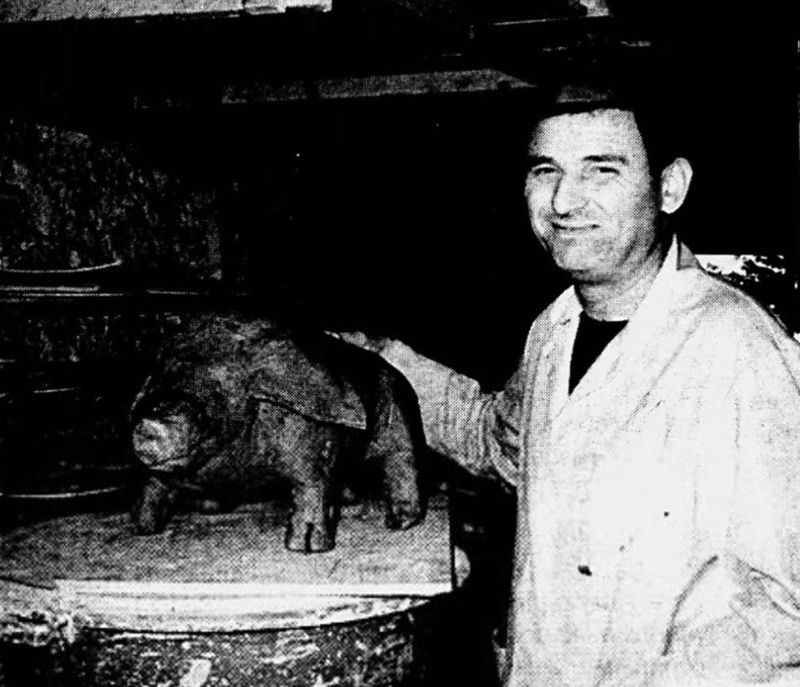
Alongside tableware, Asenbryl pursued an increasingly experimental practice, inspired by jazz improvisation, American Pop art and the Funk ceramics movement. His witty, sometimes unsettling objects included distorted clocks, expressive hands and pig's heads presented on platters. In 1975 he represented Britain at the Second U.S. International Ceramic Symposium at Arrowmont School of Crafts, Gatlinburg, Tennessee, where he experimented with combinations of thrown and slip-cast forms. He made 'self-pouring' teapots incorporating casts of human hands and used a pig's head obtained from a local slaughterhouse to produce a sculptural work (Hieronymus 1975; Layer n.d.). In Wales his work became more abstract, while his functional porcelain featured increasingly free decoration, using brushing, sponging and slip trailing. His larger dishes combined glazes, enamels, lustres and photographic transfers.
He showed in a joint exhibition at the Lantern Gallery, Worsley, Greater Manchester, n 1978, alongside Rod Taylor and Steve Wright, and in a group show of five North Wales potters at Bolton Art Gallery, Lancashire in 1981. The same year, his Flat Teapot was included in An International Ceramics Symposium at the Louisville Art Gallery, Kentucky, featuring 48 works produced during the 1975 symposium in Tennessee. Reviewing the exhibition, Sarah Lansdell praised its combination of humour and technical accomplishment (Lansdell 1981). He also exhibited at the Oxford Gallery and in Belgium and the United States (Course 1987). In 1983, however, a severe stroke paralysed the left side of his body, fundamentally changing his working methods. Despite pessimistic medical predictions, he returned to making pottery, throwing simple forms one-handed with very soft clay, employing mechanically formed or extruded shapes, and relying on assistants for production. He increasingly concentrated his creative energy on surface decoration (Course 1987; Layer n.d.). His work continued to be exhibited, including in Porcelain and Stoneware, 1984 at Southampton Art Gallery and the touring Artist Potters Now, shown at Sotheby's in London in 1985. His experimental approach, however, was not universally appreciated: a Southampton reviewer questioned his use of Pop art imagery, while Terence Mullaly, reviewing Artist Potters Now, dismissed his unconventional forms as 'silly shapes' (The Echo 1984; Mullaly 1985). In 1988, he participated in a group exhibition at Mostyn, Llandudno.
Following his illness, Christian faith became central to Asenbryl's outlook and work. In 1989, he described turning away from intellectually conceived one-off works to concentrate on high-quality domestic ware and the pleasure of selling directly to customers (Asenbryl 1989, quoted in Layer n.d.). In a 1991 interview at Sarn Pottery, where his deliberately crooked vessels, bread crocks, salt jars and garden ornaments attracted visitors, he credited his perseverance to God and displayed Biblical quotations around his shop (Caernarfon and Denbigh Herald 1991). He also lectured in Cardiff, Newport, Belfast and Bechyně and participated in international ceramic symposiums in Aberystwyth, Wales, in 1987 and Wałbrzych, Poland, in 1999 (Layer n.d.). Oldrich Asenbryl died in Aberdaron, Wales on 14 May 2024. In the UK public domain, his work is represented in the collections of the Amgueddfa Cymru – Museum Wales; Fitzwilliam Museum, Cambridge; and Centre of Ceramic Art, York, while archive material is retained in the Craft Potters Association Archive at the National Library of Wales.
Irene Iacono
Related books
- Jane White, Alan Caiger-Smith and the Legacy of the Aldermaston Pottery (Oxford: Ashmolean Museum, 2018), p. 67, 68
- Adriana Kiss-Davies, The Exile Experience: Hungarian and Czech Cold War Refugee Artists in Britain, PhD thesis, Aberystwyth University, 2011
- ‘From Red Army’s Grip to Bliss of Rural Wales’, Caernarfon and Denbigh Herald, 11 October 1991, p. 23
- Oldrich Asenbryl, ‘A Potter in Wales’, Ceramics Monthly, February 1989, pp. 26–27
- Deiniol Tegid, ‘Check Out the New Exhibition of Expressions’, The North Wales Weekly News, 18 February 1988, p. 51
- Stephen Course, ‘Oldrich Asenbryl’, Ceramic Series, No. 21, Aberystwyth Arts Centre, 1987
- Terence Mullaly, ‘Misguided Ingenuity, The Daily Telegraph, 5 September 1985, p. 13
- L.T., ‘Gallery Exhibition Has Great Scientific Value’, The Echo, 23 July 1984, p. 2
- Sarah Lansdell, ‘Welty Used Her Photos For Inspiration’, The Courier-Journal, 30 August 1981, p. 130
- ‘Pot-It-Yourself’, The Bolton News, 15 December 1980, p. 4
- ‘Lantern Show’, The Bolton News, 10 April 1978, p. 4
- ‘International Ceramic Symposium’, The Arrow, Vol. 92, No. 2, Winter 1975
- Clara Hieronymus, ‘International Potters Meet in Gatlinburg’, The Tennessean, 12 September 1975, p. 53
- ‘Symposium’, The Tennessean, 31 August 1975, p. 71
- ‘Big Display of Quality Art’, Southern Daily Echo, 29 March 1972, p. 9
Public collections
Related organisations
- Bechyně College of Ceramics (student)
Related web links
- Craft Potters Association Archive, National Library of Wales
- Death notice
- Joanna Bird
- McNeill Gallery
- Naturalisation Notice, London Gazette, 22 April 1975
- Tennessee Arts Commission
Selected exhibitions
- Oldrich Asenbryl: Ceramics, National Museum of Wales, Cardiff (1989)
- 12 Studio Potters, Aberystwyth Arts Centre, Wales (1989)
- Group Exhibition, Mostyn Art Gallery, Llandudno, Wales (1988)
- Artist Potters Now, Sotheby's, London (1985)
- Porcelain and Stoneware, Southampton Art Gallery, Southampton (1984)
- An International Ceramics Symposium, Louisville Art Gallery, Kentucky, USA (1981)
- Group Exhibition of five North Wales potters, Bolton Art Gallery, Bolton, Lancashire (1981)
- Oldrich Asenbryl, Institute of Contemporary Arts, Side Show in the Restaurant, London (1980)
- Oldrich Asenbryl: Ceramics, Oxford Gallery, Oxford (1979)
- Joint Exhibition with Rod Taylor and Steve Wright, Lantern Gallery, Worsley, Greater Manchester (1978)
- Members' Exhibition, Bladon Gallery, Hurstbourne Tarrant, Hampshire (1972)
Ben Uri archive
Consult items in the Ben Uri archive related to [Oldrich Asenbryl]
Ben Uri library
Publications related to [Oldrich Asenbryl] in the Ben Uri Library