Born: 1908 Tarnow, Poland
Died: 1979 Birmingham, England
Year of Migration to the UK: 1929
Other name/s: Pauline Segal
Biography
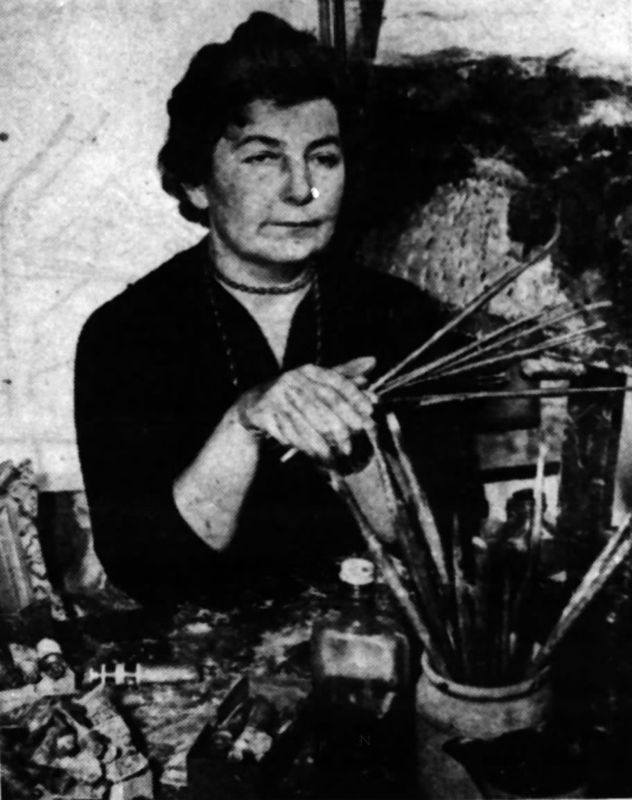
Artist Pauline Glass (née Pauline Segal) was born into a Jewish family in Tarnów, Poland, in 1908, although contemporary British press accounts variously described her as Belgian-born or, more specifically, as born in Brussels. She lived in Belgium and studied at the Académie Royale des Beaux-Arts in Brussels, where she received strict academic training focussed on form, including portraiture, still life and flower painting.
Following her marriage to Dr Samuel Glass, a Birmingham doctor, around 1929–30, Glass moved to England and settled in her husband's home city. The couple lived at 146 Lordswood Road, Harborne, and had one son, Alan, who later became a doctor and taught at Birmingham University Medical School. After migrating, Glass furthered her studies at Birmingham School of Art and began exhibiting at the Royal Academy of Arts in 1937. In 1939, as ‘Miss Pauline Glass of Edgbaston’, she showed The Knitter, which a critic described as painted ‘in a natural manner’ and as ‘a vivid impression’ (Birmingham Daily Gazette 1939, p. 4). She exhibited there 20 times between 1937 and 1969. Her subjects included flower pieces, portraits, interiors and landscapes, and she was particularly noted for her paintings of flowers and domestic subjects.
Glass’s London reputation developed in the postwar years. In February 1950, nearly 30 of her works were shown at Walker’s Galleries, New Bond Street, in an exhibition shared with Mary Dickinson and A. C. Winter. The same report noted that her flower pieces and portraits had appeared regularly in London exhibitions for several years, and that she had painted several Birmingham personalities, including a theatre sister at Queen Elizabeth Hospital (The Birmingham Post 1950, p. 4). Later that year she exhibited The Black Couch at the New English Art Club (NEAC). In 1951 two of her oil paintings were included in the eighteenth exhibition of the National Society of Painters, Sculptors and Engravers at the Royal Institute Galleries, London, and in the same year her portrait Miss Onyekwere Ngbarange was accepted for the Royal Academy Summer Exhibition. In 1953, a portrait of a Queen Elizabeth Hospital nurse, possibly the same work as the earlier theatre-sister portrait, was hung at the Paris Salon and described in the Birmingham press as one of her favourite paintings. During the 1950s she continued to exhibit widely. She held a further show in Oxford in 1956, where 17 oil and gouache paintings were displayed at the Regency restaurant in St Giles, and another exhibition at Thrussells Ltd in Birmingham. In 1958 her work was included in Ben Uri’s Annual Exhibition. In 1959 her paintings were shown at the Elisabeth Gallery, Coventry, alongside sculpture by George Wagstaff.
Glass was closely associated with the artistic life of Birmingham and the Midlands. She was elected a member of the Royal Birmingham Society of Artists in 1957 and later became its honorary librarian and vice-president. She exhibited at RBSA shows, including the 1959 Spring Exhibition, where her View of Frejus was singled out as a colourful and successful watercolour (Birmingham Daily Post 1959, p. 22). In 1957 she also contributed to Pictures for the Home at the Midlands Ideal Home Exhibition at Bingley Hall, an initiative intended to bring art into ordinary domestic settings rather than formal galleries. By 1959 she was also described as a teacher at Bournville School of Art, and later taught art at Edgbaston High School for Girls and helped teach children with cerebral palsy at Harborne (Coventry Evening Telegraph 1959, p. 12; The Birmingham Post 1979, p. 3). Although based in Birmingham, Glass drew inspiration from the surrounding countryside, especially Warwickshire and Worcestershire, and particularly liked painting in places such as Hagley Park. She worked from a small private studio at home, usually standing at her easel for a few hours a day. She was self-critical, sometimes worrying that she painted too quickly, but she accepted this as part of her working method. While trained in figurative traditions, she remained interested in modern art and admitted that she wished she could paint abstract pictures, though she found this difficult after her academic training (The Birmingham Post 1963, p. 25).
In later years Glass continued to exhibit and receive favourable critical attention. In 1967, her painting Venice at the RBSA was praised for using colour beautifully, while in 1970 a critic wrote: ‘Pauline Glass’s impressionist studies are always a pleasure to look at’ (L.B.D. 1970, p. 20). Outside her artistic career, she was active as a hospital librarian at Queen Elizabeth Hospital, a member of the Central Birmingham Soroptimist Club, the Friends of the Art Gallery and the Midland Antique Collectors’ Circle. Pauline Glass died in Birmingham, England on 12 January 1979. Her work is not currently represented in UK public collections.
Irene Iacono
Related books
- ‘Pauline Glass’, Jewish Chronicle, 29 June 1979, p. 12
- ‘Mrs. Pauline Glass’, The Birmingham Post, 18 January 1979, p. 3
- L.B.D., ‘Six Artists’, Birmingham Daily Post, 11 August 1970, p. 20
- L.B.D., ‘Autumn Exhibition at the RBSA Galleries’, Birmingham Daily Post, 7 October 1967, p. 22
- ‘Mrs. Pauline Glass’, The Birmingham Post, 2 September 1963, p. 25
- ‘Contrasts in Art at Exhibition’, Birmingham Daily Post, 15 October 1960, p. 7
- ‘Art Shows’, Coventry Evening Telegraph, 1 May 1959, p. 12
- ‘R.B.S.A. Water Colours and Sculpture’, Birmingham Daily Post, 11 April 1959, p. 22
- ‘Dudley Artists’, Stourbridge News, 7 March 1959, p. 7
- ‘Pictures for the Home’, The Birmingham Post, 2 October 1957, p. 26
- ‘Painting and Pottery’, Birmingham Weekly Post and Midland Pictorial, 14 December 1956, p. 4
- ‘Home Pages’, Birmingham Weekly Post and Midland Pictorial, 9 November 1956, p. 12
- ‘Two Birmingham Women Have Their Paintings Hung in Paris Salon’, Birmingham Gazette, 6 June 1953, p. 3
- ‘‘Progressive’ Artists Show Their Work’, Smethwick Telephone, 13 June 1952, p. 7
- ‘Midland Artists Prominent in Academy Show’, Birmingham Evening Mail, 5 May 1951, p. 3
- ‘A Painting Of Snow in Moseley’, Birmingham Gazette, 12 February 1951, p. 4
- ‘Birmingham Painters’, The Birmingham Post, 11 May 1950, p. 2
- ‘Flowers and Portraits’, The Birmingham Post, 16 February 1950, p. 4
- ‘Midland Artists at the Academy’, Birmingham Daily Gazette, 2 May 1949, p. 2
- ‘Dudley Artist’, Birmingham Daily Gazette, 29 April 1939, p. 4
- ‘Midland Artists’ Works at Academy’, Birmingham Daily Gazette, 3 May 1937, p. 7
Related organisations
- Birmingham School of Art (student)
- Bournville School of Art (teacher)
- Edgbaston High School for Girls (teacher)
- Central Birmingham Soroptimist Club (member)
- Friends of the Art Gallery (member)
- Midland Antique Collectors’ Circle (member)
- Royal Academy of Arts, Brussels (student)
- Royal Academy of Arts (exhibitor)
Related web links
Selected exhibitions
- Group exhibition, Bilston Art Gallery, Staffordshire (1960)
- Solo exhibition, Royal Birmingham Society of Artists, New Street Gallery, Birmingham (1960)
- Dudley Art Circle exhibition, Brierley Hill, Birmingham (1959)
- Royal Academy of Arts, London (1969, 1967, 1966, 1965, 1964, 1960, 1959, 1958, 1957, 1955, 1953, 1952, 1951, 1949, 1948, 1947, 1946, 1945, 1939, 1937)
- RBSA Autumn Exhibition, Royal Birmingham Society of Artists, Birmingham (1967)
- Royal Society of British Artists, London (1967)
- Paintings by Pauline Glass and Sculpture by George Wagstaff, Elisabeth Gallery, Coventry, Warwickshire (1959)
- RBSA Spring Exhibition, Royal Birmingham Society of Artists, Birmingham (1959)
- Ben Uri Annual Exhibition, Ben Uri Gallery, London (1958)
- Midlands Ideal Home Exhibition, Bingley Hall, Birmingham (1957)
- Solo exhibition, Regency restaurant, St Giles, Oxford (1956)
- Royal Society of British Artists, London (1955)
- Paris Salon, Paris, France (1953)
- Birmingham Artists’ Committee, New Street Galleries, Birmingham (1952)
- New English Art Club, London (1950)
- Paintings by Mary Dickinson, Pauline Glass, A. C. Winter, Walker’s Galleries, London (1950)
Ben Uri archive
Consult items in the Ben Uri archive related to [Pauline Glass]
Ben Uri library
Publications related to [Pauline Glass] in the Ben Uri Library