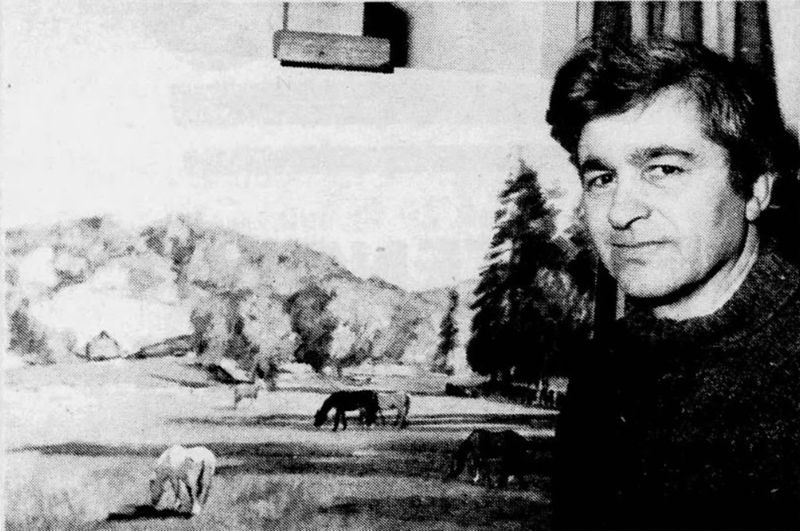
Born: 1932 Turin, Italy
Died: 2020 England
Year of Migration to the UK: 1969
Other name/s: Pier L. Baffoni
Biography
Painter Pier Luigi Baffoni was born in Turin, Italy, in 1932. He came from a family of professional artists, including his uncle Achille Parachini, a noted portrait painter, and began studying art seriously during his teens. His early training took place in Turin, where he developed a strong attachment to European painting traditions. He particularly admired the nineteenth-century Italian painters, Giovanni Segantini and Giovanni Fattori, later recalling that ‘They were my pop stars’ (Bedfordshire on Sunday 1986, p. 19). Baffoni regarded himself as part of a continuing classical tradition and consistently looked to earlier masters for discipline, inspiration and artistic continuity.
Baffoni first came to London in 1969 to study English, where he met Mary, his future wife. They married four years later and settled in Lower Stondon, Bedfordshire, in 1973. From his home and studio in Station Road, he established himself as a professional painter, working mainly in oils, but also in watercolour, pastel and drawing. His subjects included landscapes, portraits, still lifes and interiors with figures. Baffoni said that the English climate led him to paint more figures indoors, whereas in Italy he would have painted more landscapes (Bedfordshire on Sunday 1986, p. 19). He also painted extensively in the Bedfordshire countryside, depicting villages and rural locations including Southill, Shillington, Meppershall and Stondon. Baffoni believed that experience had given him greater control over colour and changed the way he interpreted his subjects. His Still Life, runner-up for the John Goss Prize at the Hertford Art Society’s 1985 annual exhibition, was described by a Hertfordshire Mercury critic as ‘a fine example of rich colour and confident brushwork’ (Saunders, 1985, p. 4). Other reviews described Reading Time as ‘serene’ and identified his view of the Venice Lido beneath a blue sky and threatening rain as one of the exhibition’s most striking works (J.H., 1989, p. 5; Hertford Mercury and Reformer, 1980, p. 18).
Soon after settling in England, Baffoni became active within professional exhibiting societies. In 1975 he was elected a member of the National Society of Painters, Sculptors and Printmakers and joined its council the following year. After having paintings accepted for three consecutive annual exhibitions of the Royal Institute of Oil Painters (ROI), he was elected a full member in 1979, one of only five new members admitted that year. He subsequently served on the council and, in 2014, was appointed an Honorary Senior Member of the ROI. Baffoni exhibited frequently in Britain and abroad. His work appeared regularly at the Mall Galleries and was shown in London, Cambridge, Reading, Petersfield and Hitchin, as well as at the Century Galleries in Windsor and the Grand Palais in Paris. In 1979 he held a solo exhibition at Hitchin Museum and Art Gallery and also showed at Luton Library. In October that year, four paintings—Waiting, Silhouette, Window and Still Life with Pumpkin and Nasturtiums – were included in the Royal Institute of Oil Painters’ 92nd annual exhibition at the Mall Galleries, opened by former prime minister, Harold Wilson.
A substantial solo exhibition at Bromham Mill Gallery, near Bedford, opened in 1986. It included approximately 25 oil paintings and 20 drawings and pastels, encompassing landscapes, portraits, interiors and still lifes. More than 200 people attended the private view, and many works depicted Bedfordshire subjects. Over the course of his career, Baffoni received several awards at Royal Institute of Oil Painters exhibitions. These included the prize for best figure painting in 1983 for On the Terrace; the Alan Gourley Prize and highest public vote in 1993 for Summer and Kasia respectively; a second Alan Gourley Prize in 2005 for The Two Sisters. He also contributed articles to Leisure Painter and Artists and Illustrators and was featured in Ron Ranson’s Modern Oil Impressionists, published in 1992.
Alongside his easel painting, Baffoni undertook several religious works in Hertfordshire and Bedfordshire. In the early 1980s, Fr Robert Henshaw commissioned him to paint a Madonna and Child, known as Our Lady Help of the Bereaved, for the Church of Our Lady Immaculate and St Andrew in Hitchin. The painting is situated in the corner to the left of the entrance, in the area containing the parish book of remembrance, where bereaved visitors can pray and light candles for their loved ones. In response to Fr Henshaw’s request, Baffoni adopted a Byzantine-inspired treatment with iconic elements, intended to draw the viewer into contemplation. The work was installed during a special ceremony held on an unidentified feast of the Virgin Mary. His other religious works in local churches included a large depiction of St Augustine in the Church of St Francis of Assisi, Shefford, and a Nativity in the Church of the Holy Family, Luton.
Pier Luigi Baffoni died in England on 21 September 2020. His work is not currently represented in UK public collections though his religious work can be seen in a number of churches outside London.
Irene Iacono
Related books
- Roy Ranson, Modern Oil Impressionists (Newton Abbot: David & Charles,1992)
- ‘Pier-Luigi’s Choice Demo’, Hertfordshire Mercury, 6 March 1992, p. 12
- J.H., ‘Art Leaders’ Work on Show’, Hertfordshire Mercury, 5 May 1989, p. 5
- ‘Paintings on Show at Mill’, Biggleswade Chronicle, 21 March 1986, p. 19
- ‘Italian Landscapes at the Watermill’, Leighton Buzzard Observer and Linslade Gazette, 13 May 1986, p. 43
- ‘Village Voice’, Bedfordshire Times and Independent, 27 March 1986, p. 12
- ‘Pier Luigi Baffoni… Exhibition at Bromham Mill’, Bedfordshire on Sunday, 23 March 1986, p. 19
- Richard Saunders, ‘Art Show Return Home’, Hertfordshire Mercury, 10 May 1985, p. 4
- ‘Work by Local Artists on Show’, Hertford Mercury and Reformer, 31 October 1980, p. 18
- ‘Top Honour for Artist’, Biggleswade Chronicle, 2 November 1979, p. 34
- ‘Royal Seal of Approval’, Biggleswade Chronicle, 12 October 1979, p. 32
- ‘One Man and His Paintings’, Biggleswade Chronicle, 23 March 1979, p. 26
Related organisations
- Hertford Art Society (member)
- National Society of Painters, Sculptors and Printmakers (member)
- Royal Institute of Oil Painters (member)
Related web links
Selected exhibitions
- Royal Institute of Oil Painters, Mall Galleries, London (2003, 1996, 1989)
- Hertford Art Society, Corn Exchange, Hertford, Hertfordshire (1989)
- Drawings and Paintings by Pier Luigi Baffoni, Bromham Mill Gallery, Bromham, Bedford, Bedfordshire (1986)
- Hertford Art Society, Corn Exchange, Hertford, Hertfordshire (1985)
- Royal Institute of Oil Painters, Mall Galleries, London (1981)
- Hertford Art Society exhibition, Coleman Crafts, Hertford, Hertfordshire (1980)
- Solo exhibition, Hitchin Museum and Art Gallery, Hitchin, Hertfordshire (1979)
- Royal Institute of Oil Painters, Mall Galleries, London (1979)
- Royal Institute of Oil Painters, Mall Galleries, London (1978, 1977, 1976, 1975)
- Recent Paintings by Pier Luigi Baffoni, Ernest Hilton Ltd., Cambridge, Cambridgeshire (1975)