Born: 1941 London, England
Other name/s: Ruth Taylor Jacobson
Biography
Artist, printmaker, stained-glass artist and teacher Ruth Taylor Jacobson was born in London, England in 1941 to Jewish parents; an English father and a Polish-Jewish mother from Kraków, Poland. Brought up in Hampstead Garden Suburb, she attended Henrietta Barnett School and demonstrated an aptitude for drawing from early childhood. From 1959–63 she studied painting and etching at the Slade School of Fine Art under Peter Brooker and Andrew Forge, receiving several awards, including first prize in figure drawing in 1961. After completing a postgraduate teaching diploma at Manchester University in 1963–64, she taught in adult education. Following her move to Reading in 1965, she also studied sculpture at the Berkshire College of Art.
Jacobson initially concentrated on painting, drawing, portraiture and printmaking, particularly etching, through which she explored contrasts of fine line and texture, luminous highlights and deep shadow. Group exhibitions included the Camden Arts Centre, the Mall Galleries, the Barbican Centre and the Jewish Museum, London. Her solo exhibitions included Agnews in 1963, Gallery Petit in 1972 and Seldown Gallery at Poole Arts Centre in 1985.
Jacobson was also a member of Bigos, a British group of artists of Polish origin; she participated in its 1986 exhibition at the Brixton Art Gallery in London and in the group’s subsequent touring exhibition in Poland in 1989. Jacobson also exhibited regularly with Ben Uri from 1975 onwards, including in a joint exhibition with Judy Bermant and Nigel Konstam in 1981 and in the Open Exhibition of Female Artists in 1988. Her exhibition La Comédie Humaine at Camden Arts Centre (1985) was praised for its imaginative and compassionate treatment of the human condition, rooted in her Jewish heritage (artist’s website). Critics similarly noted the warmth and physical presence of her painted figures, the immediacy of her portraits and her ability to convey the personalities of her sitters. Her print Two Doves was praised at the 13th Barnet Artists’ Exhibition in 1987 as a ‘beautifully textured’ work, ‘crisp yet velvety’ (Hendon and Edgware Press 1987, p. 42).
Human figures, both observed and imagined, have remained central to Jacobson’s vision, but her most personal work addresses Jewish identity, collective memory and the destruction of European Jewry. Her painting Wedding at Cracow, completed over almost four years, was based on a 1939 photograph of her mother’s family gathered for a wedding shortly before the German invasion of Poland. All but two of those pictured were subsequently murdered in the Holocaust. By depicting the family before catastrophe overtook them, Jacobson created a memorial, not only to her relatives, but also to innumerable people for whom no individual monument survives. The painting was a focal point of her 1985 Poole Arts Centre exhibition and was shown repeatedly. An etching based on the composition was accepted for permanent exhibition at Yad Vashem in Jerusalem, together with an accompanying guide identifying the family members and outlining their histories. She also submitted a poster to the international Auschwitz Warns competition organised by the Auschwitz-Birkenau State Museum. Selected from 539 submissions representing 22 countries, the work was retained in the museum’s collection (Hillmore 1986, p. 11).
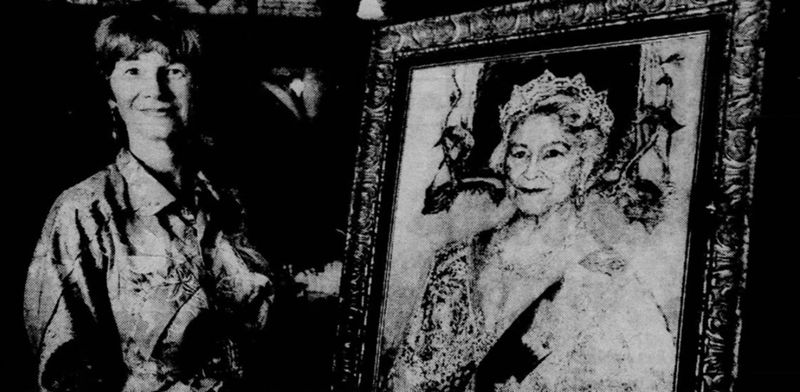
Portraiture was another important strand of Jacobson’s oeuvre. Following her 1985 Poole exhibition, Bournemouth Museums and Arts Society commissioned her to paint the Queen Mother for the Museums Association’s centenary. Completed over 18 months from a sitting, photographs, notes and memory, the portrait was unveiled at the Russell-Cotes Art Gallery and Museum, Bournemouth, in 1989 before travelling to York. She also exhibited with sculptor Chaim Stephenson at the Sternberg Centre, Finchley, in 1988. Her portraits and studies of musicians, workers and people absorbed in everyday tasks reflect her enduring interest in character and physical presence.
Many years after her Slade training, Jacobson turned increasingly towards stained glass, completing an advanced postgraduate course at Central Saint Martins and receiving a fellowship in stained glass in 1991–92. She adapted the strong contrasts and textural effects of her etchings to the glowing colour and expressive lead lines of her new medium (artist’s website). Her works Sefarad and Kiddush Hashem were unveiled at the Spiro Institute, Hampstead, in 1993, and she participated in Art in Glass at the Sternberg Centre in 1995. In 1996 her stained glass was exhibited at the Etz Chayim Gallery and Northwood and Pinner Liberal Synagogue. Inspired by Jewish ritual objects, symbols, literature, biblical texts, poetry and historical events, these works explore Jewish history, spirituality and survival. In 2000 she participated in the Contemporary Glass Society exhibition, at the Plumbline Gallery, St Ives, Cornwall. Although conscious of stained glass’s traditional religious function, she has also advocated its ability to introduce colour, movement and atmosphere into secular architecture. In 2001 she was elected an associate member of the British Society of Master Glass Painters. In 2008 she was invited as a Jewish artist to commemorate those lost in the Holocaust in a solo exhibition at the Städtische Galerie Haus Seel in Siegen, Germany, and in 2012 she was a finalist in Ben Uri’s International Jewish Artist of the Year (IJAYA) exhibition. She lives and works in London. In the UK public domain her work is represented in the Ben Uri and V&A collections.
Irene Iacono
Related books
- Mirosław Adam Supruniuk, ‘’Permanence and Liquidity’. Polish Art in Great Britain in the 20th Century – Introduction to a Description’, Archives Emigration, Vol. 3, 2023, pp. 332, 344, 345
- ‘Poignant Exhibitions Chart a Turbulent History’, Ruislip and Northwood Gazette, 24 January 1996, p. 3
- Bernise Carn, ‘A Different View’, Barnet Borough Times, 14 December 1995, p. 110
- David Sonin, Artists in the Frame, Jewish Chronicle, 15 October 1993, n.p.
- ‘Hampstead’, Potters Bar Times, 13 May 1993, p. 28
- Barry Fealdman, ‘Ben Uri Open Entry Sets a New Record’, 22 September 1989
- Barry Fealdman, ‘Art’, Jewish Chronicle, 19 September 1989, p. 17
- ‘Royal Portrait’, Daily Echo, 13 September 1989, p. 5
- Barry Fealdman, ‘Art’, Jewish Chronicle, 30 September 1988, p. 13
- ‘Artist and Sculptor to Exhibit Together’, Potters Bar Times, 11 February 1988, p. 122
- 'Artists Create’, Hendon and Edgware Press, 3 December 1987, p. 42
- Róża Hillmore, ‘Natrętne Wspomnienia’, Dziennik Polski, 5 April 1986, p. 11
- ‘London Etching for Yad Vashem’, Louise Goldschmidt, Jewish Chronicle, 11 October 1985, p. 3
- ‘A Haunting Memorial’, Daily Echo, 13 February 1985, p. 14
- ‘Three in One’, Marylebone and Paddington Mercury, 4 December 1981, p. 3
Public collections
Related organisations
- Ben Uri Gallery (exhibitor)
- BIGOS (member)
- British Society of Master Glass Painters (Associate member)
- Central Saint Martins (student)
- Slade School of Fine Art (student)
Related web links
- Activating Brixton Art Gallery, 1983-86: Archives and Memories A symposium at University of Westminster on 5th June 2010
- Artist’s website
- Ben Uri Archive
- Bigos – Anglo-Polish Artists Group, Brixton Art Gallery Archive
- Bigos: Artists of Polish Origin -Grupa artystów polskiego pochodzenia z Wielkiej Brytanii [Group of artists of Polish origin from Great Britain], Muzeum Zamek w Sandomierzu [Castle Museum in Sandomierz], July–August 1989, exhibition catalogue
- British Society of Master Glass Painters
Selected exhibitions
- International Jewish Artist of the Year, Ben Uri Gallery, London (2012)
- Judaica 2000, Jewish Museum, London (2000)
- Contemporary Glass Society exhibition, Plumbline Gallery, St Ives, Cornwall (2000)
- Traces of Five Millennia, Hanover Gallery, Liverpool (1999)
- Of Memories and Birdmen, Bernard Becker Gallery, London (1994)
- Fellowship Exhibition, Jeannetta Cochrane Theatre, Central Saint Martins, London (1993)
- Printmakers’ Union exhibition, Barbican Centre, London (1992)
- Printmakers’ Union exhibition, Royal Festival Hall, London (1989)
- Prints and Drawings from the Permanent Collection, Ben Uri Gallery, London (1989)
- Constellation Bigos, Artists of Polish Origin, Polish Cultural Institue, London (1988)
- Open Exhibition of Female Artists, Ben Uri Gallery, London (1988)
- Chaim Stephenson and Ruth Jacobson, The Manor House, Sternberg Centre for Judaism, London (1988)
- Songs of My People, Drawings and Prints by Ruth Jacobson, Totteridge Library, Totteridge (1987)
- Open Exhibition, Ben Uri Gallery, London (1987, 1986, 1985)
- Bigos - Artists of Polish Origin, Brixton Art Gallery, London, subsequently touring Poland (1986)
- La Comédie Humaine, Poole Arts Centre, Dorset, and Camden Arts Centre, London (1985)
- Jewish Faces, Ben Uri Gallery, London (1982)
- Judy Bermant, Ruth Jacobson, Nigel Konstam, Ben Uri Gallery, London (1981)
- Solo exhibition, Agnew’s, London (1963)
Ben Uri collection
Ruth Jacobson in the Ben Uri collection
Ben Uri archive
Consult items in the Ben Uri archive related to [Ruth Jacobson]
Ben Uri library
Publications related to [Ruth Jacobson] in the Ben Uri Library