Born: 1921 Biłgoraj, Poland
Died: 1996 Sandhills, Wormley, Surrey
Year of Migration to the UK: 1942
Biography
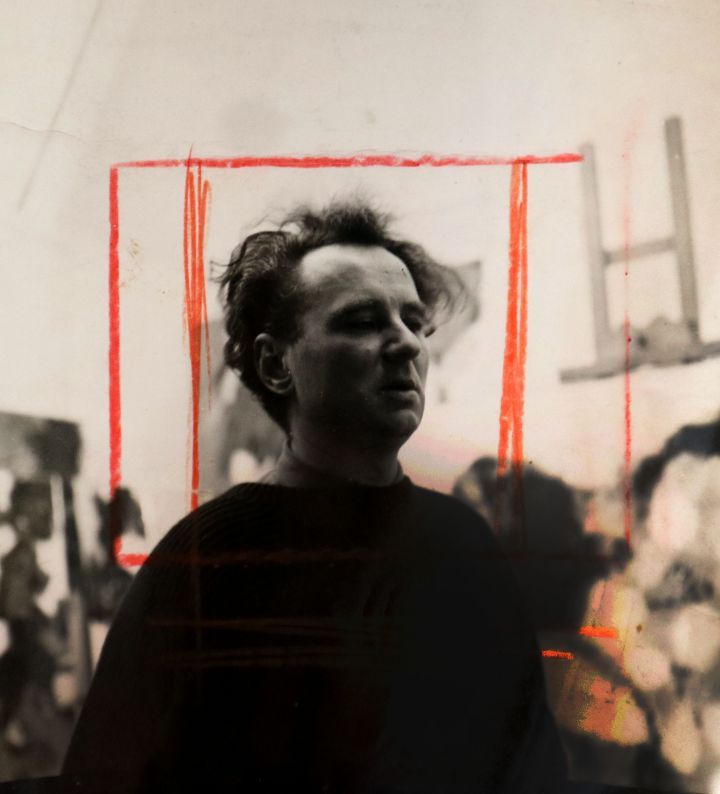
Painter, sculptor, muralist and enamellist, Stefan Knapp (born Knap) was born in Biłgoraj, Poland on 11 July 1921. In 1936, he began his studies at the III State Lyceum and Gymnasium named after King Stefan Batory in Lviv, but his education was interrupted by the outbreak of the Second World War. His family was interned deep inside Russia; His mother, sister and brothers survived the war, while his father disappeared shortly after its outbreak., and the place of his death and burial was never fully established. Stefan Knapp was caught while attempting to cross the border illegally and was sent to a gulag in Karelia near the Finnish border (Soroki) where, with his creativity severely curtailed, he resorted to making, among other things, chess sets out of bread. After his release in 1941, following the Sikorski-Mayski Agreement signed in London, Knapp eventually made his way to England with the Polish 'Anders' Army, where he volunteered as a pilot for the Polish Airforce in exile until 1945. He joined 318 Squadron, a Polish tactical reconnaissance aircraft unit which fought alongside the Royal Air Force (RAF). While in this role, Knapp sketched portraits of his fellow pilots.
Following the end of the war, Knapp remained in London and used his veteran’s stipend to study at the Central School of Arts and Crafts (1946–49) and the Slade School of Fine Art (1947–50). Knapp’s experiences during the war caused him to suffer from recurring nightmares and insomnia for many years and were highly influential in his artworks, notably, a series of multi-media works titled Siberia in the late 1940s. He held his first solo show at the Jabe Gallery in 1946, while his most critically-acclaimed exhibition was presented at émigré, Erica Brausen’s Hanover Gallery, London, in 1954. He later published an autobiography, The Square Sun (London: Museum Press, 1956), the title referencing the sun’s appearance from a prison cell window, and which accompanied images of his wartime experiences. Following his increasing success and attention in the 1950s, Knapp was involved in many mural commissions in Britain and abroad, for which he pioneered the application of enamel on steel instead of copper. In 1954, he produced a mural for Bentalls' department store in Kingston-upon-Thames and in 1959, a monumental abstract mural for London's Heathrow Airport, demonstrating his signature ability to create freeform paintings at a large scale, the aerial-like imagery reminiscent of his experiences in the RAF. ‘Flying taught me one thing’, Knapp observed in his autobiography, ‘frontiers are fiction’: ‘How foolish, how petty to try and split the grain of the granite, to etch a line across the running waters, to clutch at one slanting ray and claim it as your own’ (Knapp, 1956).
Between the 1950s and the 1990s, Knapp held many exhibitions in the UK, France, Germany, America and Brazil. A retrospective was presented at Warsaw Gallery of Zachęta in 1974, while completing international commissions. In 1973, he was the recipient of the Churchill Fellowship Award, the money from which he used to expand his knowledge of murals in Guatemala, India, Iran, Japan and Mexico. It was around this time that he moved to Sandhills, Wormley, Surrey, where he built a furnace big enough to accommodate his large-scale works. It was also in the 1970s that Knapp’s painting shifted in a less expressive direction, towards the simplicity of Op-Art influences, establishing his reputation for subtle spray gun pictures. Two days after the reinstallation of his Heathrow murals, and three days after he completed The Battle of Britain mural for the Polish metro in Warsaw, Knapp had a fatal heart attack. Stefan Knapp died in his studio in Sandhills, England on 12 October 1996. In 1999 posthumous shows at the Polish Cultural Institute and Whitford Fine Art in London traced Knapp’s wide-ranging artistic career, embracing elements from Surrealism, freeform abstraction and Op-Art. His works can be found in several UK public collections, including the Victoria and Albert Museum and Contemporary Art Society, London.
Related books
- David Buckman, Artists in Britain Since 1945, Vol 1, A to L (Bristol: Sansom & Co, 2006)
- Margery Winifred Benn ed., Stefan Knapp (London: MBA Publishing, 1999)
- Cathy Knapp, 'Stefan Knapp: A Visionary Artist Who Worked in Enamel', Glass on Metal: The Enamelist's Magazine, Vol. 18, No. 3, 1999
- Nigel Gosling, 'Gallery Guide', The Observer, 15 September 1963, p. 25
- Patrick Furse, 'Dimensions in Enamel', The Guardian, 20 September 1962, p. 10
- Stefan Knapp, The Square Sun (London: Museum Press, 1956)
- Stephen Bone, 'Stefan Knapp: Enamels on Plates of Copper', The Manchester Guardian, 17 March 1956, p. 5
- Eric Newton, Graham Sutherland, Leonard Rosoman, Stefan Knapp, Donald Hamilton Fraser, Philip Sutton (London: A. Tooth, 1955)
- J. B., 'Paintings by Stefan Knapp at the Hanover Gallery', New Statesman and Nation, Vol. 47, 20 March 1954, p. 357
- James Laver, Image of Kingston: A Mural Painting at Bentalls by Stefan Knapp (London: Bentalls, 1954)
- 'The Slade', The Sketch, Vol. 212, 12 April 1950, p. 329
Public collections
Related organisations
- Central School of Arts (student)
- Lwów Polytechnic (student)
- Slade School of Art (student)
Related web links
- Artnet: Stefan Knapp biography
- Hanina Fine Arts: Stefan Knapp biography
- Mid Wales Arts: Stefan Knapp
- Personnel in the Polish Air Force in Britain
- Powys County Times, 'Gallery Hosts Stefan Knapp's Centenary Exhibition', 2021
- Rachel Jones, 'Stefan Knapp Centenary Exhibition at Mid Wales Arts Centre', Business News Wales, 2021
- Stefan Knapp full biography and events:
- Stefan Knapp: Official website
- Themes and Variations: Stefan Knapp
- Whitford Fine Art: Stephan Knapp
Selected exhibitions
- Stefan Knapp. Before the Artist, Museum of the Polish Partisans in Osuchy, Poland (2025)
- Stefan Knapp. Alchemist and Visionary, Centre for Contemporary Art Znaki Czasu, Toruń, Poland (2025)
- Stefan Knapp – 1921–2021, Centenary Exhibition, Museum of the Biłgoraj Region, Poland (2021)
- Stefan Knapp Centenary Exhibition, Mid Wales Arts Centre, Newtown, Wales (2021)
- British Post-War Abstraction, Whitford Fine Art, London (2020)
- Stefan Knapp Retrospective 1921-1996, Polish Cultural Institute, London (1999)
- Email und Architektur, Coburger Justizgebäude, Coburg (1995)
- Stefan Knapp: Paintings – Sculpture, Grabowski Gallery, London (1986–87)
- Stefan Knapp: Architectural Enamels, Sculpture and Painting, Grabowski Gallery II, London (1986)
- Stefan Knapp: Recent Paintings, Crane Kalman Gallery, London (1980)
- Stephan Knapp: Paintings, Rutland Gallery, London (1975)
- Stefan Knapp (Anglia). Malarstwo, rzeźba, Zachęta, Warsaw (1974)
- Stefan Knapp, Hanover Gallery, London (1963)
- Stefan Knapp: Recent Paintings, Hanover Gallery, London (1963)
- Seven British Painters, Hanover Gallery, London (1962)
- International Exhibition for Christian Action, O’Hara Gallery, London (1962)
- Contemporary Art Society, Whitechapel Art Gallery, London (1961)
- Society of Mural Painters, Williamson Art Gallery, Birkenhead (1961)
- Humour in Art, Crane Kalman Gallery, London (1960–61)
- Mural Art Today, Society of Mural Painters, Victoria and Albert Museum, London (1960)
- London Group, R.B.A. Galleries, London (1960)
- Paintings by Stefan Knapp, Crane Gallery, Manchester (1960)
- British Artist Craftsmen, Smithsonian Institution, Washington, D.C., USA (1959–60)
- Stefan Knapp, Hanover Gallery, London (1959)
- 66th Spring Exhibition, Cartwright Memorial Hall, Bradford, Yorkshire (1959)
- The Religious Theme, Tate Gallery, London (1958)
- Stefan Knapp: Paintings on Metal – Sculpture, Pierre Matisse Gallery, New York, USA (1957)
- Tercentenary of the Resettlement of Jews in England, Whitechapel Art Gallery, London (1956)
- Graham Sutherland, Leonard Rosoman, Stefan Knapp, Donald Hamilton Fraser, Philip Sutton, Tooth Gallery, London (1955)
- Stefan Knapp, Hanover Gallery, London (1954)
- Stefan Knapp, London Gallery, London (1947)
Ben Uri archive
Consult items in the Ben Uri archive related to [Stefan Knapp]
Ben Uri library
Publications related to [Stefan Knapp] in the Ben Uri Library