Born: 1893 Adelaide, Australia
Died: 1947 London, England
Year of Migration to the UK: 1914
Other name/s: Esther Gwendolyn Bowen
Biography
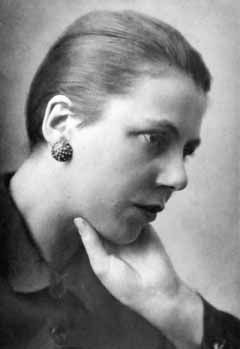
Painter, writer and war artist Stella Bowen, née Esther Gwendolyn Bowen, was born on 16 May 1893 in North Adelaide, South Australia. Her father died when she was three, and she was brought up by her mother in a genteel, church-going household, where cultural and artistic life was limited. In a posthumous article, she described the social world of her Adelaide childhood as revolving around the bishop's wife, the Governor's wife, and the wives of university professors, recalling early stirrings of artistic ambition that sat uneasily with South Australian Anglicanism ('Memories of Stella Bowen', 1953). She found an early mentor in the artist Margaret Preston, with whom she studied painting in Adelaide. In 1914, aged twenty, Bowen immigrated to England, enrolling at Westminster School of Art in London, where she studied under Walter Sickert and came into contact with British and European modernism. In 1919, she met the writer Ford Madox Ford, through the poet, Ezra Pound, with whom she began a relationship, and in 1920 their daughter Julie was born. For nearly a decade the family lived between England and France, and Bowen engaged with bohemian artistic and literary milieux in both countries. A trip to Italy in 1923 proved formative: exposure to the early Italian primitives, particularly Giotto and Piero della Francesca, led her to adopt a narrow tonal scale that reduced the effects of light and shade, a stylistic approach that would characterise her mature work. Her often difficult relationship with Ford ended in 1927, and thereafter she supported herself and Julie through portrait commissions and a modest family allowance.
Bowen worked primarily in oils, specialising in portraiture and figure composition. Her practice was marked by precision of drawing, restraint of tone, and acute sensitivity to her sitters. Among her distinguished sitters before the Second World War were Edith Sitwell, Dorothy Thompson, Lady Cripps, Robert Lynd, and Clifford Bax, as recorded in the article 'Stella Bowen Looks Back' (The Age, 14 February 1942). Her position as an Australian who had lived in England and France for three decades gave her work a cosmopolitan range of reference, while her sitters placed her at the centre of British intellectual and political life. In 1941 Collins published her memoir, Drawn from Life: Reminiscences, by Stella Bowen, the same year she exhibited in the Royal Academy of Arts Summer Exhibition.
Bowen was almost 50 when, in February 1944, she accepted a commission as an official Australian war artist, the second woman to be appointed in this capacity (Canadian War Museum, 'Art and War: Stella Bowen', 2005). The announcement of her appointment described the range of her subjects: 'Portraits might be described as her chief interest, but she also paints landscapes, interiors, and still life studies, working mostly in oils. She has been a regular exhibitor at the Royal Academy and other English exhibitions' (The Canberra Times, 22 February 1944). Her brief was to document the activities of the Royal Australian Air Force stationed in England. She painted group portraits of RAAF aircrew at stations across the country, catching men 'on the hop as they were about to leave an aerodrome on a mission over enemy territory, or returning to base' (The Advertiser, 8 May 1946). The work was often psychologically distressing: she painted crews who did not return, completing some portraits with the assistance of photographs. One group was painted at two in the morning after an aircrew returned from what she later discovered had been a bombing mission over Cherbourg on D-Day (The Advertiser, 8 May 1946). During the commission, she also painted repatriated Australian prisoners of war at Eastbourne. Over twenty months, Bowen completed 49 works for the Australian War Memorial (Australian War Memorial, collection record). Among the paintings from this period is Bomber Crew, held in the collection of the Australian War Memorial.
After the war, Bowen expressed the wish to return to Australia and had been invited to hold a one-woman show at a Sydney gallery (The Advertiser, 8 May 1946). Lack of funds, the rejection of her repatriation application, and deteriorating health prevented her from making the journey. Her war paintings were subsequently exhibited at the National Gallery in Adelaide, organised by the Australian War Museum, and a representative selection was intended for the National War Memorial in Canberra, with further exhibitions planned in England, on the Continent, and in the United States (The Advertiser, 23 May 1948).
Stella Bowen died in London, England on 30 October 1947, aged 54, having never returned to Australia. She lived and worked in Chelsea, London, in the final years of her life. Her work is held in the UK public domain, including in the National Portrait Gallery, London. In 1984 Drawn from Life was republished by Virago. In 2024 Bowen featured in the exhibition, Dangerously Modern: Australian Women Artists in Europe 1890-1940, held at the Art Gallery of South Australia, Adelaide, Australia. The Ben Uri Research Unit welcomes contributions from researchers or family members who may have further biographical information.
Michal Mel
Related books
- Lola Wilkins and Australian War Memorial, Stella Bowen: Art, Love and War (Canberra: Australian War Memorial, 2002)
- Drusilla Modjeska, Stravinsky's Lunch (New York: Farrar Straus and Giroux,1999)
- Ralph Elliott, 'Stella Bowen, an indomitable spirit', The Canberra Times, 3 August 1985, p. 18
- Stella Bowen, Drawn From Life (London: Virago, 1984)
- 'Memories of Stella Bowen', The Advertiser, 1 May 1953, p. 15
- 'Stella Bowen Plans Australian Visit', The Advertiser, 8 May 1946, p. 5
- 'S.A.-Born Woman War Artist: Stella Bowen's Work in England', The Advertiser, 21 March 1945, p. 6
- 'Official War Artist: Appointment of Miss Stella Bowen', The Canberra Times, 22 February 1944, p. 2
- 'Stella Bowen Looks Back', The Age, 14 February 1942, p. 2
- Drawn from Life: Reminiscences, by Stella Bowen (London: Collins Publishers, 1940)
Public collections
Related organisations
- Westminster School of Art (student)
Related web links
- Art Gallery of South Australia, 'Dangerously Modern Podcast'
- Australian War Memorial, Stella Bowen collection record
- Canadian War Museum, 'Art and War: Stella Bowen'
- Neglected Books
- Neglected Books
- Royal Academy of Arts, online catalogues
Selected exhibitions
- Dangerously Modern: Australian Women Artists in Europe 1890-1940, Art Gallery of South Australia, Adelaide, Australia (2024)
- R.A.A.F. Paintings by Stella Bowen, National Gallery, Adelaide, Australia (1948)
- Royal Academy of Arts, London (1941)
Ben Uri archive
Consult items in the Ben Uri archive related to [Stella Bowen]
Ben Uri library
Publications related to [Stella Bowen] in the Ben Uri Library