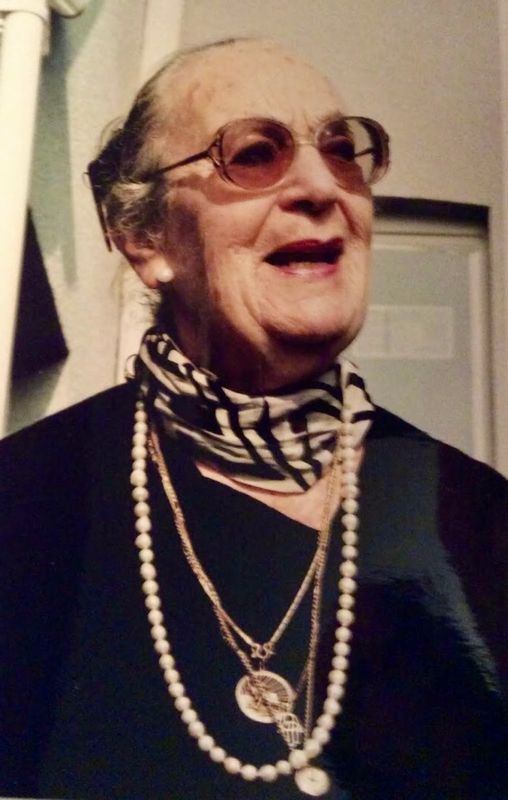
Born: 1927 Frankfurt am Main, Germany
Died: 2021 London, England
Year of Migration to the UK: 1939
Other name/s: Suzanne Maria Connard
Biography
Outsider artist and maker Suzanne Maria Lee (née Straus) was born in Frankfurt am Main, Germany, on 7 May 1927 into a Jewish family. Her uncle was killed during the Kristallnacht pogrom in November 1938. A cousin, Eva, reached the UK on a Kindertransport the following month, while Suzanne and her mother Liesl travelled to England in August 1939, only days before the outbreak of the Second World War. Having arrived as refugees with few possessions, they left behind much of their former life in Germany. Lee later became a British citizen through naturalisation in 1948, but retained a strong Frankfurt accent and continued to identify closely with her German origins. According to her daughter, Alix Lee, she frequently repeated a principle that reflected both her refugee experience and her faith in practical skill: ‘What you can make, what you can do with your hands, no one can take away from you.’ Throughout her life she remained sceptical of social convention, commercial success and institutional approval, preferring to work independently and largely outside established artistic circles.
Lee received little formal education after leaving a refugee boarding school in Tunbridge Wells, aged 15. Although she was not a graduate of an art school, neither was she entirely self-taught. Instead, she spent decades attending classes, workshops and evening courses, determined to master a wide range of skills and techniques. By the late 1960s she was a regular at Putney School of Art, where she continued to study for many years. Pottery, sculpture, stained glass, mosaic, macramé, basketry, calligraphy, painting, pastel drawing and glass blowing all became part of her practice, often pursued simultaneously. She worked with extraordinary consistency, but had little interest in exhibiting or selling her work, often dismissing the idea that artistic value could be measured through sales. Most of her production remained in her home, where handmade crockery filled the kitchen and sculptures, ceramics and stained-glass works occupied shelves, walls and windows, each carefully positioned according to her own sense of balance.
Lee worked across ceramics, sculpture, stained glass, collage, painting and pastel, with several recurring features that unite this diverse body of work. Her sculptures favour rounded, biomorphic forms, punctuated by openings and voids that blur the distinction between figure and abstract object. Some works recall the sculptural language of Henry Moore, through the rounded shapes of the reclining silhouettes and use of negative space, though Lee’s pieces remain more intimate in scale and often more playful in character. Her ceramics, similarly move, between functional object and sculpture, transforming vessels into organic and sometimes architectural-like forms. Her stained-glass panels have a sophisticated understanding of colour in the juxtaposition of vivid greens, blues, ambers and earth tones. Equally distinctive was her use of ceramic glazes, which often produced richly textured surfaces and subtle tonal transitions.
This independence extended to her working methods. Rather than discarding unsuccessful clay fragments, she incorporated them into new compositions. While many fellow pottery students concentrated on producing technically perfect bowls and vessels, Lee assembled unconventional works, including her irreverent ‘cock pots’, groups of hand-modelled phallic forms arranged as sculptural flower arrangements. In sculpture classes she paid little attention to measurements or exact likenesses, focusing instead on the underlying shapes and energies of the body. Her materials ranged widely and included clay, wood, marble, sandstone, fibreglass, plastic and plaster. As advancing age reduced her ability to carve harder materials, she began producing large plaster blocks that could be cut and shaped with less physical effort, while retaining the formal qualities of her earlier work. Later still, she turned to collages constructed from found objects. Stones, feathers, combs, scissors, hair clips, broken mobile phones and electrical cables were reorganised into carefully balanced compositions that extended her longstanding interest in transformation and reuse. Some surviving ceramic pieces bear the surname ‘Connard’, indicating that at least part of her artistic activity began before her 1957 divorce from her first husband.
Suzanne Maria Lee died in London, England in June 2021 at the age of 94, leaving behind a substantial body of work that remained largely unseen beyond family, friends, acquaintances and visitors to her home. In 2027, Putney School of Art & Design plans to mark the centenary of her birth with an exhibition organised by her daughter, Alix Lee, bringing attention to an artist whose creative life unfolded largely beyond public institutions. This profile was written using information provided by Alix Lee. Her work is not currently represented in the UK public domain.
Ana-Maria Milčić
Related organisations
- Putney School of Art (student )
Selected exhibitions
- Suzanne Maria Lee (solo exhibition), Putney School of Art & Design, London (2027)