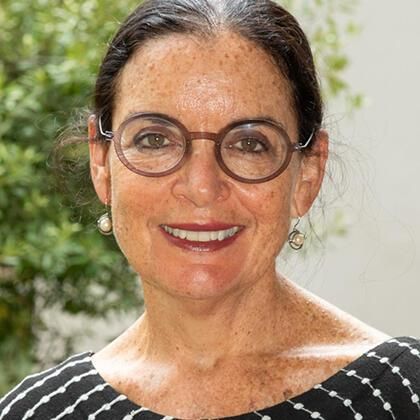
Born: 1956 Jerusalem, Israel
Year of Migration to the UK: 1979
Other name/s: Professor Tamar Garb, Tamar Hammerschlag, Tamar Garb FBA
Biography
Art historian, curator and writer, Tamar Garb was born in Jerusalem, Israel, in 1956 to Werner and Cynthia Hammerschlag. As a child, she took her stepfather’s name, when her mother married Ivor Garb. She grew up in South Africa during the apartheid era. The political and cultural environment of that period, marked by racial segregation and profound social divisions, provided an important backdrop for her later academic research on questions of identity, representation and the politics of visual culture. After immigrating to the UK in 1979, she married fellow South African art-student, the journalist Rasaad Jamie, and they have one son. The marriage was forbidden under Apartheid law, transgressing the Immorality Act, which prohibited inter-racial relationships.
Garb studied Fine Art at the University of Cape Town, completing a BA at the Michaelis School of Fine Art in 1978. Her education took place within an intense intellectual community of artists and writers in Cape Town, where questions of representation, politics and social responsibility were widely debated among practitioners working under the constraints of apartheid. After completing her undergraduate studies, she moved to London to continue her studies. She undertook postgraduate research at the Institute of Education and the Courtauld Institute of Art, University of London, where she completed both a master’s degree and a doctoral thesis. Her research examined the position of women artists and the gendered representation of the body in 19th-centur yand early 20th century French art, an area that would remain central to her subsequent publications. Garb joined the academic staff at University College London and has taught there since the late 1980s, contributing to the development of feminist and global perspectives within the discipline of art history. A central focus of Garb’s research has been the visual culture of modernity in 19th-century France, particularly the ways in which artists represented the body and negotiated changing ideas about gender and social identity. Her work examines the relationship between artistic practice and broader historical transformations associated with urbanisation, modern consumer culture and the emergence of new public spaces. Through close visual analysis combined with historical research, she has explored how representations of femininity in painting and photography were shaped by contemporary debates about morality, sexuality and the role of women in modern society. Her publications have contributed to the development of feminist art history by reconsidering the work of both canonical artists and women artists whose contributions were historically marginalised. Studies such as Sisters of the Brush: Women’s Artistic Culture in late Ninetheenth Century Paris, Bodies of Modernity: Figure and Flesh in Fin-de-Siècle France and The Painted Face: Portraits of Women in France 1814–1914 examine the role of women artists and how images of the body were embedded within the visual and social structures of modernity.
Alongside her work on European modernism, Garb has developed an important body of research addressing art and visual culture in South Africa and across the African diaspora. Drawing on both personal and scholarly connections to the region, she has examined the role of photographic archives in shaping historical narratives and collective memory. Her curatorial and editorial projects have brought attention to the work of photographers and artists who engage critically with colonial and apartheid-era imagery. The publication and exhibition project Distance and Desire: Encounters with the African Archive explored the ways in which contemporary artists reinterpret historical photographs, while Figures and Fictions: Contemporary South African Photography addressed the relationship between documentary traditions and newer conceptual photographic practices in the post-apartheid era. Tackling ideas surrounding Jewish identity, Garb co-edited, with distinguished American art historian, Linda Nochlin, The Jew in the Text: Modernity and the Construction of Identity, published by Thames and Hudson (1995).
Garb has also been active as a curator and public lecturer, contributing to exhibitions and research initiatives that examine the global circulation of images and ideas. Her curatorial project Beyond the Binary: Santu Mofokeng and David Goldblatt reflects a continuing engagement with South African photography, focusing on the work of two photographers whose practices addressed questions of landscape, history and identity. Other curated exhibitions include artists from Dumile Feni to William Kentridge, Portia Zvavahera and Vivienne Koorland. Through lectures, exhibitions and publications she has sought to situate African photographic and contemporary/modern art practices within broader histories, challenging Eurocentric narratives within the discipline. In addition to her teaching and research at UCL, Garb has participated in international research programmes and held visiting fellowships at several institutions, including the Clark Art Institute in Massachusetts and Stellenbosch University in South Africa. Her work has contributed to broader debates about the global history of art and the role of archives in shaping the writing of art history. These projects have emphasised the importance of transnational approaches that connect European and African visual cultures and aesthetic debates within a shared historical framework.
Tamar Garb lives and works in London, where she continues to teach and conduct research at University College London. Her publications, curatorial projects and lectures have contributed to expanding the scope of art history, particularly in relation to gender studies and the global histories of art.
Michal Mel
Related books
- Tamar Garb et al, Beyond the Binary: Santu Mofokeng and David Goldblatt: African Photography from the Walther Collection (Göttingen: Steidl and The Walther Collection, 2025)
- Tamar Garb et al. Portia Zvavahera: Zvakazarurwa (Edinburgh and Cambridge: Fruitmarket and Kettle’s Yard, 2024)
- Tamar Garb ed. Distance and Desire: Encounters with the African Archive (Göttingen: Walther Collection and Steidl, 2013)
- Tamar Garb ed. Figures and Fictions: Contemporary South African Photography (London: V&A and Steidl, 2011)
- Tamar Garb, The Body in Time: Figures of Femininity in Late Nineteenth-Century France (Seattle: University of Washington Press, 2008)
- Tamar Garb, The Painted Face: Portraits of Women in France 1814-1914 (New Haven and London: Yale University Press, 2007)
- Tamar Garb, Bodies of Modernity: Figure and Flesh in Fin-de-Siècle France (London: Thames and Hudson, 1998)
- Tamar Garb and Linda Nochlin eds. The Jew in the Text: Modernity and the Construction of Identity (London: Thames and Hudson, 1995)
- Tamar Garb, Sisters of the Brush: Women's Artistic Culture in Late Nineteenth-Century Paris (New Haven and London: Yale University Press, 1994)
- Tamar Garb, Berthe Morisot (Oxford: Phaidon, 1987)
- Tamar Garb and Kathleen Adler eds. The Correspondence of Berthe Morisot (London: Camden Press, 1986)
- Tamar Garb, Women Impressionists (Oxford: Phaidon, 1986)
Related organisations
- Courtauld Institute of Art (lecturer )
- UCL ( Durning Lawrence Professorship)
- Courtauld Institute of Art (student)
- UCL (student)
Related web links
- Clark Art Institute
- Gresham College
- Institute of International Visual Arts
- Prabook
- Richard Saltoun Gallery
- Stedelijk Museum
- University College London UCL, Personal Profile:
- University College London UCL, Staff Journeys:
Selected exhibitions
- Portia Zvavahera: Zvakazarurwa, Fruitmarket Gallery, Edinburgh and Kettle’s Yard, Cambridge (2024)
- Beyond the Binary: Santu Mofokeng and David Goldblatt, Walther Collection, Ulm, Germany (2023)
- Made Routes: Vivienne Koorland and Berni Searle, Richard Saltoun Gallery, London (2019)
- William Kentridge and Vivienne Koorland: Conversations in Letters and Lines, Fruitmarket Gallery, Edinburgh (2015-16)
- Figures and Fictions: Contemporary South African Photography, Victoria and Albert Museum, London (2011)
- Land Marks/Home Lands: Contemporary Art from South Africa, Haunch of Venison Gallery, London (2008)
- Reisemalheurs, Freud Museum, London (2007)