Born: 1892 Annenieki, Latvia
Died: 1958 London, England
Year of Migration to the UK: 1949
Other name/s: Voldemars Tone
Biography
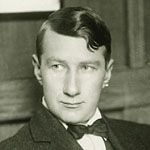
Painter, draughtsman, and art educator, Valdemārs Teodors Tone was born on 28 March 1892, in Annenieki parish, Courland governorate of the Russian Empire, territory that would later become the independent Latvian Republic in 1918. The youngest of twelve children, his parents were Krišas Tone, owner of the 'Ļuki' houses, and Lavīze Tone. He attended local schools before commencing his formal art education. He first enrolled at Riga City Art School for one term in 1909, resuming his studies in 1911, under Jānis Rozentāls, Vilhelms Purvītis, and Jānis Roberts Tillbergs. Riga City Art School, which had been reorganised under the auspices of the St. Petersburg Academy of Arts in Russia in 1906, trained a generation of artists who would go on to define Latvian modern painting. Among Tone's contemporaries in Tillbergs's class were Konrāds Ubāns, Romans Suta, and Aleksandrs Drēviņš.
In February 1915, Tone co-founded the Zaļā puķe (Green Flower) group with Jāzeps Grosvalds, Drēviņš, Ubāns, and Kārlis Johansons. In 1917, during the First World War, Tone enlisted in the second Latvian Rifle Brigade, serving on the Eastern Front. After his return to Riga in 1918, Tone established and directed a private art studio from 1919 to 1923. In the summer of 1919, the circle of artists in which he worked expanded and formalised themselves as the Expressionists group, renamed the following year as the Riga Artists Group. According to Latvijas mākslas vēsture, members shared orientations towards cubist simplification, fauvism, and eventually a painterly realism, while remaining committed to individual self-expression over academic convention.
In 1925, Tone joined the faculty of the Latvian Academy of Arts, where he was head of the Portrait Painting class from 1925 to 1932 and the Nude Painting class from 1932 to 1944, being elected Professor in 1944. In the autumn of that year, as Soviet forces re-occupied Latvia, Tone and his wife Aina fled, leaving behind decades of paintings and his violin, and spent the following years in displaced persons camps in Weilburg, Detmold, and Märbeke in northern Germany. Tone organised solo exhibitions in Detmold, Münster, Lübeck, and Gothenburg during this period. In Germany, he turned intensively to still life and figure painting, his wife Aina remaining his most constant model. He arrived in London in 1949 to join her, choosing England as his country of residence while retaining hope of returning to Latvia in the future.
Tone worked principally in oil and in large-scale charcoal on primed canvas, his subjects particularly favouring the female portrait and still lifes, his early work reflecting the influence of Dutch Old Masters encountered in the Hermitage. After a cubist phase in 1919-20 and landscape studies in Paris, in the company of Ubāns, his practice moved decisively towards psychological realism. Among his notable works is the portrait of Alberta Silzemnieka (1924), his first work in tempera. Tone joined the Sadarbs artists' society (1924-25) and the Mūksala group (1934-38). Between 1927 and 1939, Tone’s artwork was included in Latvian art exhibitions in Stockholm, Oslo, Moscow, Brussels, Helsinki, Tallinn, Warsaw, Kraków, Vienna, Prague, Budapest, Kaunas, Copenhagen, Paris, and London. Tone was awarded the Latvian Cultural Fund Prize in 1924, 1934, and 1937, the Latvian Academy of Arts distinction in 1934, and the Order of the Three Stars, Fourth Class, in 1938. His most celebrated canvases are the series of portraits of his student and model, Anna Dārziņa, from the 1930s: Anna (1932), Pie loga (1932), Guļošā (Anna) (1935), which critics have interpreted as idealisations, not of outward appearance, but of inward spiritual life. The poet Edvarts Virza wrote of these works that Tone had probed 'deeply the particular qualities of the Latvian woman's spirit, finding in them a kind of mournful apprehension […] all their gazes turn inwards' (Neputns).
Soon after arriving in London, Tone held two solo painting exhibitions in 1951: at the Drian Gallery (owned by Polish refugee, Halima Nalecz) and at the Kensington Art Gallery. The latter exhibition, held in July, formed part of the Latvian Song Festival, held in the capital as a contribution to the Festival of Britain. The catalogue described Tone's artistic method as achieving, through 'a very personal use of the elements of painting: colour, light, and space, a very delicate approach to the subtlest nuances of the human personality'. In 1953, the National Fund organised a significant solo exhibition for Tone at the Art Academy in Stockholm, Sweden.
Valdemārs Tone died on 30 July 1958, in London, England. His work is not currently represented in the UK public domain. Works are held in the Latvian National Museum of Art, Riga; the Malmö Konstmuseum, Sweden; tM. K. Čiurlionis National Art Museum, Kaunas; and in Kuldīga and Tukums museums. The Ben Uri Research Unit welcomes contributions from researchers or family members who might have further biographical information on the artist.
Michal Mel
Related books
- Ginta Gerharde-Upeniece, et. al., 1914, ed. Laima Slava (Riga: Latvijas Nacionālais mākslas muzejs, 2014)
- Stella Pelše, Rezension von: Valdemārs Tone (Centropa, 2013)
- Dace Lamberga, Valdemārs Tone (Riga: Neputns, 2010)
- Imants Bērziņš, ‘Gleznotāju karalis’, Brīvā Latvija, 12 April 1993
- Pēteris Savickis, Valdemārs Tone: Gleznu un Zīmējumu Izstāde = Valdemars Tone: Vystavka Živopisi I Risunka (Riga: Latvijas PSR Mākslas Muzejs, 1973)
- Eric Newton, Valdemars Tone (Stockholm: Zelta ābele, 1953)
- The Scotsman, 21 July 1951, p. 9
- Kensington News and West London Times, 13 July 1951, p. 4
- Anšlavs Eglītis, Valdemārs Tone (Riga: Latvju Grāmata, 1944)
Related web links
- Antonija Gallery, Riga
- Changing Identities
- Festival of Britain, Latvian Song Festival programme, 1951
- Izsoļu Nams Galerija Jēkabs
- Latvians in the UK, National Archives of Latvia
- Latvijas mākslas klasika, Belēviča collection
- Latvijas Nacionālā enciklopēdija
- Neputns, Lamberga monograph
Selected exhibitions
- Retrospective Exhibition, Latvian National Museum of Art, Riga, Latvia (1993)
- Valdemārs Tone - Memorial Exhibition, Latvian National Museum of Art, Riga, Latvia (1965)
- Solo Exhibition, Art Academy, Stockholm, Sweden (1953)
- Solo Exhibition, Kensington Art Gallery, London (1951)
- Solo Exhibition, Drian Gallery, London (1951)
- Solo exhibitions, Detmold, Münster, Lübeck, Germany; Gothenburg, Sweden, (1945-48)
- Annual Exhibition of Latvian Artists, Latvian National Museum of Art, Riga, Latvia (1936-39)
Ben Uri archive
Consult items in the Ben Uri archive related to [Valdemārs Tone]
Ben Uri library
Publications related to [Valdemārs Tone] in the Ben Uri Library