Born: 1925 Krustpils, Latvia
Died: 2014 UK
Year of Migration to the UK: 1947
Other name/s: SAX , SAX Sarkans
Biography
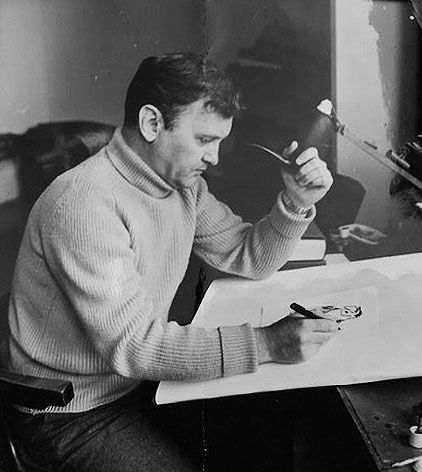
Graphic artist and cartoonist, Vitālijs Sarkans was born in 1925 in Krustpils, a town on the Daugava River in the Republic of Latvia. He grew up in Krustpils and, in his own words, his first conscious act was to reach for a pencil, having harboured ambitions from an early age to become a professional artist and painter. The outbreak of the Second World War interrupted these plans. Following the Soviet occupation of Latvia in 1940 and the subsequent years of conflict, Sarkans, like thousands of his contemporaries who survived the war, found himself in exile. He immigrated to England in 1947, arriving as part of the postwar movement of Latvian displaced persons to the UK.
In the early years of his life in England, Sarkans undertook various forms of manual labour, working first in Liverpool and then in Manchester, while pursuing his artistic ambitions in his spare time. He attended evening classes at college and enrolled in correspondence courses at a press art school. It was through this process of self-directed study, alongside formal training, that he developed his distinctive approach to gag cartooning. Following his first publication in 1957 he became a professional cartoonist. In 1959, he moved to London and joined Associated Newspapers, while living at the Lithuanian House in Notting Hill. In 1970, he married Māra Švinka, a fellow Latvian, painter and graphic artist who had immigrated to England from Australia in the late 1960s. Their daughter Aiva was born in 1976.
Sarkans worked primarily in the medium of the single-panel gag cartoon, a form in which a drawn image is accompanied by a brief caption intended to produce a comic effect. Working under the pseudonym SAX, his cartoons were characterised by their economy of line, expressive characterisation, and consistent comic invention. His fellow cartoonist, Rod McKie, described SAX as having filled each small rectangle, not merely with drawings, but with fully realised characters that perfectly matched the accompanying captions and identified him as one of the few artists of genuine giant talent remaining in the field of gag cartooning. The international reach of his work was notable: his cartoons were published across a wide range of British mass-circulation newspapers and magazines, including the Daily Mirror, Daily Express, Titbits, Weekend, Woman's World, She Magazine, The Sun, The Star, and the Weekly News, as well as in the Italian weekly puzzle publication, La Settimana Enigmistica, where his cartoons appeared anonymously for several decades. Beyond the mainstream commercial press, Sarkans also contributed cartoons to the Latvian exile community publications and events in exile. He produced a dedicated series of cartoons for the Baltic Peace and Freedom Cruise in 1985. These images were reproduced across a range of informational materials, postcards, and periodicals directed at Latvian and Baltic diaspora communities in Europe, Australia, and North America.
Other projects encompassed illustrations for the publisher Atvase, based in Stockholm, including a 17-panel biographical sequence on the Latvian writer, Aleksandrs Grīns, for the graphic novel adaptation, Zemes Atjaunotāji (1972). He created illustrations for the children's book, Krikša Krusttēvs a volume about the writer Jānis Širmenis. He also contributed designs for propaganda postage stamps and envelopes produced by the Daugavas Vanagi (Latvian War Veterans' organisation) in England, including the design for the 1985 stamp, which bore the slogan 'Russia, Get Out of the Baltic States', and which depicted Soviet nuclear missiles stationed in the Baltic states, and a further stamp for the 1991 series with the same political message. These activities positioned Sarkans as an active participant in the cultural and political life of the Latvian exile community in England, even as his professional reputation rested almost entirely on his work in the British commercial press. The Sarkans’ participated jointly in a group exhibition of cartoons and paintings at the Latvian House in Sydney, Australia, in 1971.
In 2005, Sarkans received a special lifetime achievement award from the Cartoonists' Club of Great Britain in recognition of his long career and sustained contribution to the art of cartooning in the UK. Vitālijs Sarkans died in London, England on 17 May 2014, at the age of 88. A Memorial exhibition was held at the London Latvian House 'Balzāmbārs' later the same year. In the UK public domain his work is preserved in newspaper archives.
The Ben Uri Research Unit welcomes contributions from researchers or family members who may have further biographical information.
Michal Mel
Related books
- Irēna Lagzdiņa, 'Atgriešanās', Brīvā Latvija, 21 November 1998
- J. Ronis, 'Pamarkas un Ilustrētas Aploksnes', Krājējs, 1 January 1998
- H. Zālītis, '55 Grāmatas 20 Gados', Austrālijas Latvietis, 22 January 1988
- H. Zālītis, 'Apgāda "Atvase" Divdesmit Gadi', Brīvā Latvija, 14 December 1987
- Aldis Harija Vinters, 'DV Propagandas Marku Otrs Izdevums', Londonas Avīze, 8 March 1985
- DV, 'CV Prezidija Sēde', Daugavas Vanagu Mēnešraksts, 1 March 1985
- Jānis Širmenis, (illustrated by Vitālijs Sarkans), Krikša krusttēvs, (Stockholm: Atvase, 1974)
- Pauls Ozols, 'Krikša Krusttēvs', Laiks, 16 March 1974
- J. Širmanis, 'Tēlvijas Latviski', Laiks, 29 November 1972
- 'Mūsu Laikmets - Unser Zeitalter', Latvieši Austrālijā, 1 March 1972
- Sp.Kl., 'Slavena Karikatūrista Izstāde', Austrālijas Latvietis, 26 November 1971
Related web links
- National Archives of Latvia, 'Latvian fine art', Latvians in the United Kingdom
- Rod McKie Illustrations and Cartoons
Selected exhibitions
- Memorial exhibition for Vitālijs Sarkans, The London Latvian House 'Balzāmbārs', London (2014)
- Group exhibition (with Māra Sarkane), Latvian House, Sydney, Australia (1971)
Ben Uri archive
Consult items in the Ben Uri archive related to [Vitālijs Sarkans]
Ben Uri library
Publications related to [Vitālijs Sarkans] in the Ben Uri Library