Born: 1895 Hobart, Tasmania, Australia
Died: 1959 Ashford, Kent, England
Year of Migration to the UK: 1911
Other name/s: William A. Kermode, William Archer Kermode
Biography
Wood-engraver and illustrator William Kermode was born in Hobart, Tasmania, Australia, in 1895. He left Australia for England around 1911, while still a teenager, and settled in London, where he later lived and worked for much of his career. During the First World War he volunteered for the British Army, serving first as a private in the Royal Engineers and later as an officer in the Tank Corps. In 1918, during the Battle of Amiens, he was awarded the Military Cross for gallantry after going forward under heavy shelling and machine-gun fire to repair disabled tanks, so that they could return to action. He was later gassed and invalided back to England. During the Second World War he served again, as Observer Corps Liaison Officer at Fighter Command Headquarters, Uxbridge.
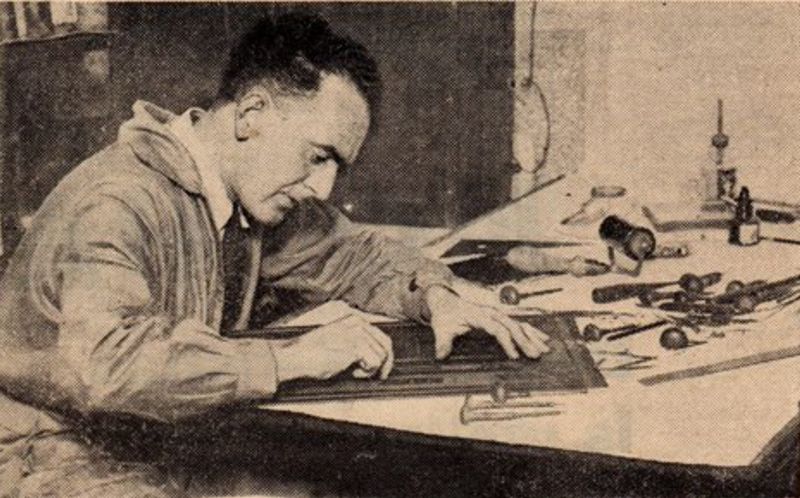
After the First World War Kermode developed his career as a printmaker, illustrator and designer. In the mid-1920s he studied at the Grosvenor School of Modern Art in London under Iain MacNab, and came into contact with the circle around Claude Flight, whose teaching helped make the linocut one of the most distinctive modern print media of interwar Britain. Kermode was known chiefly for his wood engravings and linocuts, but his professional work ranged widely across posters, book illustration, dust-jackets and periodical illustration. His images appeared in publications including The Times, Radio Times, The London Mercury and the Evening Standard, where the initial 'K' became familiar to readers. He also gave a lecture-demonstration on black-and-white woodblock printing attended by Sybil Andrews, whose interest in relief printing later developed through Claude Flight’s linocut classes (Osborne Samuel).
Kermode was among the artists who helped popularise linocut and scraper-board techniques in Britain. His work was occasionally shown at the prestigious Redfern Gallery and the Grosvenor Gallery, and in 1929 his linocut High Water, West Mersey was favourably noted in The Queen’s review of a comprehensive display of linocuts at the Redfern (The Queen 1929, p. 20). His prints were also included in British Artists Printmakers at the Ward Gallery in 1932. His commercial design work was represented in the Royal Academy of Arts' Exhibition of British Art in Industry, where two groups of four book jackets by Kermode were listed in Gallery D, Commercial Printing. Later, his work was included in Michael Parkin Gallery’s exhibition British Printmakers of the Twenties and Thirties, where he was placed among artists associated with Claude Flight and the Grosvenor School (Fulham Chronicle 1974, p. 21). Kermode’s practical expertise also led to the publication of Drawing on Scraper Board for Beginners, reviewed in the Evening Standard in 1936 as ‘a most illuminating book’. The review presented him as ‘one of the most experienced practitioners’ of the method, capable of explaining its processes clearly to beginners (Evening Standard 1936, p. 23).
His best-known achievement remains his collaboration with Henry Williamson on The Patriot’s Progress, first published by Geoffrey Bles in 1930. The project began when J. C. Squire, editor of The London Mercury, introduced Williamson to Kermode and to a group of his war linocuts. The original idea was that Williamson would write captions for Kermode’s prints, but after several meetings the plan developed into a fully integrated illustrated narrative. Kermode cut new images and Williamson wrote the story of Private John Bullock, an ordinary soldier whose patriotic enlistment leads through the physical and psychological devastation of the Western Front to the loss of a leg and a bleak return home. Contemporary and later responses emphasised the inseparability of Kermode’s images and Williamson’s prose. The Daily Telegraph noted that Kermode’s many line-cuts ‘intensify the sombre atmosphere of the book’ (Daily Telegraph 1930, p. 6), while James Laver observed in The Sphere that the roughness of linocut was particularly suited to the subject: ‘An art of scoop and gouge is a fit accompaniment for such a story’ (The Sphere 1930, p. 24). The Evening Standard described the illustrations as remarkable linocuts which ‘accompany the text in theme and spirit.’ (Evening Standard 1930, p. 1). The Henry Williamson Society later underlined the visual strength of the book, noting the power of its design, typography and continuous visual rhythm. Kermode’s linocuts, stark, dark and compressed, gave the book much of its emotional force (The Henry Williamson Society website).
Kermode also illustrated other publications, including the English edition of Moscow Has a Plan (1931) and Charles Sale’s The Specialist (1930), and he designed the cover for Williamson’s 1929 Putnam edition of Tarka the Otter. He was also active as a poster designer, particularly for the Underground Group. His 1924 poster Leave this and Move to Edgware, issued to promote suburban life after the extension of the Hampstead line to Edgware, is now in the London Transport Museum. William Kermode died in Ashford, Kent, England in 1959. In the UK public domain his work is represented in the collections of the London Transport Museum, British Museum and Victoria and Albert Museum.
Irene Iacono
Related books
- Gordon Samuel, Cutting Edge of Modernity (London: Lund Humphries Publishers, 2002)
- ‘Parkin Show Was Art and Social History’, Fulham Chronicle, 6 December 1974, p. 21
- J.W.D., ‘Patriot At War’, Huddersfield Daily Examiner, 6 February 1969, p. 6
- ‘Henry Williamson’, Bookseller, p. 24 August 1968, p. 38
- ‘Drawing on Scraper Board for Beginners’, Evening Standard, 9 October 1936, p. 23
- William Kermode, Drawing on Scraper Board for Beginners (London: George Routledge & Sons, 1936)
- ‘Moscow Has a Plan’, Yorkshire Post and Leeds Intelligencer, 27 May 1931, p. 6
- M. Ilin, Moscow Has a Plan illustrated by William Kermode (London: Jonathan Cape, 1931)
- ‘The Old Songs’, Evening Standard, 7 November 1930, p. 1
- Oliver Way, ‘The Graphic: An Illustrated Weekly Newspaper’, 24 May 1930, p. 43
- James Laver, ‘Some New Novels’, The Sphere, 24 May 1930, p. 24
- ‘The Patriot’s Progress’, The Daily Telegraph, 23 May 1930, p. 6
- ‘The War Story of the Ordinary Man’, Evening Standard, 8 May 1930, p. 5
- Henry Williamson, The Patriot’s Progress, illustrated by William Kermode (London: Geoffrey Bles, 1930)
- Charles Sale, The Specialist, illustrated by William Kermode (London: Putnam, 1930)
- ‘The World of Art’, The Queen, p. 24 July 1929, p. 20
Public collections
Related organisations
- Grosvenor School of Art (student)
Related web links
- Artists Biographies Database
- Contemporary Art Society
- London Gazette, 31 January 1919
- Osborne Samuel
- Sotherans, Moscow Has a Plan
- The Henry Williamson Society
Selected exhibitions
- British Printmakers of the Twenties and Thirties, Michael Parkin Gallery, London (1974)
- Exhibition of British Art in Industry, Royal Academy of Arts, London (1935)
- British Artists Printmakers, Ward Gallery, London (1932)
- Linocuts exhibition, Redfern Gallery, London (1929)
Ben Uri archive
Consult items in the Ben Uri archive related to [William Kermode]
Ben Uri library
Publications related to [William Kermode] in the Ben Uri Library